USDC Yield 2026: How Much Can You Actually Earn Safely?
USDC yield is the question most stablecoin holders ask first, and it has an uncomfortable answer: the headline rate often loses to a Treasury bill. Before you deploy a dollar, it pays to know what the yield actually compensates you for. RWTS isn't bullish or bearish on any token. We're the credit-rating agency for tokenized real assets. We rate. You decide.
How much yield can you earn on USDC in 2026?
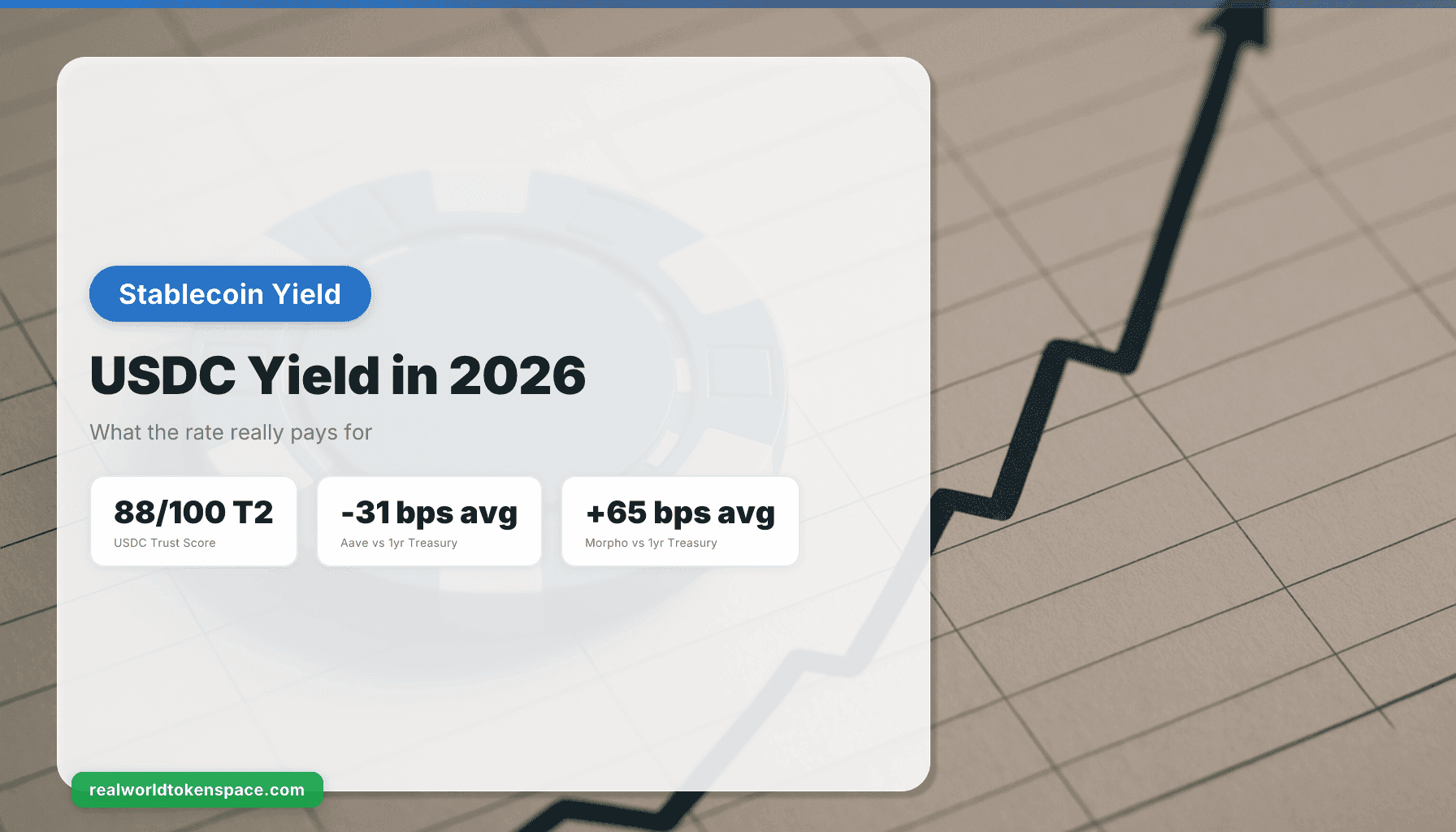
The verdict up front: on reputable venues, expect roughly 4% to 7% on USDC, with anything higher pricing in real risk. USDC itself carries an RWTS Trust Score of T2 (88/100), the yield venue is a separate risk layer stacked on top.
The realistic range is narrow at the safe end and wide at the speculative end. In 2026, the interesting range is 3.5% to 9% APY on the reputable venues, Aave, Morpho, Compound, Spark, and Sky, with the higher end available only if you accept specific risks most treasury teams should price carefully. The two on-chain venues most holders use price out roughly as follows. Aave V3 has USDC supply APY 3.8-5.2%, with the deepest audit history. Morpho Blue offers USDC supply APY 4.1-6.8% via curated vaults.
The lowest-friction option pays less but is the easiest to hold. Coinbase USDC Rewards pays around 4% (rate varies by region and account type). That's competitive with most high-yield savings accounts. On the RWTS scale, Coinbase USDC Rewards rates T2 (82/100).
Does USDC yield beat Treasuries?
This is the finding that reframes the whole category. Fresh Coin Metrics analysis measured on-chain USDC lending directly against the government benchmark, and the answer is: not reliably. Aave's USDC yield trailed the one-year Treasury by 31 basis points on average, while Morpho's median USDC vault beat the same Treasury benchmark by 65 basis points, but carried roughly 3.3 times the annualized volatility of the Aave figure.
Put plainly, the safest large on-chain venue underperformed a risk-free bill most of the year. USDC on Aave yield is on average a 31 basis point discount from the 1-year treasury rate. For 78% of 2026, USDC on Aave has earned lower annualized returns than the 1-year treasury rate. The mechanism behind this matters: lending rates are set by supply and demand within each pool, not by Fed policy. Lending yield is driven by supply and demand which can change at any time, whereas treasury yield is set by Fed policy and shifts more gradually.
What the extra basis points pay for
When a Morpho vault pays 65 basis points over Treasuries, that spread is compensation, not a free lunch. Depositors in DeFi carry risks a Treasury holder does not: depegging of the stablecoin from fiat, oracle manipulation and smart-contract vulnerabilities. After the KelpDAO exploit earlier in 2026, several analysts argued lenders in some pools were not being paid enough for exactly these hazards.
There is also a liquidity risk the APY number hides entirely. A high advertised rate can coincide with almost no exit liquidity. Aave's USDT0 pool on Monad displayed a 6.10% APR over one weekend, but only about $4.4 million of its $55.9 million supplied balance was unborrowed. For a lender weighing a large withdrawal, that smaller number mattered more than the headline yield. The same dynamic applies to USDC pools at high utilization: the rate you see is not the rate you can necessarily exit at.
The clean comparison
The honest way to compare venues is to hold the asset, window, and treatment of rewards constant, then price each risk separately. Averages mislead: Coin Metrics reported a 4.79% median yield and approximately 5.31% average among Morpho USDC vaults over a 90-day window. Higher-yield outliers lifted the average. That describes a historical distribution across vaults, not a rate available to every USDC lender.
Two named RWTS-rated on-chain options illustrate the tier spread. Aave's core USDC market (receipt token aUSDC) rates T3 (75/100). A curated Morpho vault such as mUSDC-SH rates T3 (77/100), reflecting an isolated-market structure that can pay more but concentrates counterparty exposure. The full weighting behind these scores lives in our methodology.
How to size a USDC position
A defensible framework: treat the one-year Treasury as your floor, and only accept a lending venue when it clears that floor by enough to pay for the added risk you can actually name. If a venue pays below the bill (as Aave did for most of 2026) a tokenized T-bill product is the more rational home for idle dollars. For that comparison, see Tokenized Money Market Fund Explained: BUIDL, BENJI, WTGXX.
If the Fed holds rates steady, expect on-chain USDC yields to stay range-bound near the T-bill line. If borrowing demand contracts, supply APYs fall first and fastest, the yield is only as durable as the leverage demand funding it. For the wider set of dollar-yield options, start at the stablecoin yield hub.
The bottom line: USDC yield is real but rarely generous, and the safest venues often trail a Treasury bill. Size to the risk you can name, not the number on the banner. We rate. You decide.
Related on RWTS
Stay Ahead of the Yield Curve
Subscribe to The Yield Report for weekly yield intelligence.
Subscribe Now