Tokenized Money Market Fund: How It Works and What to Own
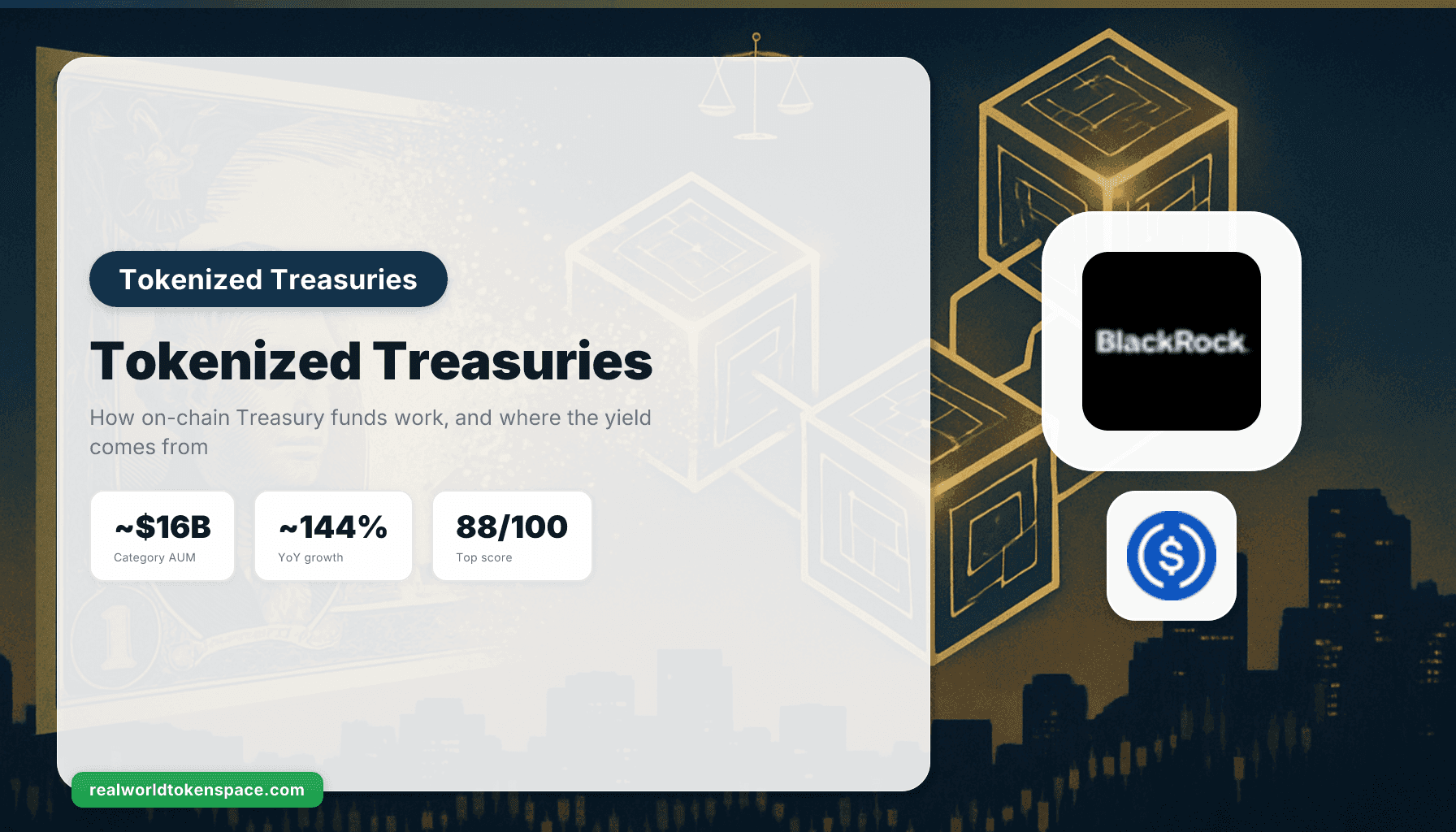
A tokenized money market fund is one of the clearest bridges between traditional finance and blockchain: a regulated fund holding short-term US Treasuries and cash, with its shares issued as on-chain tokens that pay the fund's yield to holders. The category has become the fastest-scaling corner of tokenized real-world assets. The overall tokenized US Treasury market has grown to $16 billion in recent weeks, reflecting sustained institutional interest in blockchain-based representations of government debt.
RWTS does not tell you to buy any of these. We rate them and you decide. This guide explains the mechanism, then applies our Trust Scores to the leading products.
What is a tokenized money market fund?
Structurally, it is a money market fund whose ownership records live on a blockchain. The underlying assets are the same conservative mix a traditional fund would hold. The wrapper is what changes, and it changes three things that matter.
Unlike traditional financial infrastructure, blockchain-based tokens allow near-instant settlement, transparent reserves and round-the-clock access. That is the first advantage: settlement. The second is composability. Treasury-backed tokens also let investors earn interest while using the assets as collateral in trading strategies, potentially improving capital efficiency compared with holding stablecoins or cash. The third is why institutions actually adopted them. By placing government securities on blockchain rails, issuers aim to improve settlement efficiency, reduce operational costs, and enable programmatic use cases such as collateral management and automated trading.
The distinction from a stablecoin is worth naming. A stablecoin holds a dollar peg and usually keeps the reserve yield for the issuer. A tokenized money market fund is a fund share that distributes that Treasury yield to the holder, typically with eligibility and minimum-size conditions a stablecoin does not impose.
Who leads the category
The competitive picture shifts month to month, which is the point: these are large, liquid products that institutions move in size. BlackRock's tokenized US Treasury fund BUIDL has regained the top position by assets under management, surpassing Circle's USYC, with AUM reaching approximately $2.8 billion. Circle's product got there through a stablecoin-adjacent route. Circle entered the tokenized fund market after acquiring Hashnote, the issuer of USYC, in early 2025.
Newer entrants keep arriving. Alongside BUIDL's resurgence, other major players including Ondo Finance and Franklin Templeton have also expanded their offerings, intensifying competition in the space. The lead changes hands often, and by a hair. Since the difference between the top products is so small, new institutional inflows or withdrawals can quickly change the current standings. Treat any "biggest fund" claim as a snapshot, not a durable ranking.
What is the highest-rated tokenized money market fund?
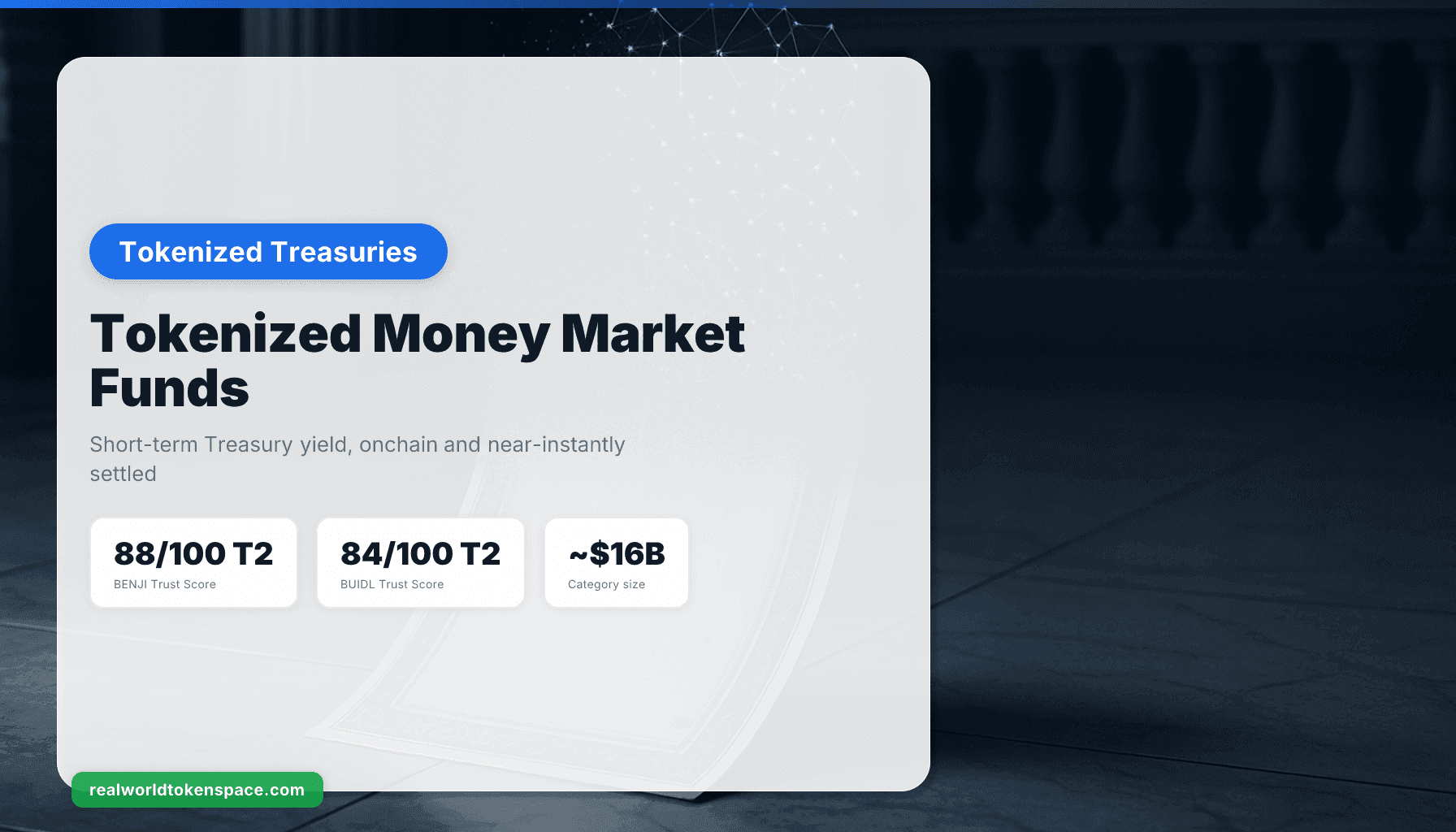
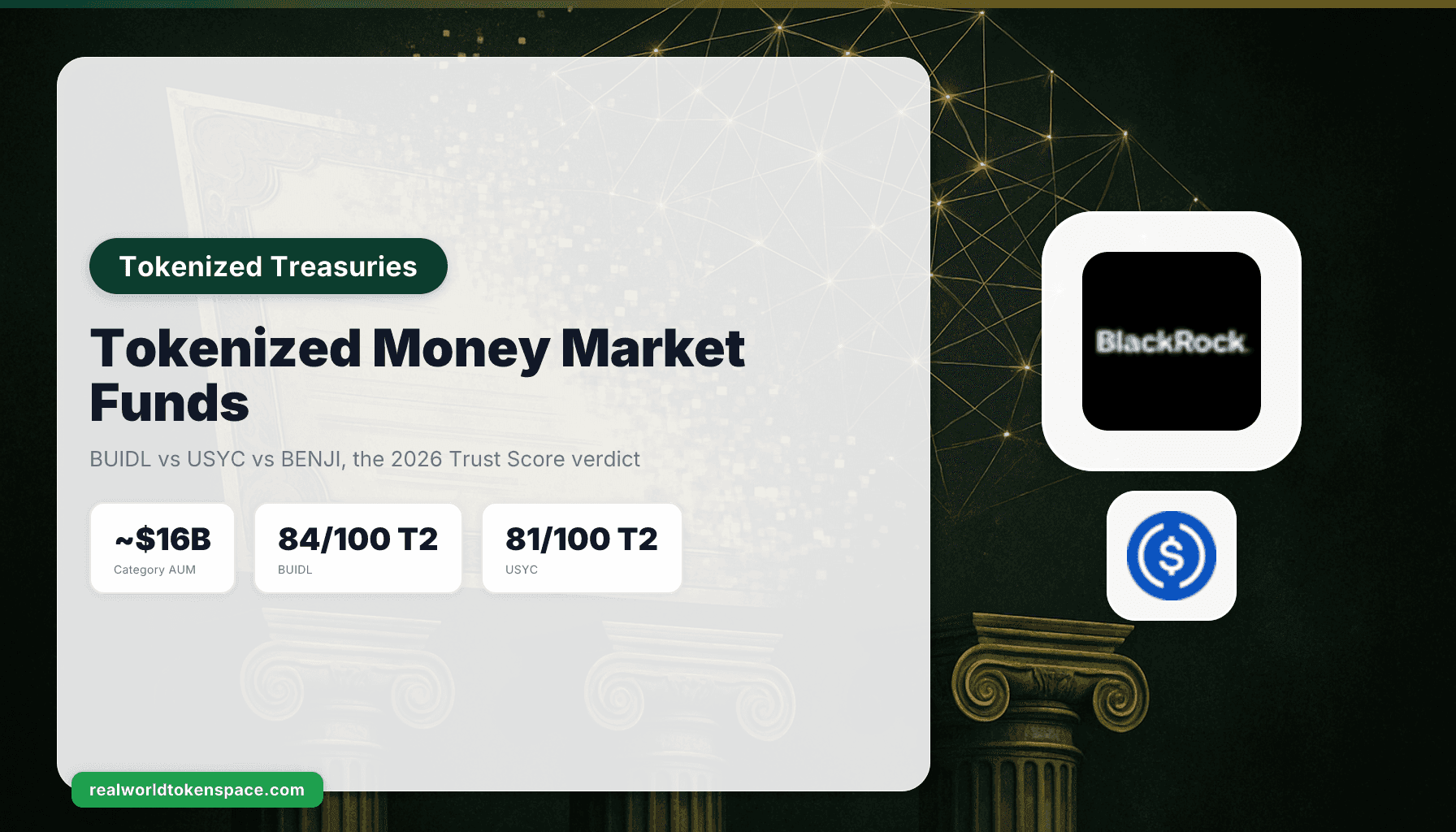
Verdict: on the RWTS scorecard, BENJI from Franklin Templeton carries the highest Trust Score in the category at T2 (88/100). It is followed by WTGXX at T2 (86/100) and BUIDL at T2 (84/100). Ondo's USDY and Circle's USYC both score T2 (81/100), alongside USTB at the same tier.
Size and score are separate questions. USYC and BUIDL trade the largest-fund title back and forth, but the Trust Score measures issuer integrity, custody, attestation quality, redemption mechanics and regulatory standing, not headline AUM. The gap between BENJI at 88 and USYC at 81 is the kind of distinction that a listicle ranking by market cap will miss entirely.
Growth is broad-based rather than concentrated in one winner. Circle's USYC led tokenized US Treasury growth with a $2 billion increase in market value over one year, with iBENJI and USDY rising by $1.7 billion and $1.5 billion respectively. The read is a market widening across several credible issuers, which is healthier for holders than a single-product monopoly.
How to choose
Start with eligibility. Several of these funds are restricted to accredited or institutional investors with meaningful minimums, so the highest-scored product may simply not be available to you. Then weigh redemption mechanics: how fast can you exit to cash or to a stablecoin, and on what settlement rail. Then weigh yield, which for all of these tracks the same short-Treasury curve and will move with the Fed rather than with any issuer's marketing.
The honest summary: these products are close on yield because they hold nearly identical assets. They differ on trust, access and redemption, which is exactly what our scores isolate. For the mechanics of how these funds are constructed and redeemed, see our explainer on how tokenized treasuries work. The inputs behind every score are documented in the RWTS methodology, and the full ranked list lives on the tokenized treasuries hub.
RWTS isn't bullish or bearish on any issuer. We're the credit-rating agency for tokenized real assets. We rate. You decide.
Related on RWTS
Stay Ahead of the Yield Curve
Subscribe to The Yield Report for weekly yield intelligence.
Subscribe Now