What happened
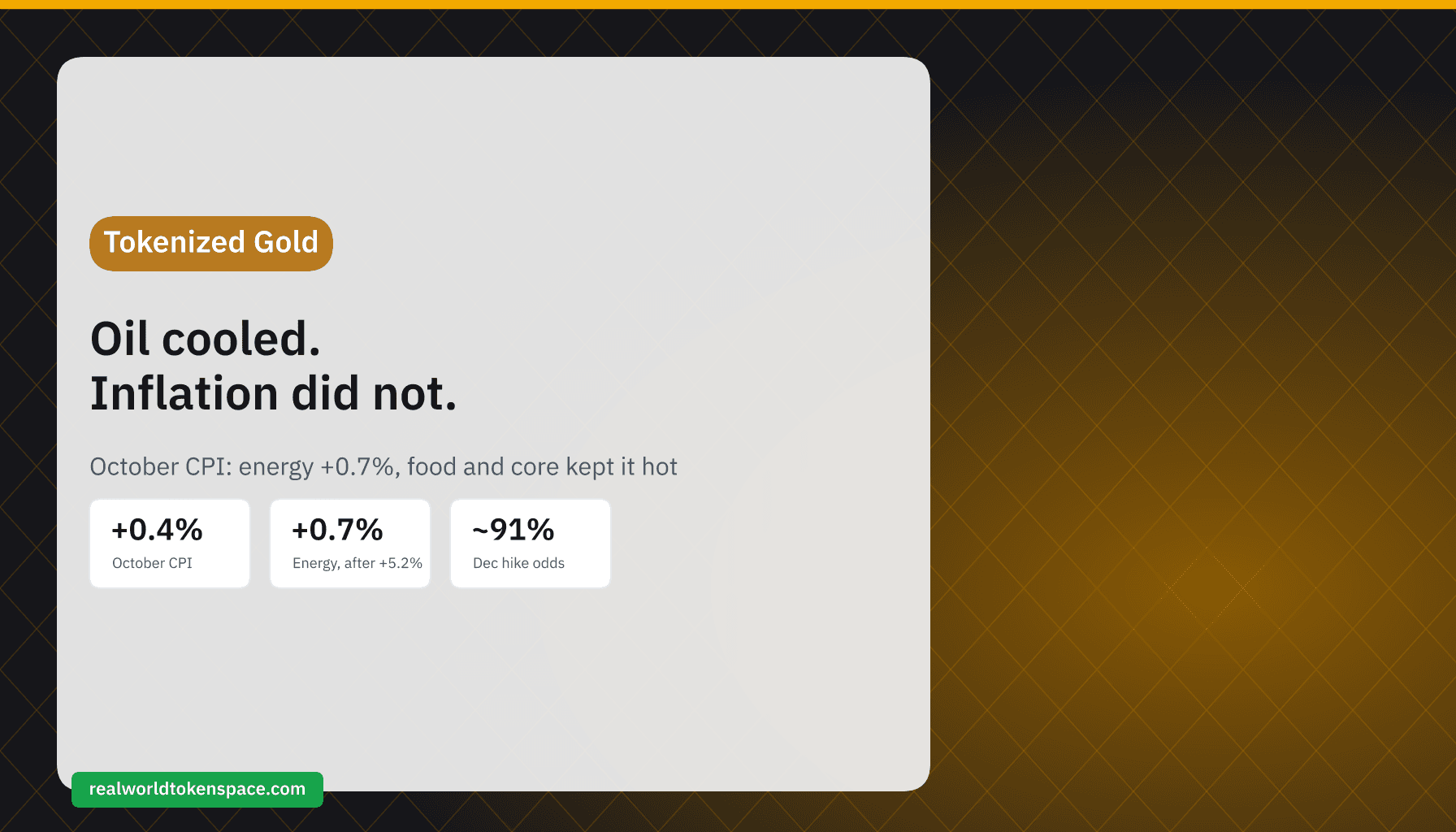
US consumer prices rose 0.4% in October, above the 0.3% forecast, and core prices rose 0.3% against 0.2% expected, the Bureau of Labor Statistics reported on Tuesday 10 November. Gold fell nearly 3% on the day, from about $4,126 before the release to about $4,032 at the close, and held below $4,060 on Wednesday morning (Trading Economics, 11 Nov).
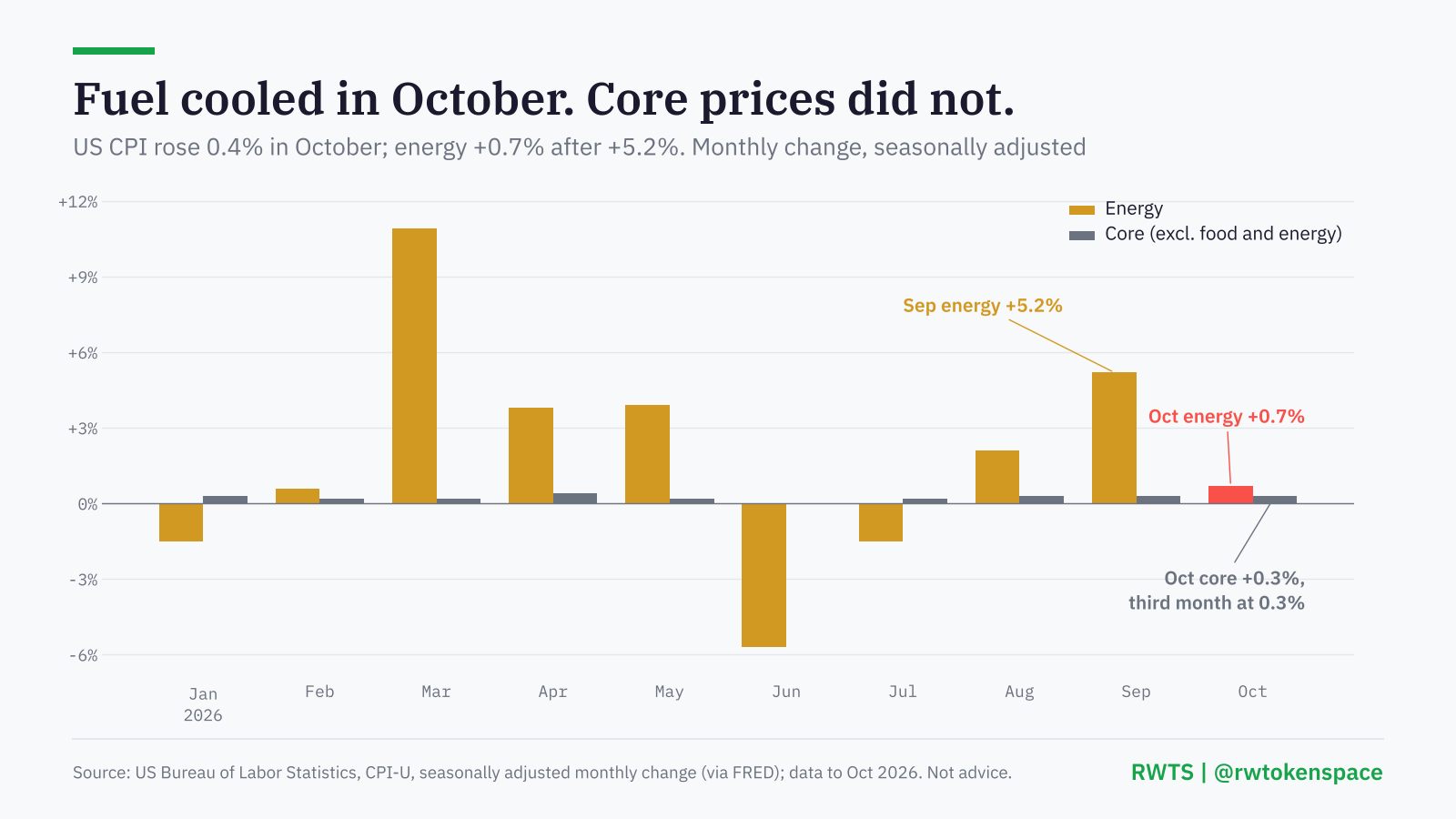
The surprise was not oil. The energy index rose 0.7% in October after 5.2% in September. Fuel stopped pushing prices up as hard. The rest of the basket did not slow down.
| Market |
Before CPI (10 Nov, about 07:00 UK) |
After (11 Nov, morning UK) |
Change |
Source |
| Gold (spot) |
$4,126 |
$4,056 |
about -1.7% (Tuesday close about $4,032, -2.3%) |
Trading Economics |
| Silver (spot) |
$53.15 |
$52.92 |
about -0.4% (fell over 3% Tuesday, rebounded about 2.8% Wednesday) |
Trading Economics |
| Dollar index (DXY) |
101.62 |
102.32 |
about +0.7% |
Trading Economics |
| US 2-year yield |
about 4.57% |
4.75% (10 Nov close) |
+18bp |
Trading Economics |
| US 10-year yield |
about 4.90% |
4.99% (10 Nov close) |
about +10bp |
Trading Economics |
| Brent |
$91.16 |
$92.50 |
about +1.5%, still near ten-week lows |
Trading Economics |
| Fed December hike odds |
about 84% |
about 91% |
+7 points |
CME FedWatch via Trading Economics |
US Treasury markets are shut today for Veterans Day, so the yields above are Tuesday's closes.
Why it moved
Food rose 0.5% in October after no change in September. Shelter rose 0.3%. Core prices, which strip out food and energy, rose 0.3% for the third month in a row (BLS). Those are the parts of the index that cheaper oil does not reach quickly.
That matters for the Fed. A central bank can look through a fuel spike that it expects to reverse. It is harder to look through three months of steady core gains. Traders responded by pricing a December hike as close to certain: odds rose to about 91% from 84% a day earlier, per CME FedWatch figures quoted by Trading Economics. The 2-year Treasury yield, which tracks the expected path of policy rates, rose 18 basis points to 4.75% in one session.
Gold is priced against that path. Bullion pays no interest, so when a two-year government note yields close to 4.75%, the cost of holding metal instead goes up. A firmer dollar, up about 0.7% since the release, adds to the pressure because it makes gold dearer for buyers paying in other currencies.
One more wrinkle: the report carried no annual rate. Most October 2025 prices were never collected during the shutdown, so BLS "cannot publish 12-month percent changes for October 2026" where the base month is missing (BLS). That left the monthly figures to carry the whole decision.
Context
Last week's rebound rested on oil. In the week to 6 November, Brent fell more than 13%, its steepest weekly drop since March 2020 (Trading Economics, 6 Nov), and gold had its best week since August (IANS via DT Next), as cheaper fuel eased inflation fears. A week earlier, rates were the force pushing gold down (RWTS week-ahead note, 1 Nov). The October report shows how far the oil reading reaches. Energy did cool sharply, from +5.2% to +0.7% on the month. The headline only eased from 0.6% to 0.4%, because food and core filled most of the gap.
The counterforce
The oil slide is not over, and most of it is not in the data yet. Brent is near $92, down about 13% over the past month and close to ten-week lows on signs of easing US-Iran tensions (Trading Economics, 11 Nov). Gasoline prices before seasonal adjustment already fell 0.7% in October. November's report should show more of the drop.
Demand for the metal has not gone away either. Global gold ETFs took in $2.7 billion in October, a fourth straight monthly inflow (World Gold Council, 5 Nov), and central banks bought 61 tonnes in September, their 2026 monthly high so far (World Gold Council, 4 Nov). On Wednesday morning gold recovered about 0.6% and silver about 2.8% of Tuesday's ground.
The catch is timing. The Fed meets on 8 and 9 December (Federal Reserve). November's CPI is due on 10 December (Trading Economics). The committee will set rates a day before it sees whether the oil drop reached consumer prices.
How it reaches tokenized gold, silver and treasuries
Gold and silver tokens track the metal, so Tuesday's fall passed straight through to tokenized gold and tokenized silver prices. Because the tokens trade around the clock, holders could react on Wednesday while the US bond market was closed for the holiday.
Tokenized treasury funds sit on the other side. They hold short-term Treasury bills, so the token price stays near $1 and the yield follows market rates with a lag. As maturing bills are replaced at higher rates, the fund's yield drifts up over weeks. The sector held $14.11 billion on 10 November with a 7-day yield of 3.63% (rwa.xyz).
What changes and what does not for holders
What changed is the gap between metal and yield. On the live RWTS directory pages read on 11 November, the treasury funds show BENJI at 3.80% APY, BUIDL at 3.53% and WTGXX at 3.50%. Bullion earns nothing, though some tokenized gold earns a small yield: KAU shows 0.50% APY and KAG 0.05%, while PAXG and XAUT show no native yield. A hotter rate path widens that gap. Tokenization lets a holder move between the two in seconds, any day of the week, with no dealer premium or shipping.
What did not change is structure. A CPI print moves price and yield, not backing, audit or redemption, which is what the RWTS Rating measures. Scores on the same pages are unchanged from Sunday: KAU, KAG and PAXG at 90/100, XAUT at 82; BENJI at 88, WTGXX at 86 and BUIDL at 84.
What to watch next
US producer prices for October on Friday 13 November at 13:30 UK give a second read on price pressure. After that, the Fed decision on Wednesday 9 December, and November CPI on Thursday 10 December, the first report likely to show the full oil drop. Related: Fed Decision and Gold.
FAQ
Why did gold fall after the October CPI report?
The report came in above forecasts, at 0.4% for the month and 0.3% for core. That raised the odds of a Fed rate hike in December. Bullion pays no interest, so a higher expected rate makes holding it more costly, and gold fell nearly 3% on the day.
Did lower oil prices show up in the October CPI?
Partly. The energy index rose 0.7% in October after 5.2% in September, so fuel added far less pressure. But food rose 0.5% and core prices rose 0.3% for a third straight month, which kept the overall figure hot.
Why is there no annual inflation rate for October 2026?
Most October 2025 prices were never collected during the 2025 government shutdown, so the Bureau of Labor Statistics has no base month to compare against. It published monthly changes only.
Do tokenized treasury funds pay more after a hot inflation report?
Gradually. These funds hold short-term Treasury bills, so higher market rates reach holders as maturing bills are replaced with new ones, over weeks rather than days.
The Yield Report is launching soon
Weekly yield intelligence on tokenized gold, silver, treasuries and on-chain yield. Join the early list for the first issue.
Join the early list