OUSG and USDY come from the same issuer, Ondo Finance, yet they solve different problems. Confusing the two is the most common mistake we see allocators make. This comparison separates them on the dimensions that actually matter: who can hold them, what backs them, how redemption clears, and where each lands on the RWTS Trust Score.
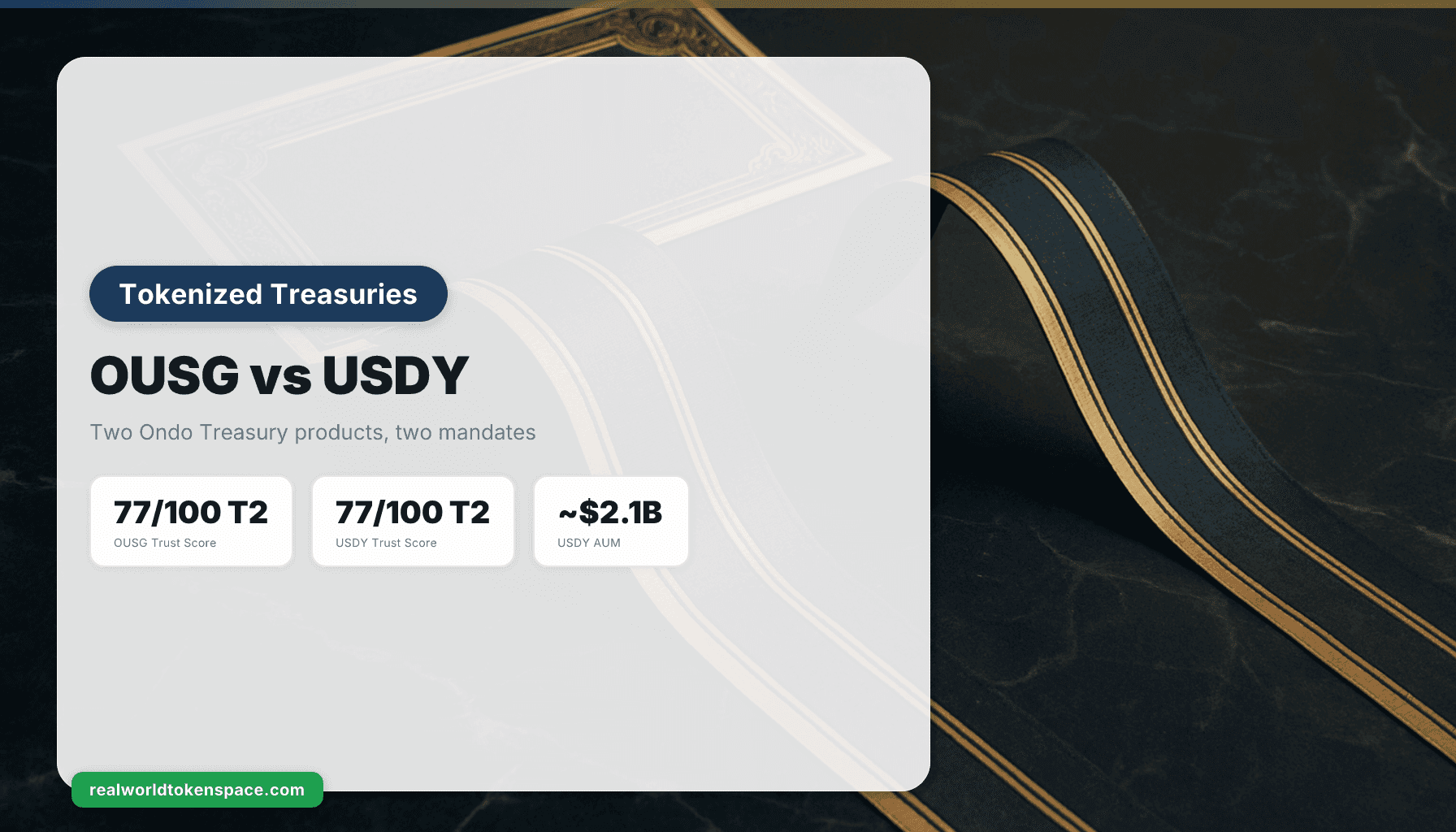
The backdrop is a category that has stopped being experimental. The tokenized US Treasury market held $15.20 billion in distributed value across 76 products with 58,658 holders and a 7-day APY of 3.36% as of May 4, 2026, per RWA.xyz. Ondo sits near the top of that table. Per RWA.xyz as of May 4, 2026, OUSG holds $682,373,912 in AUM while USDY holds $2,140,124,145, making USDY the third-largest tokenized treasury product globally.
RWTS isn't bullish or bearish on Ondo, BlackRock, or any token. We're the credit-rating agency for tokenized real assets. We rate. You decide. For the full comparison set, start at our tokenized treasuries comparison hub.
The core split: eligibility
The single most important difference is who is allowed to hold each token.
USDY is the retail-facing product. USDY is designed for non-US retail holders. Anyone outside the United States with a wallet and KYC clearance can hold USDY. The token earns yield from the underlying T-bills automatically, distributed through a daily-rebasing token model where the redemption value of each USDY increases over time. There is a seasoning catch: USDY is freely transferable after the 40-day Reg S seasoning period.
OUSG is the accredited-investor product. OUSG is designed for accredited investors. It requires US securities accreditation, higher minimum sizes, and provides direct exposure to BlackRock's BUIDL fund. If you are an individual outside the US looking for Treasury yield on idle dollars, USDY is the door. If you are a qualified entity wiring institutional size, OUSG is built for you.
What actually backs each token
The backing chain matters because it determines who holds the collateral and how a default would unwind.
USDY's structure is a note, not a fund share. USDY is a yield-bearing token issued by Ondo Finance, backed by short-duration U.S. Treasuries and bank demand deposits. Each USDY represents a senior unsecured claim on a portfolio held by Ondo USDY LLC, a Delaware bankruptcy-remote vehicle. The token accrues interest through a rising redemption value: holders see USDY trading at a premium to $1.00 that grows over time, with the premium reflecting accumulated yield.
OUSG inherits its backing from the largest institutional product in the category. Ondo's OUSG uses BUIDL as its primary backing, and Ethena, Sky, and Frax all hold BUIDL as reserve collateral. That nesting is a double-edged sword: OUSG holders benefit from BlackRock and BNY Mellon's infrastructure, but they also inherit BUIDL's wrapper and counterparty assumptions. BUIDL carries an RWTS Trust Score of T2 (87/100), higher than either Ondo product.
Redemption mechanics
For a Treasury product, redemption speed is the real liquidity test.
OUSG offers two lanes. Redemptions are T+0 to USDC via a Circle facility and T+1 to USD via wire. More precisely for OUSG itself: OUSG offers instant USDC redemption at $100,000 increments through its smart-contract gateway, or USD wire redemption on a T+1 schedule.
USDY clears more slowly. USDY accepts USDC redemption requests through Ondo's portal, settled T+1 to T+2. The trade-off is symmetric with eligibility: USDY is easier to obtain and freer to transfer post-seasoning, but its redemption window is a day or two longer than OUSG's instant USDC lane.
Yield and rate sensitivity
Both products pass through short-duration Treasury yield, so both compress as the Fed cuts. A 25 bps cut translates to approximately 22 bps in USDY APY (the small difference is the time it takes the portfolio to roll into newly issued bills at the lower rate). As a recent reference point, as of April 25, 2026, USDY pays 4.65% APY, with $740 million in supply across Ethereum, Solana, Mantle, Sui, and Aptos.
If the front of the curve holds above 4%, both products keep paying competitive carry on idle dollars. Below that, the spread over plain USDC narrows and the operational friction of whitelisting and seasoning weighs more heavily. The humility variable here is Fed posture, the entire thesis for holding either token over a bank money-market fund hinges on where the dot-plot lands next quarter.
The Trust Score read
On the RWTS scale, the two products land at the same level. OUSG carries T2 (77/100). USDY also carries T2 (77/100). They share an issuer, a custody philosophy, and Treasury backing, so the rating convergence is expected rather than coincidental. The methodology that produces these scores (weighting custody, redemption rights, transparency, and counterparty depth) is documented in full on our methodology page.
For context on how Ondo's products sit against the rest of the field, see our companion piece, Tokenized Money Market Funds: BENJI, BUIDL, WTGXX.
Which one fits
The decision tree is short. If you are non-US retail and want a yield-bearing dollar you can move around freely, USDY is the natural choice, accept the 40-day seasoning and the T+1 to T+2 redemption. If you are an accredited or qualified investor who values instant USDC redemption and BlackRock-grade backing, OUSG fits. Both are Tier 2, both are rate-sensitive, and both depend on Ondo's custodian relationships holding up.
We rate. You decide.
Related on RWTS
Stay Ahead of the Yield Curve
Subscribe to The Yield Report for weekly yield intelligence.
Subscribe Now