Most tokenized-treasury coverage fixates on the two giants. The more useful comparison for cash managers who want regulated, retail-friendly structure is between two registered funds: Franklin Templeton's BENJI and WisdomTree's WTGXX. Both put a US government money market fund on a public blockchain. They are not the same risk, and the Trust Score gap reflects that.
Start with the category context. The tokenized US Treasury market held $15.20 billion in distributed value across 76 products with 58,658 holders and a 7-day APY of 3.36% as of May 4, 2026, per RWA.xyz. Inside that market, two structural families exist. Two structural categories define the market: tokenized regulated fund shares (BUIDL, BENJI, USTB) where blockchain is the system of record for fund shares, and offshore wrapper debt tokens (USYC, USDY, TBILL) issued by Cayman/BVI vehicles holding T-bills, with eligibility and redemption mechanics that differ materially. BENJI and WTGXX both sit in the first family, the registered-fund-share camp.
The registration matters
The single most important fact about BENJI is its regulatory wrapper. BENJI launched in 2021 as the first U.S.-registered mutual fund to use a public blockchain as its official system of record for processing transactions and recording share ownership. That registration is not cosmetic. Registered investment companies like BENJI carry the investor protections of the Investment Company Act of 1940.
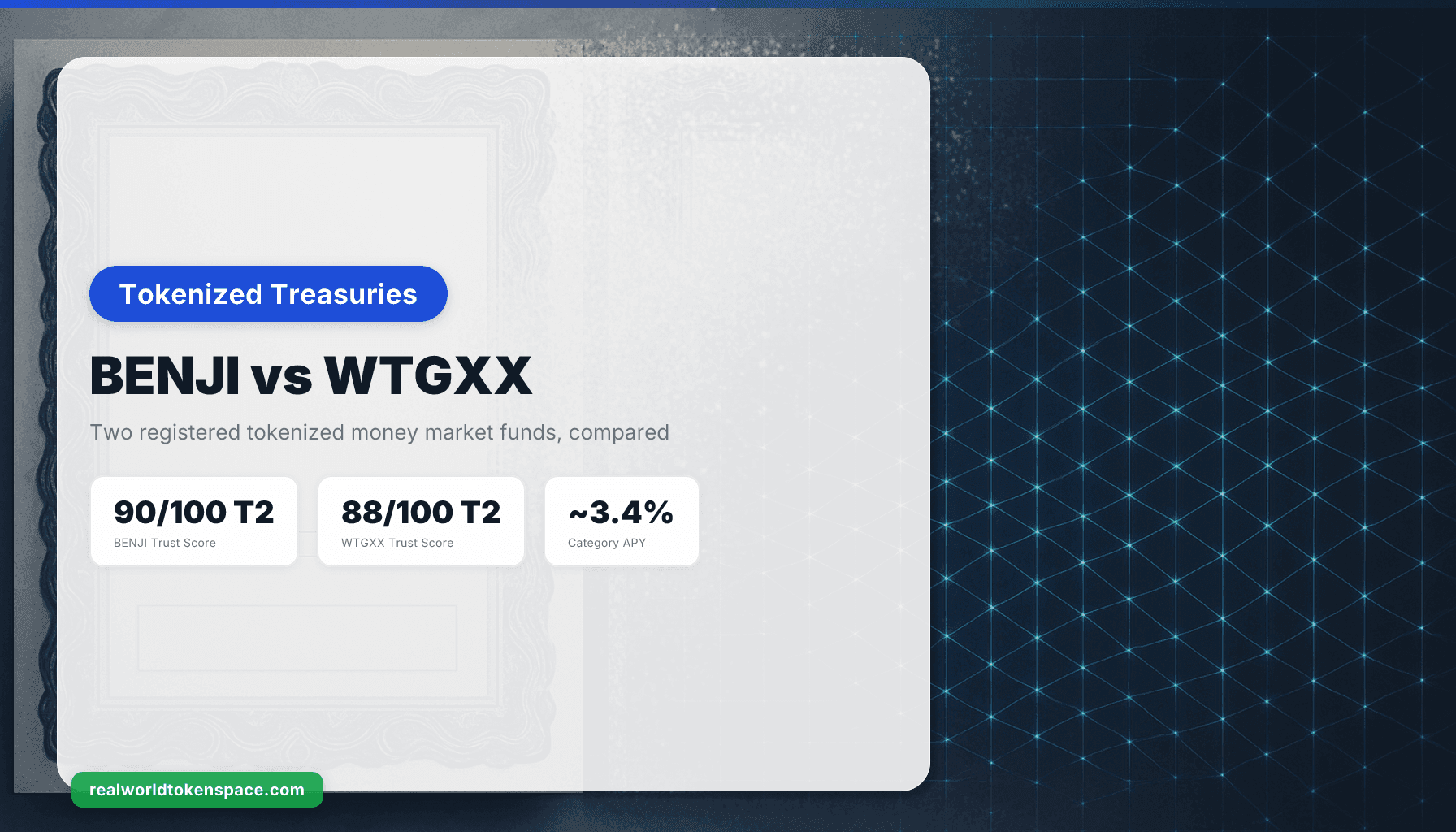
It also determines who can hold it. Across the tokenized-treasury map, access is the dividing line. Most products restrict access to Qualified Purchasers under the 1940 Act (BUIDL, USTB) or non-US persons under Reg S of the Securities Act of 1933 (USYC, USDY); Franklin BENJI is the lone retail-eligible registered money market fund. For a US retail allocator who wants on-chain Treasury yield inside a familiar fund structure, that makes BENJI the natural entry point. Its RWTS Trust Score is T2 (90/100), among the highest in the category.
WisdomTree's WTGXX is the on-chain government money market fund from a manager with deep tokenized-fund history through its WisdomTree Prime and Connect platforms. Its Trust Score is T2 (88/100), a strong rating, two points below BENJI. The gap is small but real, and it traces to the structural and distribution details our framework weights. On the AUM tape, WTGXX is the smaller fund: RWA.xyz has listed it near the high-$800-million range against BENJI's multi-billion-dollar footprint, which feeds liquidity depth and holder-base breadth into the score.
How yield is delivered
Both funds belong to the rebasing, stable-price school rather than the price-accrual school. Rebasing tokens like BUIDL and BENJI maintain a stable $1.00 price and distribute yield as additional tokens, making them suitable for collateral accounting where a stable NAV matters. That contrasts with the offshore wrappers: price-accrual tokens like USDY and USYC appreciate in value over time, producing a single taxable event on sale rather than monthly distributions, which is more tax-efficient for long-term institutional holders.
The practical takeaway: if your accounting or collateral system prefers a set $1.00 share and periodic distributions, BENJI and WTGXX fit cleanly. If you want compounding inside the token price and a single taxable event, the wrapper tokens are the better mechanical match. Neither approach is superior in the abstract, it depends on whether you are a treasury desk optimizing for collateral simplicity or a long-term holder optimizing for tax timing.
Where each one fits
For a benchmark on the institutional end of this same family, BUIDL (BlackRock's tokenized money market fund at T2 (87/100)) remains the qualified-purchaser anchor. BUIDL requires qualified purchaser status and minimum investment thresholds that exclude most retail participants. That single restriction is why retail-eligible BENJI and the broadly available WTGXX occupy a distinct niche.
A short decision frame:
- US retail cash that wants 1940 Act protection on-chain: BENJI, T2 (90/100), is the only retail-eligible registered option among the majors.
- Allocators prioritizing a registered fund from a tokenization-native manager: WTGXX, T2 (88/100), with the caveat of a smaller AUM base.
- Qualified-purchaser institutional cash: BUIDL, T2 (87/100), for Securitize infrastructure and the deepest institutional signal.
To understand exactly how registration, redemption windows, holder concentration, and chain coverage roll into each number, read our methodology. For the wider category (including the offshore wrappers we contrast above) the tokenized treasuries comparison hub maps every rated product. And for a head-to-head on the institutional leaders, see our OUSG vs BUIDL: Tokenized Treasury Comparison.
One caveat worth naming: rankings inside this category shift with normal fund flows, and a few large holders can dominate supply on any single token. That concentration risk is a live variable in our scoring, not a static input. As yields move with the Fed's posture (and with a hot CPI print pulling rate-hike odds forward) the relative appeal of a stable-NAV distributing fund versus a price-accrual wrapper will keep moving too.
RWTS isn't bullish or bearish on any issuer. We're the credit-rating agency for tokenized real assets. We rate. You decide.
Related on RWTS
Stay Ahead of the Yield Curve
Subscribe to The Yield Report for weekly yield intelligence.
Subscribe Now