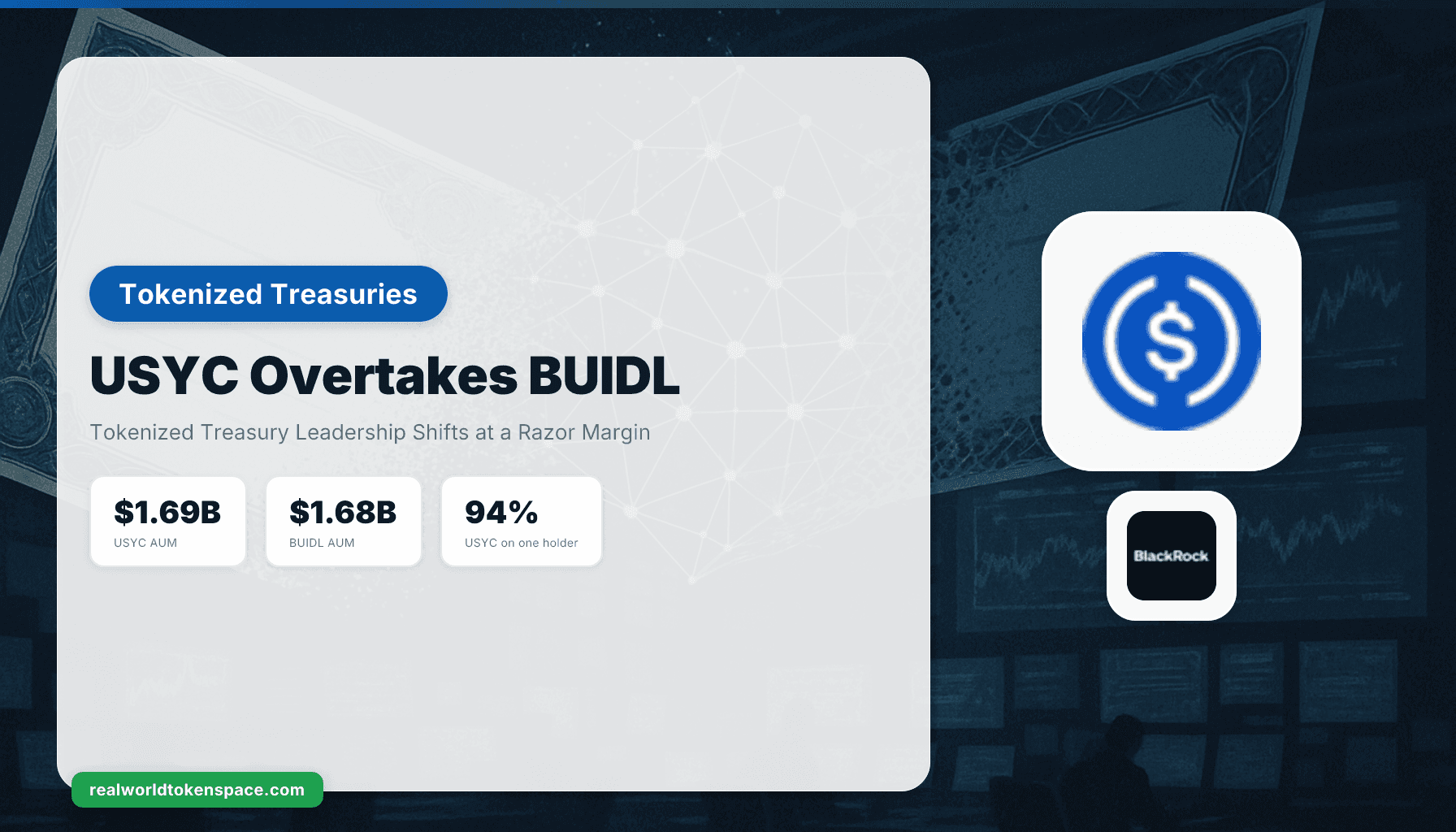
The leaderboard for tokenized treasuries has changed hands again, and the margin is almost a rounding error. USYC reached $1.69 billion in assets while BUIDL fell to $1.68 billion, with USYC growing 11% in 30 days while BUIDL declined 2.85%, according to RWA.xyz data. The headline writes itself: Circle's tokenized money market fund has overtaken BlackRock's. The on-chain data tells a more cautious story.
RWTS isn't bullish or bearish on Circle, BlackRock, or any tokenized fund. We're the credit-rating agency for tokenized real assets. We rate. You decide. And on the metric that actually governs redemption risk (who holds the supply) the two funds look nothing alike.
The headline number hides the holder base
The ranking is real but fragile. The thin margin between the two funds means rankings could shift with normal fund activity. A single large subscription or redemption moves the title. That alone should temper any narrative about a decisive changing of the guard.
The concentration data is the part allocators should read first. The roughly $6 million margin between the two comes with a significant caveat, as Arkham Intelligence data shows Binance holds $1.43 billion of USYC, representing 94% of the total supply. In practical terms, nearly all of USYC's growth came from a single institutional relationship with Binance, following Circle's July 2025 partnership allowing institutional clients to use USYC as backing for trades on the exchange.
BUIDL's distribution sits at the other end of the spectrum. BlackRock's BUIDL fund maintains a more diversified holder base with 103 distinct holders, though its top 10 holders still account for over 95% of total value. Both funds are institution-heavy (neither is broadly distributed) but a 103-holder base behaves very differently from one where a single counterparty controls nearly all the float.
What's actually backing each token
Structurally, the two products serve the same demand from different legal wrappers. Both funds invest in short-duration U.S. Treasury securities and serve institutional investors seeking interest-earning digital assets. The difference is in the wrapper. USYC is the Hashnote International Short Duration Yield Fund token, a permissioned share of a Cayman-domiciled fund that invests in US Treasuries and reverse repos. BUIDL, by contrast, is a tokenized regulated fund share administered through Securitize's transfer-agent framework, with BNY Mellon as administrator.
Redemption mechanics differ accordingly. USYC is restricted to qualified investors with a $100K minimum, settles on Ethereum, Canton, and Sui, and offers same-day redemption to USDC during US market hours. BUIDL redeems T+0 to USDC via a Circle facility or T+1 to USD by wire. Both rely on the same overnight Treasury and repo market for liquidity, the wrapper changes the claim, not the underlying.
The two funds also anchor a much larger stack. The overall tokenized treasury market reached $10.07 billion, with USYC and BUIDL combined representing approximately one-third of that value. When one third of a category sits in two products, and one of those two is 94% controlled by a single relationship, the category's resilience is more concentrated than the aggregate AUM implies.
How RWTS reads the leadership shift
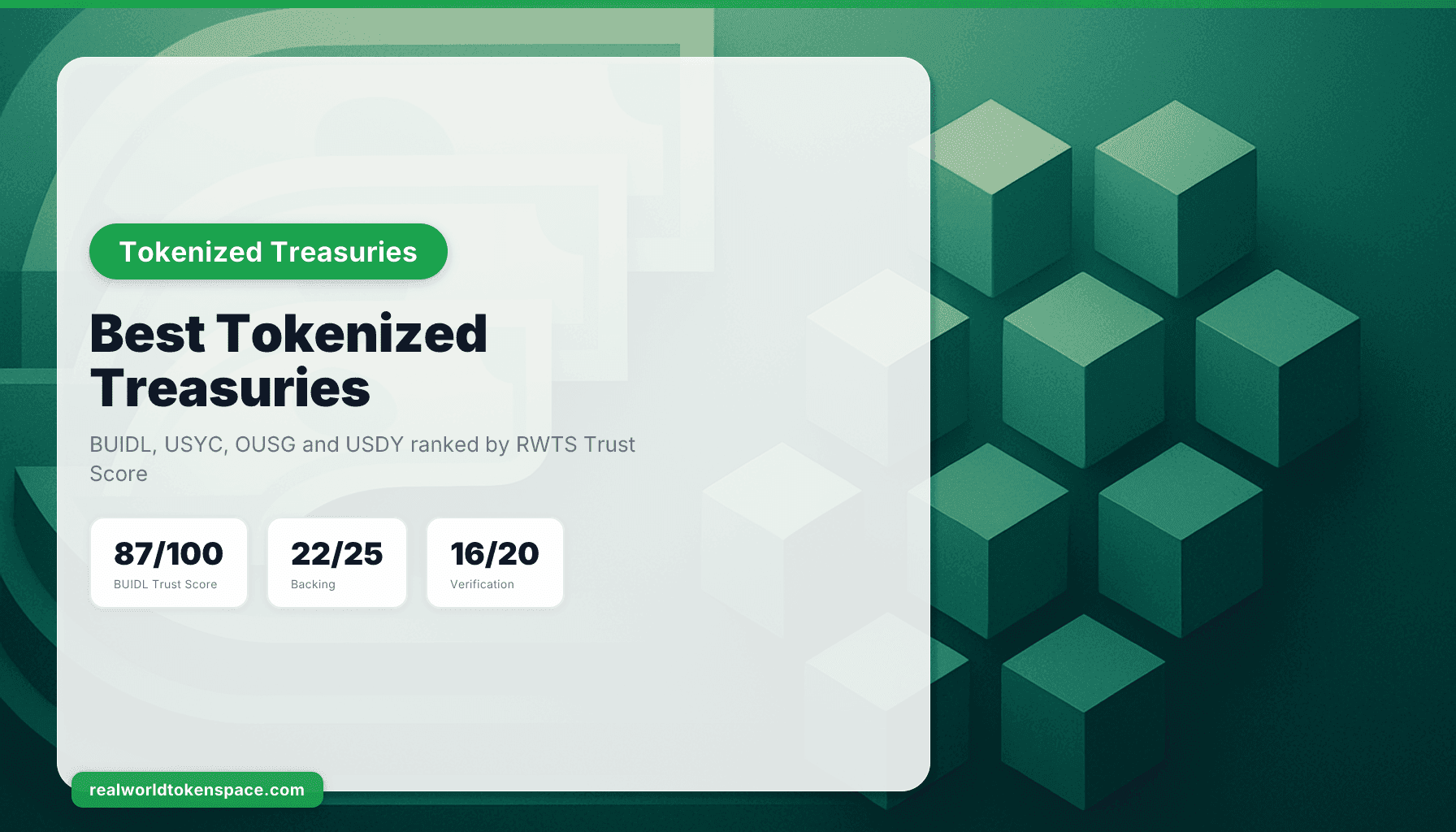
This is where the Trust Score and the headline diverge. RWTS rates BUIDL at T2 (87/100) and USYC at T2 (84/100). Both are Tier 2, institutional-grade tokenized money market funds with strong underlying collateral. The three-point gap is not a verdict on the Treasury bills inside either fund. It reflects holder concentration, wrapper transparency, and redemption-path diversity, which are exactly the variables the AUM headline ignores.
For allocators who want the same Treasury yield without either fund's qualified-investor gate, Ondo's USDY sits at T2 (77/100) and serves a different audience. It is an offshore wrapper debt token issued under Reg S of the Securities Act for non-US persons, alongside BUIDL and USTB as tokenized regulated fund shares restricted to Qualified Purchasers. The structural split matters: headline AUM flattens a critical distinction, regulated fund shares versus offshore debt tokens carry different redemption, bankruptcy, and tax mechanics.
The full scoring framework (how we weight concentration, custody, wrapper, and liquidity into a single number) lives at our methodology page. For the broader cluster context, see our tokenized treasuries comparison hub, and our earlier breakdown in OUSG vs BUIDL: Tokenized Treasury Comparison.
The conditional read
If USYC's Binance relationship holds and grows, the fund keeps its narrow lead and the headline stays accurate. If that single counterparty rotates collateral elsewhere (as Usual Protocol did with a similar position in late 2024) USYC's supply could contract sharply and the ranking reverses overnight. Previous on-chain records showed Usual Protocol held a similar share before diversifying its reserves in late 2024. That precedent is the humility variable here: the lead is real, but it rests on one relationship's appetite to stay.
The macro backdrop favors both funds regardless of who's first. Stablecoin transaction volumes increased to reach $33 trillion in 2025, which may continue driving institutional interest in related products. Rising real rates make idle on-chain dollars expensive to hold; tokenized T-bills are the obvious destination.
We don't pick the winner of the AUM race. We score the risk underneath it. RWTS rates. You decide.
Related on RWTS
Stay Ahead of the Yield Curve
Subscribe to The Yield Report for weekly yield intelligence.
Subscribe Now