Most "OUSG vs BUIDL" comparisons frame the two as rivals. They are not. Ondo's OUSG uses BUIDL as its primary backing, and Ethena, Sky, and Frax all hold BUIDL as reserve collateral. So the real question is not which fund wins, it is what the Ondo layer adds on top of the same underlying Treasury engine, and whether that layer is worth it for you. RWTS rates. You decide. Here is the side-by-side, and where each sits in our tokenized treasuries coverage.
What BUIDL is
BUIDL is the anchor of the category. BlackRock USD Institutional Digital Liquidity Fund launched in March 2024 on Ethereum and is the largest tokenized treasury product. BUIDL is administered by BNY Mellon with Securitize as transfer agent. The fund holds cash, US Treasury bills, and repurchase agreements with weighted average maturity under 30 days. It distributes income predictably: token balances rebase daily as dividends accrue, paid in additional BUIDL each month.
Access and redemption are institutional but increasingly fluid. BUIDL is restricted to qualified purchasers and is now live on Ethereum, Polygon, Arbitrum, Optimism, Avalanche, and Aptos. Redemptions are T+0 to USDC via a Circle facility and T+1 to USD via wire. That T+0 USDC path is a meaningful liquidity feature for treasury desks that need same-day exits.
What OUSG is, and why it exists on top of BUIDL
OUSG is Ondo's institutional Treasury token, and its plumbing has shifted toward BUIDL over time. OUSG was Ondo's first product. It originally held the BlackRock iShares short-duration treasury ETF, then migrated in 2024 to a stack that is mostly BUIDL plus USYC and Superstate USTB for instant liquidity. The current portfolio is broader than BUIDL alone. The portfolio primarily holds BlackRock's BUIDL fund, along with allocations to Franklin Templeton, WisdomTree, Fidelity, and Wellington/FundBridge vehicles.
The value OUSG adds is access and on-chain mechanics, not a different Treasury bet. OUSG is available to qualified purchasers outside the US. The token is a constant $1 NAV with a rebasing variant (rOUSG). Mint and redeem are 24/7 against USDC. For DeFi-native institutions, that 24/7 USDC mint-and-redeem and the lower effective minimum are the reasons to hold OUSG instead of going straight to BUIDL.
Yield: nearly identical gross, slightly lower net
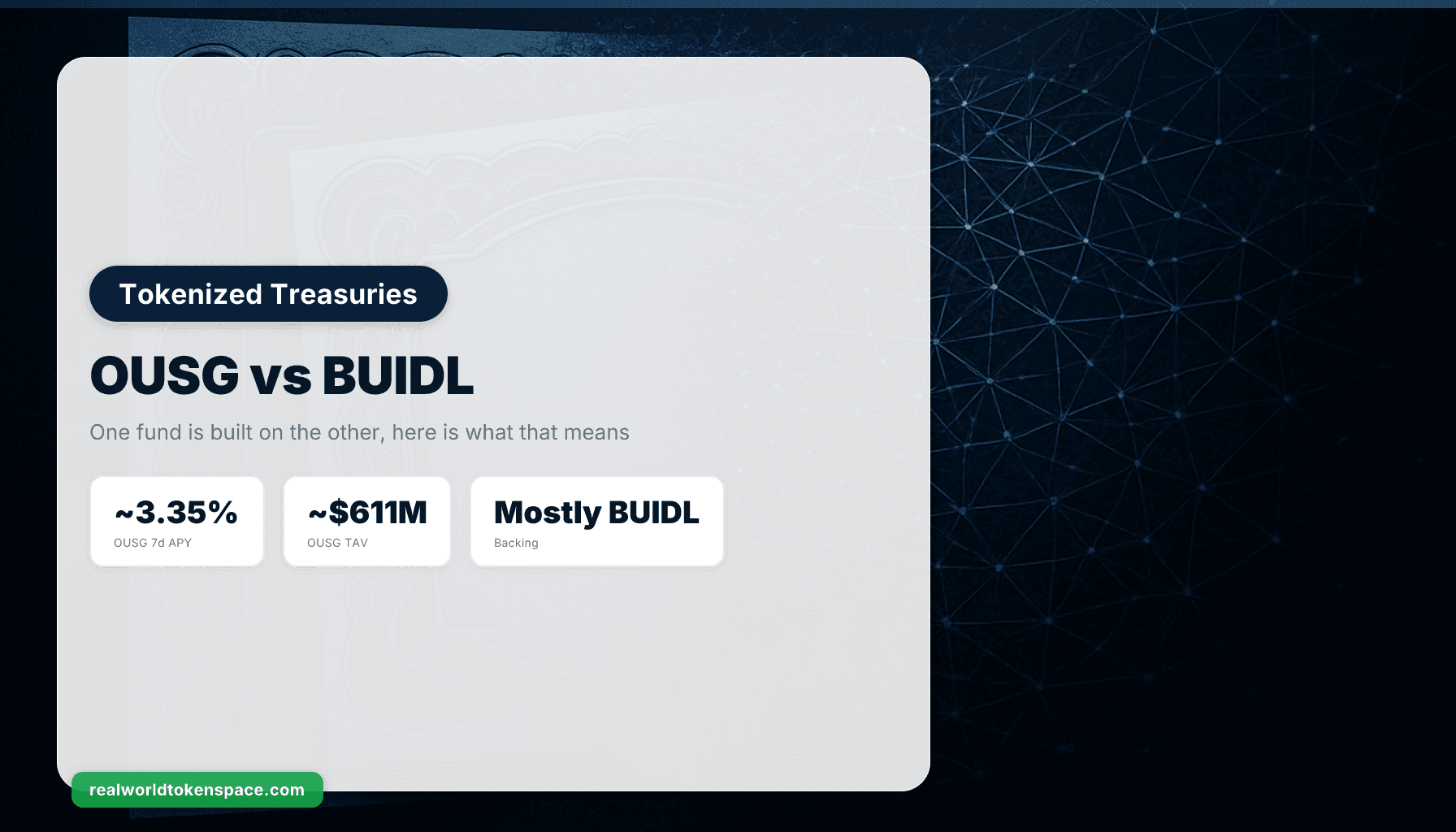
Because OUSG mostly holds BUIDL, gross yields track tightly. The gap is the fee layer. Recent on-chain data put OUSG with a 7D APY of 3.35% and a management fee of 0.15%. That fee is the price of the Ondo wrapper, the 24/7 redemption, the rebasing option, and the broader liquidity sleeve. If you can hold BUIDL directly and do not need OUSG's mechanics, you keep that spread. If you need instant on-chain composability, the fee buys real functionality.
One more data point worth watching for allocators sizing positions: OUSG flows move. As of a recent snapshot, OUSG total asset value was about $611 million, down 10.43% from 30 days prior. Flow swings in a fund-of-funds like OUSG are normal as institutions rotate; they are not a backing-quality signal on their own.
Access, in one paragraph
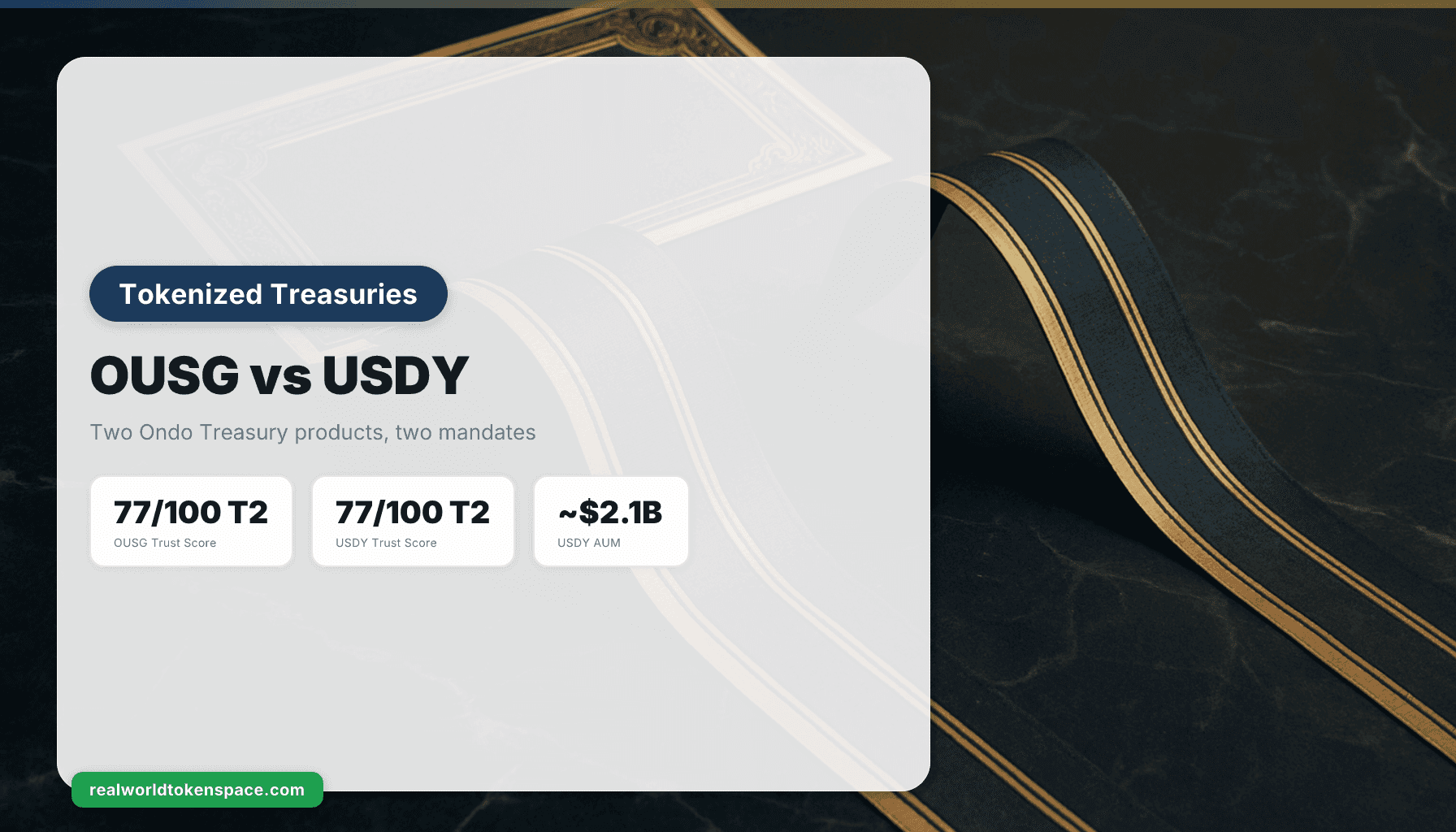
The eligibility lines are similar but not identical. Most of the institutional funds (BUIDL, OUSG, USYC, USTB, Maple Cash) require qualified purchaser or qualified investor status, which in practice means $5 million in investments for entities or $1 million in net worth for individuals plus a Reg D 506(c) verification. Neither is a retail product. If you want a non-US retail-eligible alternative from the same issuer, Ondo's USDY is the relevant comparison, a tokenized note with a lower minimum and a 40-day lockup.
The RWTS Trust Score angle
We score BUIDL higher than OUSG, and the reason is structural, not a knock on Ondo. BUIDL is the direct claim; OUSG is a claim on a portfolio whose largest position is BUIDL. That extra layer adds counterparty and operational steps even as it adds convenience. Our methodology treats each layer of intermediation as a distinct risk surface, which is precisely why a fund built on a top-rated fund still scores a notch below it.
For the head-to-head one rung up the stack, our BUIDL vs USYC comparison covers how BUIDL stacks against the other major institutional money market token. Read together, the two pieces map the tokenized-Treasury core: BUIDL as the anchor, USYC as the closest peer, and OUSG as the composable layer built on top.
The takeaway: OUSG vs BUIDL is rarely an either-or on credit quality, it is a choice between holding the anchor directly or paying a small fee for on-chain flexibility. RWTS rates. You decide.
Related on RWTS
Stay Ahead of the Yield Curve
Subscribe to The Yield Report for weekly yield intelligence.
Subscribe Now