Ondo Finance, one of the largest issuers of tokenized US Treasuries, has a new chief executive. Ondo Finance said its founder, Nathan Allman, has died unexpectedly, without disclosing the cause; Ian De Bode, the firm's longtime president who has overseen strategy, product and daily operations, will become chief executive with the backing of the leadership team. The announcement, reported by CoinDesk on May 26, 2026, marks a significant leadership transition for a protocol that anchors a meaningful share of the on-chain Treasury market.
At RWTS we do not take a view on Ondo the company. Our job is narrower: rate the products, surface the structural facts, and let allocators decide. The relevant question for holders of OUSG and USDY is straightforward, does a CEO transition change the backing, the redemption mechanics, or the custody chain? On the available evidence, it does not.
The scope of what changed
Allman, a Brown graduate and former member of Goldman Sachs's digital assets team, founded Ondo in 2021 and led its growth into a tokenized real-world asset pioneer with $3.5 billion in total value locked and products including the USDY stablecoin and OUSG Treasury fund. De Bode is not an outside appointment. Tokenized real-world assets firm Ondo Finance announced the unexpected death of founder Nathan Allman on Tuesday, with longtime president Ian De Bode stepping in as CEO.
A leadership change at the issuer level is a governance event, not a collateral event. The tokens themselves are claims on segregated portfolios, not on Ondo's corporate balance sheet. For tokenized treasury products, the chain of trust runs through the fund structure, the custodian, and the transfer agent, none of which turns on who holds the CEO title. That distinction is exactly what our Trust Score methodology is built to isolate: counterparty and operational risk separated from the underlying asset quality.
What backs OUSG and USDY today
The structural facts remain intact. OUSG (Ondo Short-Term US Government Bond Fund) was Ondo's first product; it originally held the BlackRock iShares short-duration treasury ETF, then migrated in 2024 to a stack that is mostly BUIDL plus USYC and Superstate USTB for instant liquidity. That gives OUSG an underlying that leans heavily on BUIDL, BlackRock's institutional money market fund administered by BNY Mellon with Securitize as transfer agent.
USDY targets a different audience. USDY is Ondo's retail-friendly tokenized note backed by short-term T-bills and bank deposits, structured as a security under Reg S; non-US persons can buy with a $500 minimum after a 40-day lockup. The backing is conservative and audited. As of April 2026 the composition is approximately 92% Treasuries and 8% bank deposits, with the deposit portion functioning as redemption-day liquidity. Yield has tracked the front of the curve. As of April 25, 2026, USDY pays 4.65% APY, with $740 million in supply across Ethereum, Solana, Mantle, Sui, and Aptos.
The key takeaway: a token holder's exposure is to short-duration Treasury risk and the custody arrangement, not to Ondo's executive suite. Ondo USDY LLC holds Treasuries through a regulated broker-dealer, Morgan Stanley, and bank deposits at multiple US insured banks; the Treasuries are short duration to minimize interest-rate risk, the deposits provide T+1 redemption liquidity, and BlackRock acts as investment manager.
The momentum behind the franchise
The transition lands during a period of unusual institutional validation for Ondo. On May 6, Ondo Finance, JPMorgan's Kinexys platform, Mastercard's Multi-Token Network, and Ripple's XRP Ledger completed what participants described as the first near real-time, cross-border redemption of tokenized US Treasuries settled atomically across four infrastructure layers, and the asset involved was OUSG, Ondo's flagship tokenized Treasury fund partially backed by BlackRock's BUIDL. That pilot demonstrated the kind of settlement utility that distinguishes tokenized Treasuries from their off-chain equivalents.
Ondo has also pushed beyond Treasuries. Ondo built Ondo Global Markets, a platform that attained a TVL of over $1 billion in May 2026 in less than 8 months. If that diversification thesis holds, the franchise becomes less dependent on any single product line. If institutional partners pause integrations during the transition, the near-term growth curve could flatten. The unknowns here are partner appetite and regulatory posture, not collateral integrity.
Where Ondo sits in the league table
Ondo remains a mid-pack issuer by AUM within a fast-consolidating category. Tokenized treasury funds crossed approximately $15 billion in aggregate assets under management by mid-May 2026, with Circle's USYC at roughly $3 billion, Franklin Templeton's BENJI and BlackRock's BUIDL each at roughly $2.3 billion, and Ondo's OUSG at roughly $670 million. OUSG's relatively smaller standalone AUM understates Ondo's footprint, because USDY, Global Markets, and other products lift total TVL toward the $3.5 billion mark.
For a fuller side-by-side of the two largest products in this category, see our BUIDL vs USYC tokenized treasury comparison. And for the broader landscape of regulated on-chain Treasury options, the tokenized treasuries hub tracks issuer scores as the category matures.
The RWTS read
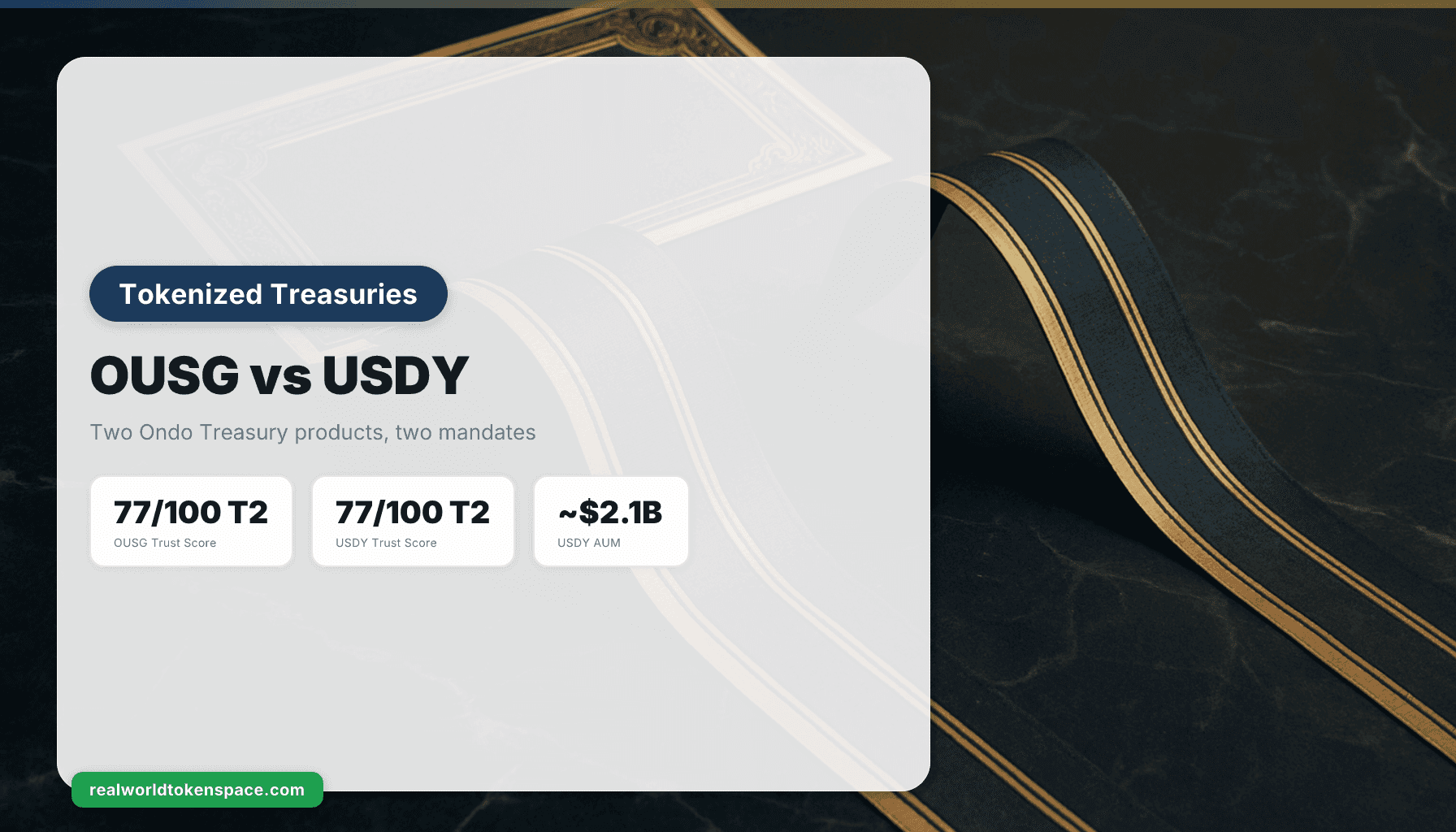
A founder's death is a human tragedy first and a governance question second. On the governance question, our assessment is that the products carry the same Trust Score profile they did a week ago: OUSG and USDY are Tier 2 tokenized Treasury exposures whose risk lives in custody, redemption rails, and duration, not in the org chart. Continuity at the president-to-CEO level reduces the operational discontinuity that can accompany sudden transitions.
If De Bode preserves the custody architecture, the audit cadence, and the institutional partnerships, the thesis stays intact. If integrations stall or disclosures thin out, that is when the score moves. We rate. You decide.
Stay Ahead of the Yield Curve
Subscribe to The Yield Report for weekly yield intelligence.
Subscribe Now