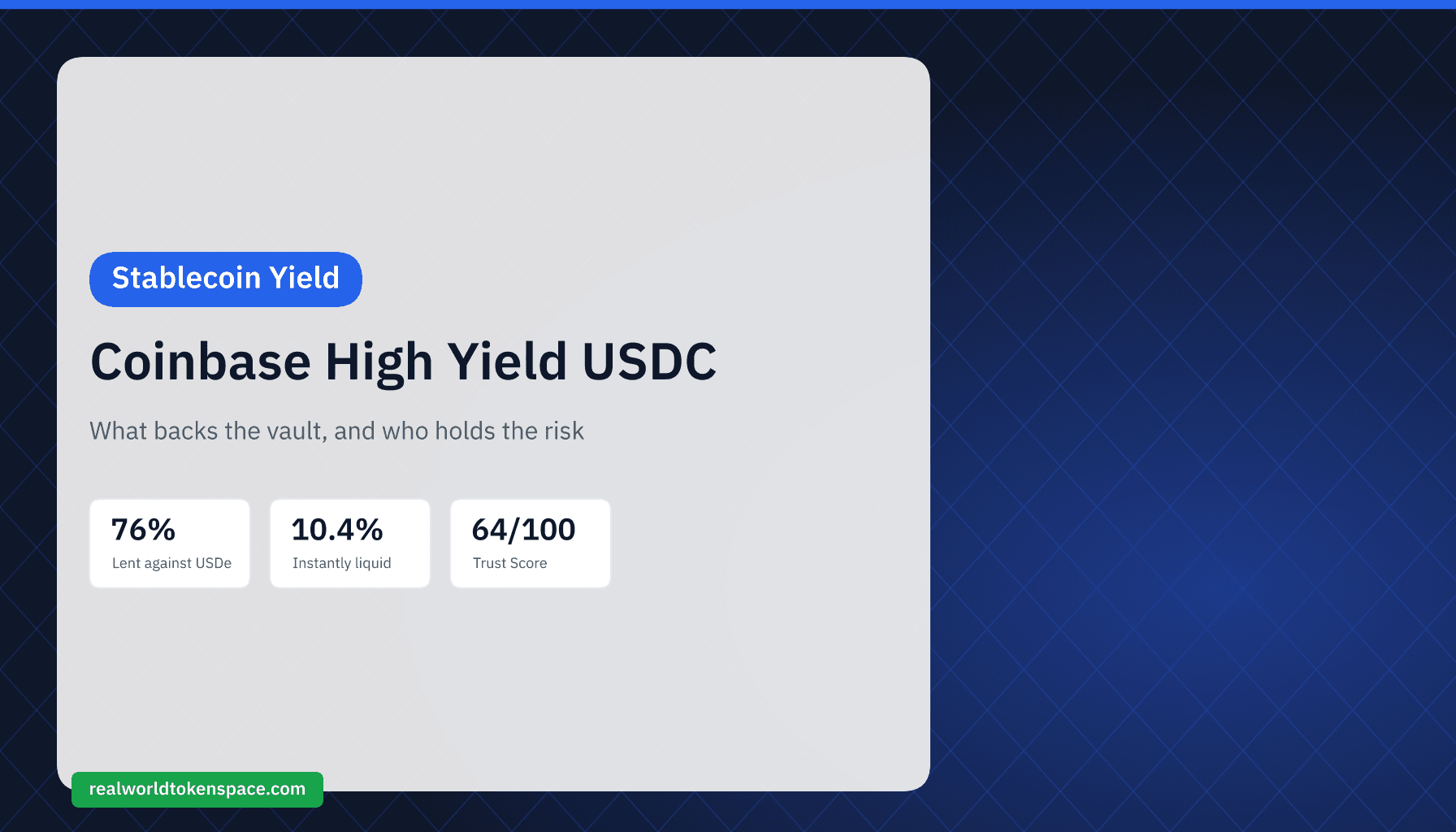
The Coinbase High Yield USDC vault lends your USDC to borrowers on Morpho, and as of 4 November 2026 about three quarters of that money is lent against one asset: Ethena's synthetic dollar, USDe. The yield is what those borrowers pay, minus a 25% fee, and your ability to get out depends on how much cash the vault holds unlent, which on that day was 10.4%.
This guide explains how the vault works, what backs your deposit, how withdrawals actually clear, what can go wrong, and how it compares with other USDC yield on the RWTS Trust Score.
How it works
Coinbase launched the High Yield vault on 11 June 2026, next to its original, more conservative USDC lending vault (The Defiant; Bankless via Yahoo Finance). Both run on Morpho, a lending protocol on the Base network, and both are curated by Steakhouse Financial. Steakhouse describes the High Yield vault as carrying slightly higher insolvency and liquidity risk than its Prime vault (Steakhouse).
On-chain, the vault is called Steakhouse High Yield USDC Edition, ticker sirloinUSDC. When you deposit through the Coinbase app, Coinbase routes your USDC into it through a smart contract wallet. The vault then supplies that USDC to separate Morpho lending markets. Each market has one type of collateral and one liquidation threshold, so a problem in one market does not spill directly into another. The curator decides where the money goes.
Borrowers pay interest. The vault passes that interest to depositors after a 25% performance fee and no management fee (Morpho API, 4 Nov 2026). As of 4 November 2026 the vault earned about 4.5% gross and paid about 3.3% net. That is variable: it moves with borrowing demand in each market, and it is not a fixed or promised rate.
What backs it and who holds it
Your deposit is backed by loans, and the loans are backed by collateral. As of 4 November 2026, the vault held $457.7M, allocated like this (Morpho API, RWTS arithmetic):
| Collateral market |
Lent by vault |
Share |
Liquidation line (LLTV) |
| USDe (Ethena synthetic dollar) |
$346.9M |
75.8% |
91.5% |
| mGLO (tokenised private-credit note, two markets) |
$94.4M |
20.6% |
91.5% |
| cbXRP |
$14.4M |
3.2% |
62.5% |
| cbZEC |
$2.0M |
0.4% |
62.5% |
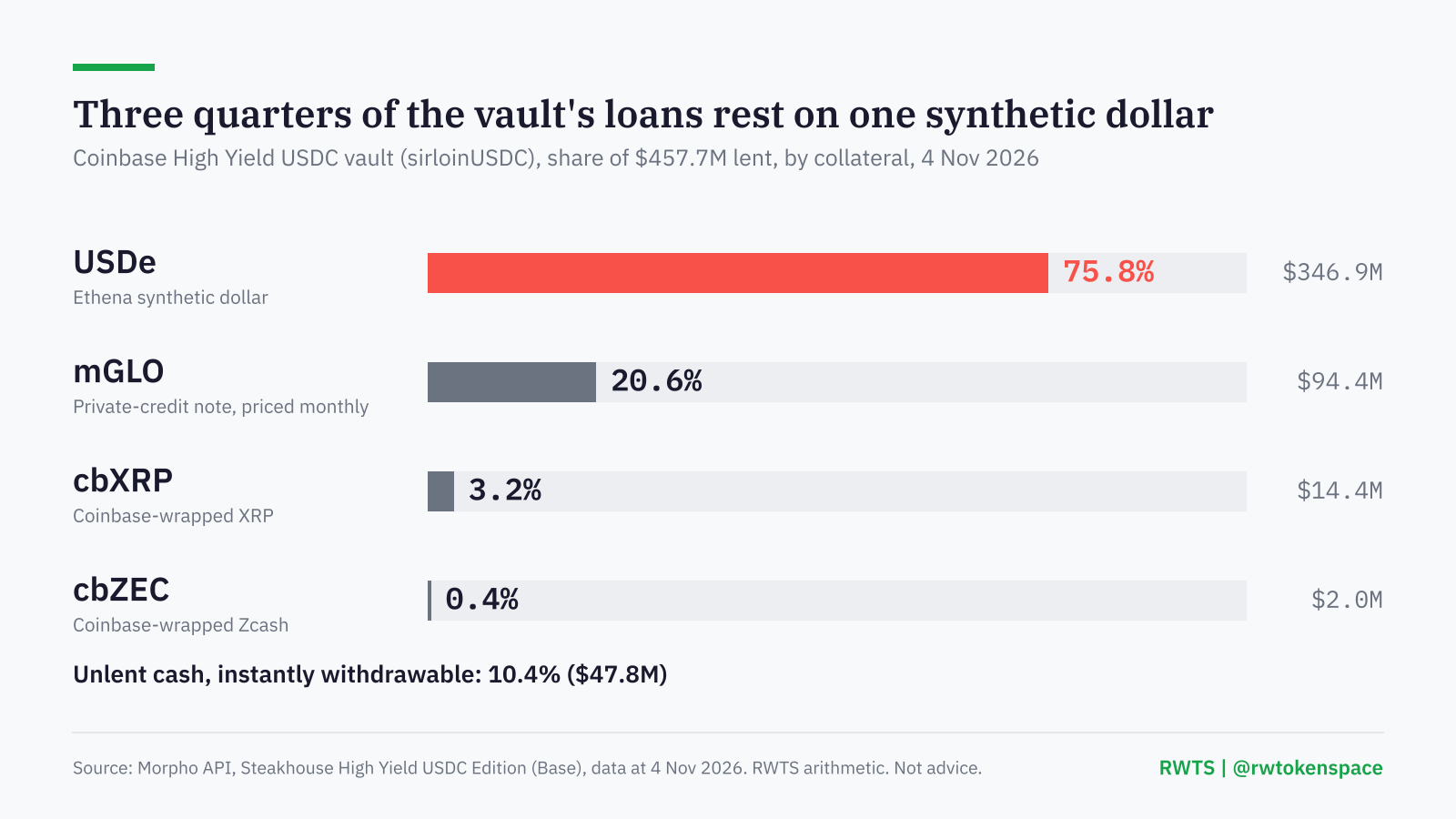
The two big lines need explaining.
USDe is not a fiat-backed stablecoin. Ethena describes it as a synthetic dollar backed by crypto assets and matching short futures positions, with direct minting and redemption limited to approved market makers (Ethena docs). Its supply was $4.59B on 4 November 2026, down from a peak of $14.82B on 4 October 2025 (DefiLlama). In the USDe market this vault lends into, borrowers had posted $396.5M of USDe against $350.3M of USDC debt (Morpho API, 4 Nov 2026). That is an average loan-to-value of about 88%, against a liquidation line of 91.5% (RWTS arithmetic). The cushion is thin by design: lending dollars against a dollar-like asset only makes sense at high loan-to-value.
mGLO is a tokenised note issued by Aureum Securitisation Fund, administered by Midas and managed by Fasanara Capital. It holds shares of a fund investing in short-term invoice receivables from small and mid-sized companies. The Morpho price feed values it at 94% of its last monthly NAV, so the effective liquidation line is about 86% of NAV. Standard redemption is monthly, about 35 days after the valuation date, and requires KYC (Steakhouse, 20 Jul 2026). In plain words: a fifth of the vault is lent against a private-credit fund that is priced once a month.
Who holds what. Morpho's contracts hold the deposited USDC and the posted collateral. Steakhouse sets allocations and says it never takes custody of user funds. Coinbase provides the app and the wallet. No regulator supervises the vault, and there is no deposit insurance (RWTS directory).
How you get out
There are three routes, and they are not equal.
- The Coinbase app. The default for most depositors. Coinbase says withdrawals are available at any time, subject to liquidity (The Block).
- Directly on Morpho. The vault is permissionless, so a depositor can withdraw through Morpho's own app without Coinbase's interface. RWTS counts this as a route the issuer cannot close.
- Force deallocate. Morpho Vault V2 lets any depositor pull funds out of a specific market into the vault's idle balance and withdraw in the same transaction, at a penalty the curator sets up to a maximum of 2%. The penalty stays in the vault for remaining depositors (Morpho docs).
All three routes run into the same constraint: cash only exists where borrowers have not taken it. On 4 November 2026 the vault could pay out $47.8M immediately, 10.4% of assets (Morpho API), down from 13.8% two days earlier. The USDe market was 88.0% borrowed and the main mGLO market 90.7%. Morpho's rate curves push borrowing costs up as utilisation rises, which encourages repayment, but that takes time. Steakhouse itself warns that withdrawals may need to wait during volatile markets.
What can go wrong
A USDe price shock, and who absorbs it. On 10 October 2025, USDe traded as low as $0.67 on Binance during a market-wide liquidation cascade. Coin Metrics describes it as a localised, venue-specific depeg, and USDe stayed overcollateralised (Coin Metrics). How a shock like that reaches this vault depends on the market's price feed. RWTS read that feed on-chain (contract 0xF4b1...9A47 on Base). It is a two-oracle design, a common pattern for dollar-like collateral. In normal times it values USDe at exactly $1.00. A backup feed tracks the market price, about $0.9994 on 4 November 2026. If the two drift more than 0.5% apart, the $1.00 price can be challenged, and after a 16-hour wait the feed switches to the market price; switching back takes 24 hours. So a brief wick like October 2025 would not set off liquidations, which spares the market fire sales at bad prices. A depeg that lasts longer would be priced in and liquidations would follow, but USDe could fall a long way in those 16 hours, and any shortfall left after liquidations lands on lenders, which means this vault's depositors.
Bad debt. Liquidators repay debt and take collateral at the oracle price plus a bonus, about 2.6% at a 91.5% line under Morpho's formula (Morpho docs). If collateral is worth less than the debt by the time it is sold, Morpho Vault V2 shares the loss across all depositors by lowering the share price. Steakhouse says none of its Morpho vaults has accrued bad debt to date, in its Coinbase lending post updated June 2026.
A run on liquidity. With about a tenth of the vault instantly available, a rush of withdrawals would empty the idle cash quickly. Later depositors would wait for repayments or pay the force-deallocate penalty.
Private-credit opacity. mGLO's value comes from a monthly NAV on invoices you cannot inspect. Defaults show up late, by design of the instrument.
Concentration. One collateral type carries three quarters of the book. The vault's risk is, to a large degree, Ethena's risk.
How RWTS scores it
On the live directory page, read 4 November 2026, sirloinUSDC scores 64/100 (C+, Tier 3, Secured DeFi):
| Dimension |
Score |
What drives it |
| Backing |
10/25 |
Synthetic-dollar and private-credit collateral, heavily concentrated |
| Verification |
16/20 |
Audited contracts, fully on-chain positions |
| Redeemability |
10/15 |
A route the issuer cannot close, but thin instant liquidity |
| Security |
13/15 |
Morpho's audited, isolated markets |
| Regulation |
10/15 |
No regulator; distributed through a regulated US exchange |
| Track record |
5/10 |
Live only since June 2026 |
The score is about structure, not yield. A higher APY elsewhere does not change it, and neither does a lower one here.
How it compares
Scores from live RWTS directory pages, read 4 November 2026. APYs are the directory's latest rates (3 November 2026), except the sirloinUSDC rate, which is Morpho's net figure on 4 November.
Two things stand out. First, "High Yield" is a description of the risk budget, not a guarantee of a higher rate: on 4 November 2026 the vault paid less than Steakhouse's conservative Prime USDC vaults on Base (about 4.7% to 4.9% net, Morpho API) and less than Coinbase USDC Rewards. Second, it sits next to sUSDe on the score ladder, which makes sense: most of its book is a loan secured by Ethena's dollar.
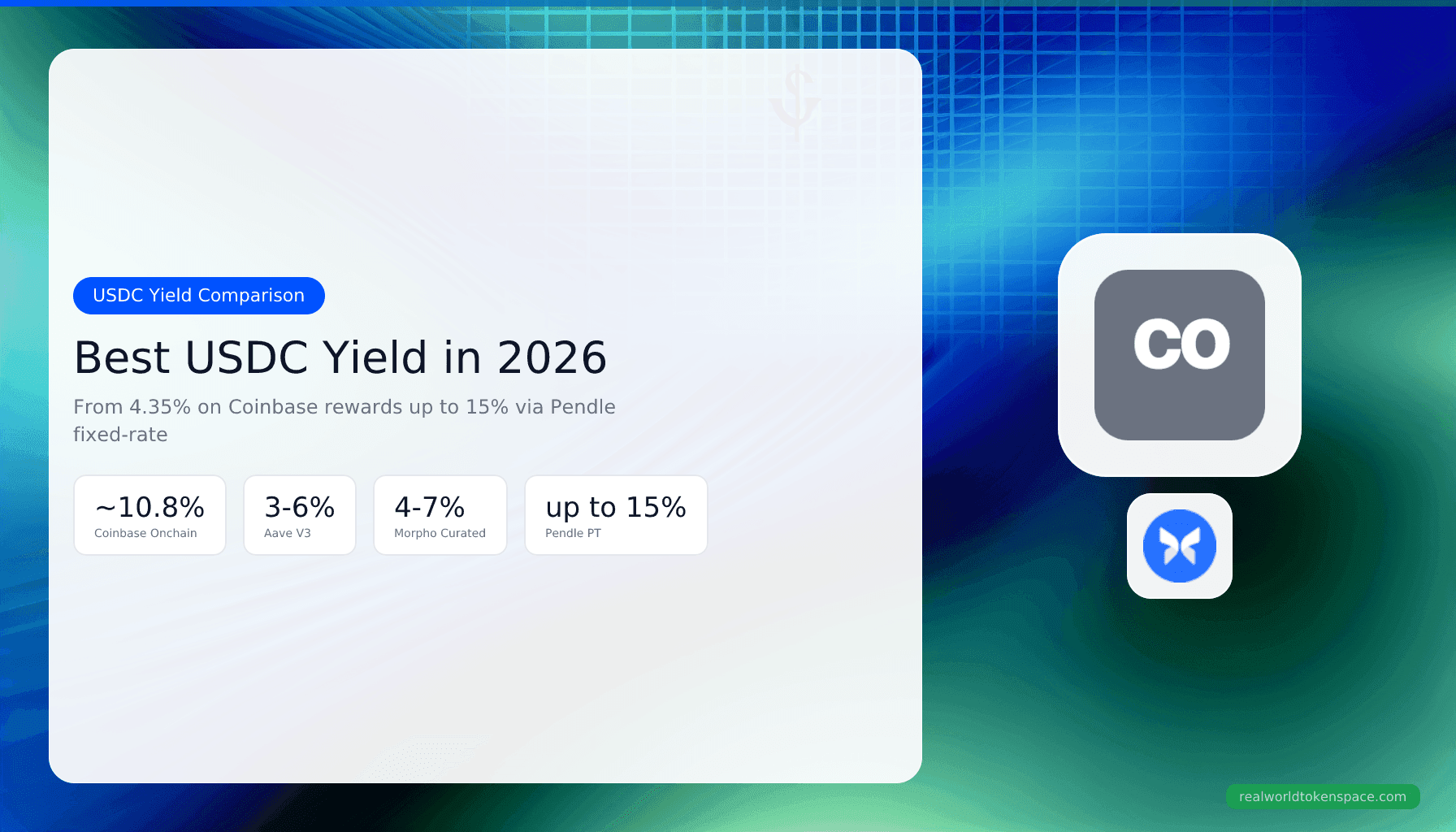
For the full range of USDC options, see Best USDC Yield in 2026 and USDC Rewards vs Stablecoin Yield. The stablecoin yield hub compares the synthetic and savings-rate dollars underneath products like this one.
FAQ
What is the Coinbase High Yield USDC vault?
A Morpho lending vault on Base, curated by Steakhouse Financial and offered in the Coinbase app since June 2026. Your USDC is lent to borrowers who post collateral, mostly Ethena's USDe. Its on-chain name is Steakhouse High Yield USDC Edition (sirloinUSDC).
Is the Coinbase High Yield USDC vault safe?
It is a secured loan book, not a bank deposit or a reserve-backed stablecoin. It scores 64/100 (C+, Tier 3) on the RWTS Trust Score, held back mainly by collateral concentration in USDe and by thin instant liquidity. No regulator covers it and there is no deposit insurance.
Can I withdraw from the High Yield USDC vault at any time?
Only up to the cash the vault holds unlent. On 4 November 2026 that was about $47.8M of $457.7M, or 10.4%. Larger exits wait for borrowers to repay or for interest rates to rise and pull repayments in.
Why does the High Yield vault sometimes pay less than the Prime vault?
Yield is set by what borrowers pay, minus fees. The High Yield vault charges a 25% performance fee, and on 4 November 2026 its USDe market paid suppliers 4.06% before that fee, so the vault's net rate (about 3.3%) sat below Steakhouse's Prime USDC vault on Base (about 4.9%, no fee).
What happens to the vault if USDe loses its peg?
Loans are liquidated when they pass the 91.5% loan-to-value line as measured by the market's price feed. That feed values USDe at $1.00 in normal times and switches to the market price if USDe stays more than 0.5% off its peg for about 16 hours. A short wobble does not trigger liquidations; a lasting depeg does, and any shortfall after liquidations is shared across vault depositors.
Figures as of 4 November 2026 unless stated; rates and allocations change daily. Not financial advice. We rate. You decide.