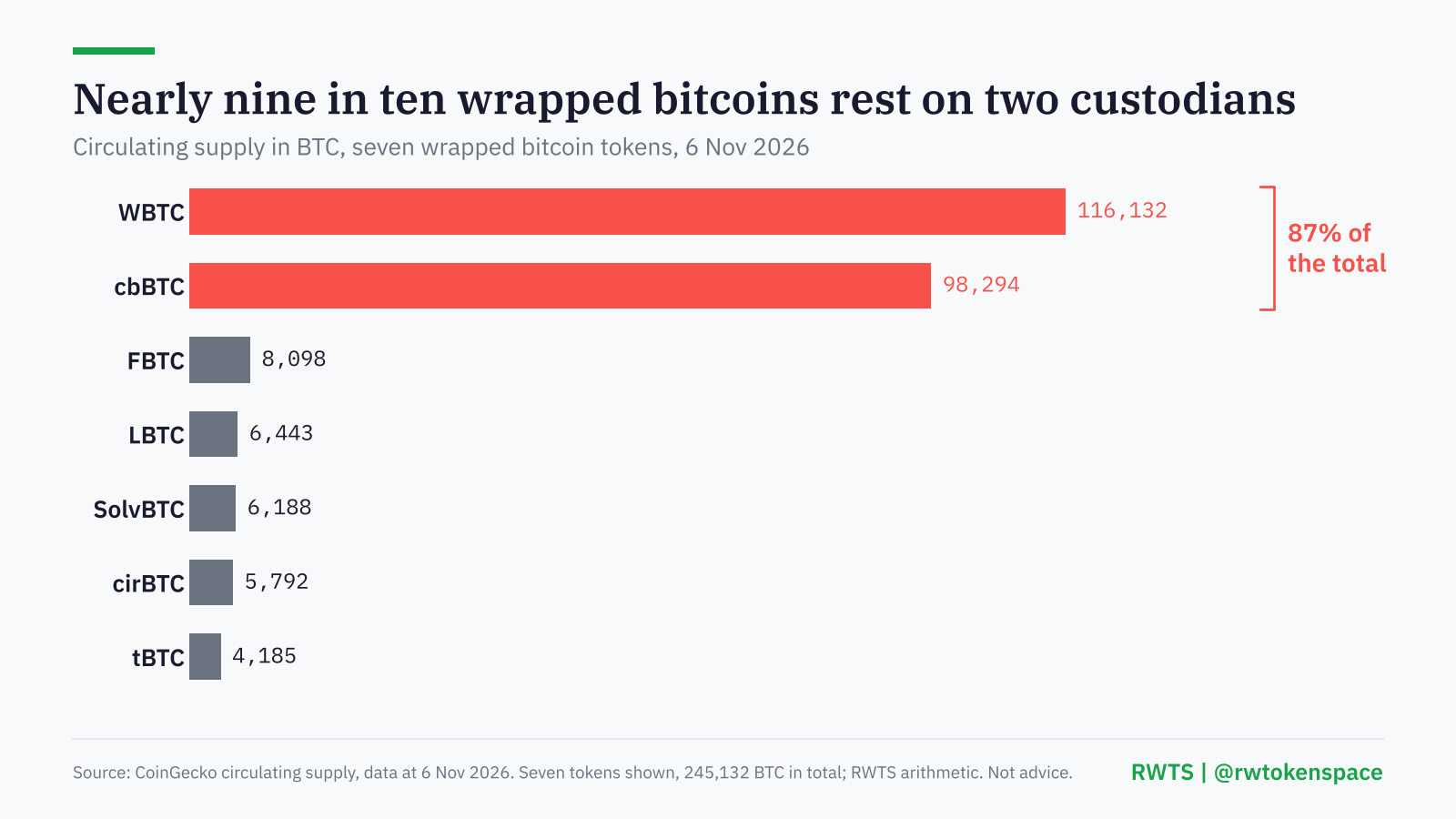
Every wrapped bitcoin is a claim on real BTC held by someone else, so the comparison that matters is who holds the coins and who is allowed to swap your token back for them. As of 6 November 2026, 87% of the 245,132 BTC sitting in the seven wrapped tokens below is held by two custodians: BitGo (with BiT Global) for WBTC, and Coinbase for cbBTC.
Below: custody, reserves and redemption for each, what changed in 2026, and how the RWTS Trust Score rates them.
How wrapped bitcoin works
Bitcoin cannot run Ethereum smart contracts, so it cannot be lent on Aave or posted on Morpho directly. A wrapper fixes that by locking BTC on the Bitcoin network and issuing a token on another chain. The token is only as good as three things: the BTC is really there, it cannot be moved without permission, and someone will give it back when you return the token.
Two designs dominate. Custodial: one company or a small group holds the keys, and approved merchants mint and redeem. Threshold: independent signers control the bitcoin, and anyone can mint or redeem through a contract. A third group puts the BTC to work so the token earns a yield.
What backs each token and who holds it
Supply below is circulating supply from CoinGecko, read 6 November 2026, when one BTC was about $75,900.
| Token |
Supply (BTC) |
Who holds the BTC |
Who can redeem for BTC |
Reserve proof |
| WBTC |
116,132 |
BitGo, in a shared arrangement with BiT Global since August 2024 |
KYB-checked merchants |
WBTC transparency page |
| cbBTC |
98,294 |
Coinbase |
Coinbase account holders |
Chainlink Proof of Reserve |
| FBTC |
8,098 |
MPC wallets overseen by Antalpha, Mantle and Cobo |
KYB-checked merchants, not US persons |
Chainlink Proof of Reserve |
| LBTC |
6,443 |
Split: Anchorage Digital Bank and Kraken Institutional (active part), Lombard's 14-member consortium (passive part) |
Holders, within up to 10 days |
Lombard and RedStone feeds |
| SolvBTC |
6,188 |
Solv vault pool, threshold signers |
Request to Solv, claim after about 7 days |
Chainlink exchange-rate feed |
| cirBTC |
5,792 |
A regulated Circle entity, segregated |
Institutions via Circle Mint |
Chainlink Proof of Reserve |
| tBTC |
4,185 |
51-of-100 Threshold signer set |
Anyone, permissionless (paused since 30 Oct 2026) |
On-chain bridge wallets |
WBTC is the oldest and largest, live since 2019. Its custody moved in August 2024 to a joint arrangement between BitGo and BiT Global, a company with perceived links to Justin Sun; MakerDAO (now Sky) voted to cut its WBTC exposure in response (Coin Bureau, updated May 2026; Upshift, 24 Sep 2026). Ordinary holders do not redeem; merchants do.
cbBTC launched in September 2024 and is backed 1:1 by BTC held by Coinbase. Coinbase customers redeem by depositing cbBTC into their Coinbase account. Since May 2025 its reserves are published on-chain through Chainlink Proof of Reserve on Ethereum and Base (feed). One company is custodian, redeemer and reporter.
tBTC has no custodian. Deposited BTC sits in addresses controlled by a 51-of-100 signer set, and minting and redemption are permissionless, at a 0.2% fee each way (Threshold, 27 May 2026).
cirBTC is the newest. Circle launched it on Ethereum on 8 June 2026, backed by BTC held by a regulated Circle entity and verified through Chainlink Proof of Reserve, with minting and redemption through Circle Mint for institutions (crypto.news, 9 Jun 2026). It reached about 5,800 BTC by 6 November, up from about 950 BTC in late September.
LBTC changed more than any other token this year. Lombard moved its yield source from Babylon staking to a covered-call options strategy managed by Bitwise, starting the week of 17 August 2026 and ramping through September (Lombard, 13 Aug 2026). Up to 60% of the backing now sits in Lombard-owned, segregated accounts at Anchorage Digital Bank and Kraken Institutional under tri-party agreements; Bitwise has trading authority only. The other 40 to 50% stays with the Lombard Security Consortium, where any critical action needs 10 of its 14 members (Lombard docs, updated 2 Nov 2026). The target is 2.5% net a year in BTC terms, after a 20% fee on strategy gains, and Lombard says it is variable and losses are possible (Lombard fees).
FBTC holds native BTC in MPC wallets overseen by a security council of Antalpha, Mantle and Cobo, with a Chainlink reserve feed. Only KYB-checked merchants mint and burn (FBTC docs).
SolvBTC is a 1:1 BTC-backed token whose reserves include BTC, BTCB and cbBTC. The yield sits in a separate token, xSolvBTC, which is minted by burning SolvBTC (Alea Research, 16 Jan 2026, commissioned by Solv).
How you get out
Most holders never redeem; they sell on a DEX, which works until the pool runs thin, and a thin pool can trade below par even with full reserves. On 4 November 2026 LBTC had about $14.8M of DEX liquidity across six pools and SolvBTC about $4.5M in one (RWTS directory, DexScreener snapshot).
When the market will not take your token at par, the redemption route decides what happens:
- Merchant only (WBTC, FBTC): you need a merchant willing to burn for you.
- Account only (cbBTC, cirBTC): you need an account with the issuer, and for cirBTC an institutional one.
- Queue (LBTC, SolvBTC): you can request BTC yourself, then wait. LBTC pays from a liquidity buffer first, within up to 10 days, for a 0.0001 LBTC fee.
- Permissionless (tBTC): anyone can redeem through the contract, if the bridge is open.
What can go wrong
The permissionless route can close. On 30 October 2026 Threshold paused new deposits, tBTC minting and new redemption requests for security maintenance, after a Linux kernel flaw affecting node servers. Holding and transferring tBTC still worked. On 31 October Threshold reported about 4,320 BTC in bridge wallets against about 4,185 tBTC, and no funds lost. Aave's guardian blocked new tBTC deposits and new borrowing against it on its Ethereum Core market, which held about 1,760 tBTC ($136.6M), while repayments, withdrawals and liquidations continued (CryptoSlate, 1 Nov 2026; TokenPost, 1 Nov 2026). As of 6 November no restart date had been given. The lesson is not that tBTC is unbacked; it is that "anyone can redeem" still depends on the signers being online.
A custodian event. For WBTC, cbBTC and cirBTC, every token depends on one institution's controls and solvency. The 2024 WBTC custody change showed how fast lending protocols react to a change in who holds the keys.
A strategy loss. LBTC's active allocation sells call options against its BTC. If bitcoin rallies hard through the strike, the strategy gives up upside; Lombard says losses are confined to the active part, capped at 60% of backing.
Stacked layers. SolvBTC adds reserve assets that are themselves wrappers (BTCB, cbBTC), so a holder carries more than one custodian.
WBTC vs cbBTC vs tBTC: which is safest?
On structure, none is safest on every count, because each fails in a different place. WBTC and cbBTC are the deepest and simplest, and their risk is concentrated in one custodian each. tBTC removes the custodian, and the past week shows its weak point: the open redemption route was the part that stopped. If your priority is not depending on a single company, tBTC is the only one of the three built that way; if your priority is an exit that worked every day this month, the custodial pair did. RWTS has not yet published Trust Scores for WBTC, cbBTC, tBTC or cirBTC.
How RWTS scores the rated wrappers
Scores from live RWTS directory pages, read 6 November 2026.
| Token |
Trust Score |
Backing /25 |
Verification /20 |
Redeemability /15 |
Security /15 |
Regulation /15 |
Track /10 |
| LBTC |
59 (C, Tier 3) |
10 |
12 |
11 |
12 |
7 |
7 |
| FBTC |
56 (C, Tier 3) |
12 |
15 |
6 |
10 |
6 |
7 |
| SolvBTC |
49 (D, Tier 4) |
6 |
12 |
5 |
12 |
7 |
7 |
FBTC scores highest on verification, because its reserves are on a Chainlink feed, and lowest on redeemability, because only approved merchants can burn and secondary liquidity is thin. SolvBTC loses most on backing and on exits: one DEX venue carries most of its volume. LBTC's 59 was set on the Babylon staking model; its custody and yield source have since changed, and RWTS is reviewing the score against the new structure. The score measures structure, not yield.
How it compares
| Token |
RWTS Trust Score |
Native yield |
Main exit for an ordinary holder |
| LBTC |
59 |
2.5% net target, variable (Lombard) |
Redeem in up to 10 days, or DEX |
| FBTC |
56 |
None |
DEX or a merchant |
| SolvBTC |
49 |
None (yield via xSolvBTC) |
Request and wait about 7 days, or one main DEX venue |
| WBTC |
Not yet rated |
None |
DEX or a merchant |
| cbBTC |
Not yet rated |
None |
Coinbase account |
| tBTC |
Not yet rated |
None |
Contract redemption (paused since 30 Oct 2026), or DEX |
| cirBTC |
Not yet rated |
None |
Circle Mint (institutions) |
For how each yield token works in more depth, read Is LBTC Safe? and the Bitcoin yield hub. cbBTC also turns up as collateral inside USDC lending vaults, as our breakdown of the Coinbase High Yield USDC vault shows, and the dependency map traces where one wrapper's problem can spread.
FAQ
WBTC vs cbBTC vs tBTC: which is safest?
None is safest on every count. WBTC and cbBTC are 1:1 custodial tokens whose risk is the custodian (BitGo with BiT Global, and Coinbase). tBTC has no single custodian and lets anyone redeem, but its bridge has been paused since 30 October 2026. RWTS has not yet scored these three; it scores LBTC 59, FBTC 56 and SolvBTC 49.
Is cbBTC safe?
cbBTC is backed 1:1 by bitcoin held by Coinbase, with reserves published through a Chainlink Proof of Reserve feed on Ethereum and Base. The risk is concentration: one company is both custodian and the only redemption route, and only Coinbase account holders can redeem.
Where does LBTC's yield come from now?
Since the week of 17 August 2026, from a covered-call options strategy run by Bitwise on 50 to 60% of LBTC's backing, targeting 2.5% net a year (variable, not guaranteed). It no longer comes from Babylon staking. The rest of the backing earns nothing and is held for redemptions.
Can anyone redeem wrapped bitcoin for real BTC?
Rarely. WBTC and FBTC redeem through approved, KYB-checked merchants; cbBTC through a Coinbase account; cirBTC through Circle Mint for institutions. tBTC is permissionless by design but paused since 30 October 2026. LBTC redeems in up to 10 days. Most holders exit by selling on a DEX.
Does wrapped bitcoin earn yield by itself?
Plain wrappers (WBTC, cbBTC, tBTC, FBTC, cirBTC) pay nothing. Yield comes from lending them out or from a yield-bearing token such as LBTC, and every extra step adds a counterparty.
Figures as of 6 November 2026 unless stated; supplies and liquidity change daily. Not financial advice. We rate. You decide.