Bitcoin holders who want yield face a narrower menu than ETH stakers. Most options route through wrapped tokens, lending markets, or restaking protocols, each with its own counterparty. Lombard's LBTC is the most prominent attempt to give Bitcoin a clean, ETH-style yield primitive. The question we field most often: is LBTC safe enough to hold real BTC in?
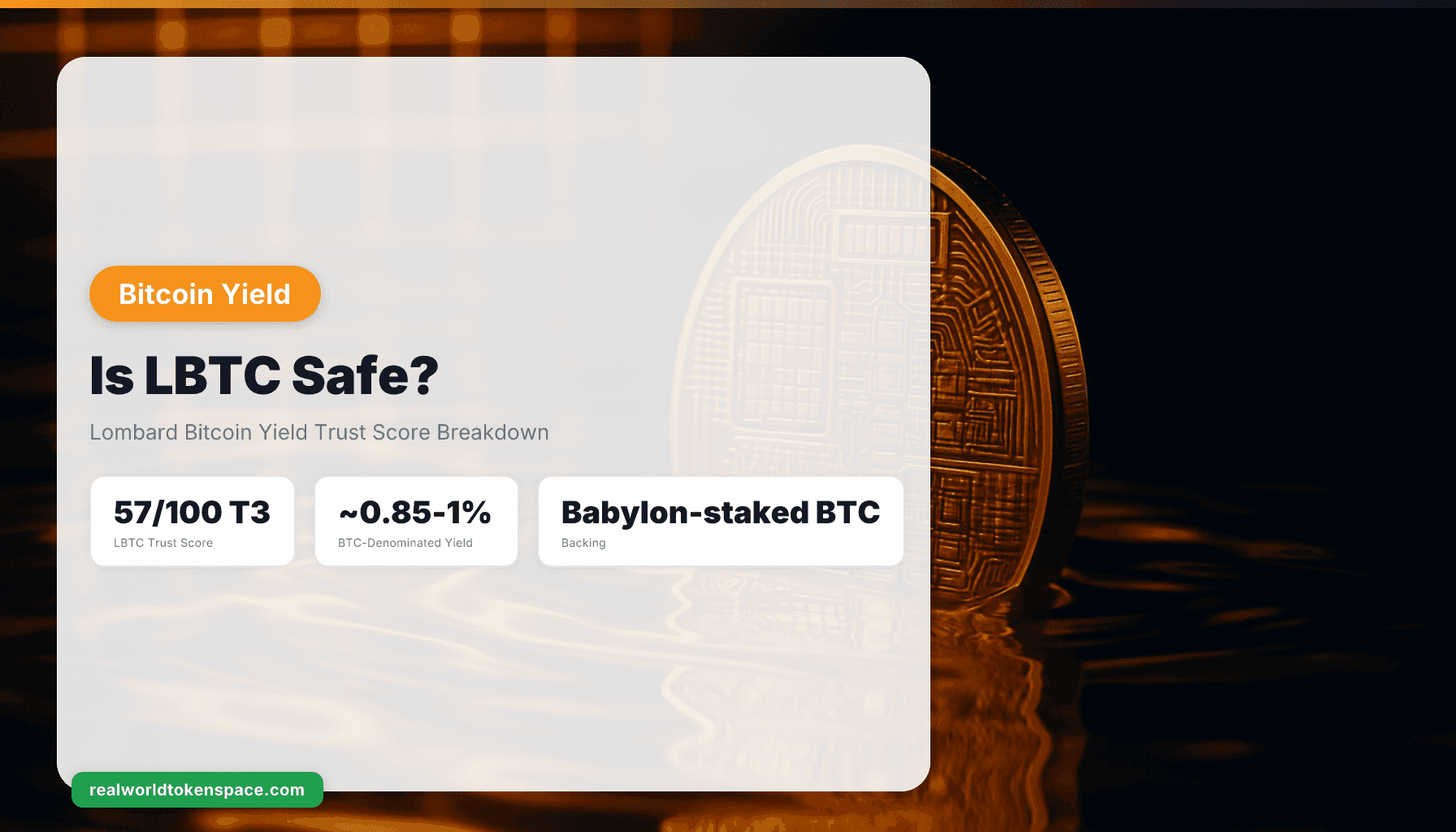
RWTS does not answer that with a yes or no. We rate. You decide. LBTC carries an RWTS Trust Score of T3 (59/100), a tier that signals legitimate mechanics and credible backers paired with risks that a Bitcoin holder used to self-custody should weigh carefully. The full scoring logic is documented in our Trust Score methodology.
What LBTC actually is
LBTC is a liquid receipt token. LBTC is a liquid receipt token issued by Lombard Finance that represents BTC staked through Babylon, packaged into a yield bearing, cross chain ERC 20. The model borrows directly from Ethereum liquid staking: deposit the base asset, mint a tradable token, earn rewards that accrue into that token's value.
The yield source is the part to understand. The BTC underlying LBTC is staked to Babylon's Bitcoin Staking Protocol. This BTC secures multiple proof-of-stake networks (including BOB, Osmosis, and TAC) which pay for that security in their native governance tokens. These rewards are converted to BTC and reflected in LBTC's value, meaning holders earn native BTC-denominated yield, passively. There is no separate reward token to claim, which is the design's main appeal: BTC in, more BTC out.
How much more? Reported figures vary by allocation and market conditions. One Solana integration cited a built-in yield around 1%, "LBTC's built-in ~1% BTC yield (currently 0.85%)" while exchange guides quote wider ranges depending on strategy. As of 2026, typical annual percentage yields range between 3.5% and 6.8%, depending on market conditions and allocation strategies. These returns are automatically reflected in LBTC's redemption value, which gradually increases relative to BTC over time. Treat the higher end skeptically: BTC-denominated staking yield is structurally thin, and the larger numbers usually fold in incentive programs or DeFi leverage rather than base protocol rewards. You can review the live profile on the LBTC directory page.
The backing and the backers
LBTC's institutional roots are a genuine point in its favor. Lombard was founded by a team with deep institutional roots, including Jacob Phillips and operators previously associated with Polychain Capital. The protocol launched mainnet during 2024 and attracted a Series A of roughly 16 million dollars led by Polychain Capital, with Babel Ventures, Mirana and angels from Coinbase, Frax, Ethereum Foundation and Babylon participating. The Solana deployment is secured by a multi-institution consortium, with a consortium of 14 leading digital asset institutions including OKX, Galaxy, Wintermute.
On transparency, Lombard publishes reserve data. Each LBTC token maintains a verifiable on-chain proof linking it to the underlying Bitcoin collateral. The protocol implements real-time reserve verification, allowing anyone to audit the backing ratio between circulating LBTC and deposited BTC. Proof-of-reserve visibility is exactly the kind of attribute our methodology rewards, but it verifies backing, not yield safety. Those are different questions.
Where the risk sits
If LBTC's backing is verifiable, why does it land in Tier 3 rather than higher? Three reasons drive the score.
Babylon staking risk. The yield exists because BTC secures external proof-of-stake networks. That introduces slashing-style and protocol-dependency risk that pure custodial wrapped BTC does not carry. The reward stream depends on those networks continuing to pay, and on the conversion of native tokens back into BTC functioning smoothly.
The redemption queue. This is the line most holders skip. Redemption goes through the Lombard app where you burn LBTC on the source chain and receive native BTC at a destination address. The process involves unstaking from Babylon, which has a queue, so timing can vary. For faster exits, users often sell LBTC on Curve or other deep secondary markets. If you need BTC instantly during a stress event, the secondary market is your real exit, and that can mean accepting a discount to 1 BTC precisely when you least want to.
Smart-contract and cross-chain surface. LBTC is a cross-chain ERC-20 bridged across Ethereum, Solana, and other venues. Every bridge and every contract is additional attack surface. The model is sound, but it is not the Bitcoin base layer.
How LBTC sits against alternatives
For context, SolvBTC (another Bitcoin yield aggregator) scores lower at T4 (49/100), reflecting a more complex, more opaque yield-routing structure. That comparison frames the trade-off across the whole Bitcoin yield category: more yield sources generally mean more layers, and more layers generally mean a lower Trust Score, not a higher one.
It is also worth contrasting BTC yield against the more mature ETH staking market, where tokens like cbETH at T3 (83/100) benefit from a far deeper validator ecosystem and a longer track record. Bitcoin yield is younger infrastructure. Our broader framing of that gap is laid out in Is Bitcoin Yield Safe? Wrapped BTC Lending Trust Score.
The conditional read
If you hold LBTC because you want a liquid, composable, BTC-denominated yield and you accept Babylon as a counterparty, the thesis is internally consistent. If your priority is the security guarantees of self-custodied Bitcoin with no third-party dependency, LBTC is a different product with a different risk profile, and the yield does not change that.
The variables that move the LBTC risk picture are knowable: Babylon's reward continuity, redemption-queue length under stress, and the depth of secondary liquidity when holders want out. Watch those, not the headline APY.
RWTS isn't bullish or bearish on Bitcoin yield, Lombard, or any token. We're the credit-rating agency for tokenized real assets. We rate. You decide.
Related on RWTS
Stay Ahead of the Yield Curve
Subscribe to The Yield Report for weekly yield intelligence.
Subscribe Now