Bitcoin does not pay native yield. No staking rewards, no block subsidy for holders, no automatic interest. If you hold BTC in cold storage, your balance stays flat. Bitcoin yield appears only when you move BTC into a strategy that introduces custody, wrapper, smart contract, or counterparty risk. That risk is the price of the APY.
Bitcoin does not pay native yield. Holding BTC in a wallet or cold storage does not create interest, staking rewards, or cash flow. Bitcoin yield appears only when BTC is put into a strategy that takes on extra risk. The yield compensates for doing something beyond passive holding, lending your BTC, wrapping it for DeFi, or entering structured products. This is not a free upgrade to Bitcoin. It changes the asset's risk profile.
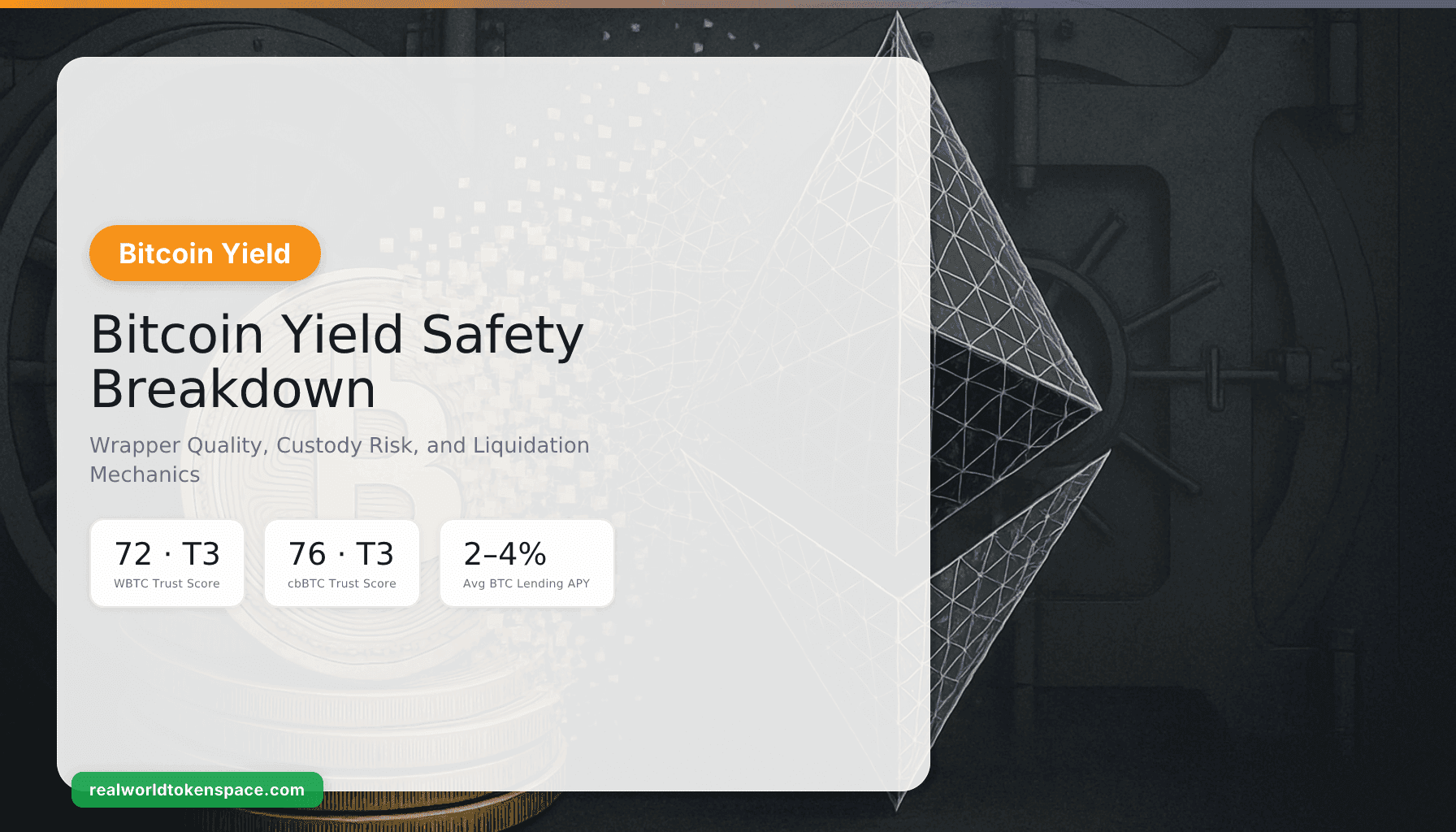
The institutional question in 2026 is not whether Bitcoin yield exists, it does, across centralized lenders, DeFi protocols, and exchange vaults. The question is whether the wrapper quality, custody structure, and liquidation mechanics justify the 2–4% APY that most platforms currently offer. RWTS rated three wrapped BTC products in May 2026. None scored above Tier 3. Here's why.
The Wrapper Matters More Than the APY
Kraken Bitcoin Vault converts deposited BTC into kBTC (a wrapped token). Wrapped Bitcoin gives the deposited BTC a form that can move into DeFi systems while tracking Bitcoin''s market value. In practical terms, it lets Kraken connect Bitcoin exposure to lending activity that would otherwise be less accessible to mainstream exchange users.
Every Bitcoin yield product on Ethereum, Arbitrum, Base, or other EVM chains requires a wrapped representation of BTC. The three dominant wrappers as of May 2026:
- WBTC (Wrapped Bitcoin): Trust Score 72, Tier 3. Custodied by BitGo, governed by a multi-institution DAO. Largest DeFi liquidity (~$9.8B circulating supply). Counterparty risk: BitGo holds the backing BTC in cold storage.
- cbBTC (Coinbase Wrapped Bitcoin): Trust Score 76, Tier 3. Issued and custodied by Coinbase Prime. Institutional-grade custody with SOC 2 Type 2 certification. Lower DeFi integration than WBTC but stronger regulatory standing.
- tBTC (Threshold Bitcoin): Trust Score 74, Tier 3. Decentralized threshold bridge model, no single custodian. Smaller liquidity pool but trustless peg mechanism via tBTC v2. Higher smart contract risk, lower custodial risk.
All three introduce a custody layer that native Bitcoin does not have. The main risk is wrapper quality. A yield on WBTC is not only a BTC yield. It is a yield on a custodial or bridged BTC representation. When you lend WBTC on Aave, you are taking BitGo custody risk on top of Aave smart contract risk on top of Bitcoin price risk. The wrapper is a separate Trust Score input.
The RWTS methodology applies the same custody attestation framework used for tokenized gold and tokenized treasuries. For wrapped BTC, the score penalizes centralized custody (WBTC, cbBTC) and rewards transparency of redemption mechanics (tBTC). No wrapper scored above 76 as of May 2026 because all introduce either custodial concentration or bridge-complexity risk.
How Bitcoin Lending Works, and Where It Breaks
Bitcoin lending yield comes from borrowers who pay to use BTC or BTC-backed liquidity. A user supplies BTC, WBTC, cbBTC, tBTC, LBTC, or another Bitcoin representation into a lending market. Borrowers use it for leverage, collateral management, market making, arbitrage, or liquidity needs. Suppliers earn a portion of the interest.
The two dominant lending architectures in 2026:
Centralized Exchange Lending (Kraken Bitcoin Vault, Ledn, Nexo)
Kraken users can now earn yield from their Bitcoin holdings via the exchange''s new Bitcoin Vaults. Putting BTC in the vaults earns up to 2.5% APY in Bitcoin rewards. Exchange users can lock their funds in the exchange''s new "Bitcoin Vault," which allows them to earn up to 2.5% APY in "Bitcoin-denominated rewards" that accrue automatically to their Kraken accounts.
When users opt to put their BTC into the Bitcoin Vaults, it is put to work in on-chain vaults powered by DeFi infrastructure firm Veda, with risk and strategy controlled by institutional DeFi firm Sentora. From there, the risk firm builds and executes lending and borrowing strategies to earn yield directly on-chain using "well-known on-chain protocols like Aave, Morpho, [and] Tydro." Kraken takes a 25% performance fee, resulting in a net 2–2.5% APY to depositors.
The operational simplification is real, deposit BTC, receive yield, no manual wrapping or DeFi navigation. The risk concentration is also real. You are trusting Kraken's custodial security, Sentora's risk management, and the smart contracts of three underlying DeFi protocols. If any layer fails, the yield stops or the principal is at risk.
Ledn, the other major centralized BTC lender, is the most credible Bitcoin-backed lender in 2026 and the strongest option for large loans. The fundamentals: $10 billion in loans funded since 2018, zero client asset losses across eight years, including the 2022 market collapse that eliminated most competitors. Ledn does not rehypothecate collateral, your BTC stays in segregated cold storage. But you are still taking custodial risk on Ledn as the intermediary.
DeFi Protocol Lending (Aave, Morpho, Compound)
Morpho is a decentralized lending protocol backed by Coinbase Ventures and one of the largest DeFi protocols by TVL. Rates are consistently in the 3-7% range, which is materially cheaper than any CeFi option. Aave, the largest DeFi lending protocol, leads in TVL at $27.8 billion with multi-chain support across Ethereum, Arbitrum, Optimism, and more.
Both offer higher capital efficiency and transparent on-chain collateral tracking. Both also introduce smart contract risk that custodial lenders do not. Liquidations are automated and immediate with no human discretion. At large loan sizes, automated over-liquidation can be more damaging than a managed partial liquidation.
The liquidation threshold is the binding constraint. If you deposit $100,000 of WBTC as collateral and borrow $50,000 USDC (50% LTV), a 30% BTC price drop pushes your position into liquidation territory. Aave will automatically sell your WBTC to repay the loan. You lose the collateral at the worst possible price.
Most lenders require a minimum LTV ratio (often 50%) meaning your collateral must always be worth at least twice your loan balance. If Bitcoin drops 30% overnight, a $20,000 loan backed by $40,000 in BTC suddenly has an LTV of 71%, triggering a margin call. You then face two choices: deposit additional Bitcoin or stablecoins to restore the required ratio, or accept partial liquidation where the platform sells enough of your collateral to bring the LTV back under the threshold.
The institutional lesson from 2022 is that rehypothecation (lending out customer collateral to generate additional yield) is the single largest platform-level risk. That tension was especially visible in the discussion around rehypothecation, the practice of reusing customer collateral to generate additional yield, which became one of the defining risks exposed during the 2022 lending collapse. "The most important thing to ask... is where is your Bitcoin stored," said Adam Reeds, co-founder and CEO of Ledn. "The biggest point in my mind is definitely the rehypothecation piece," Patel said.
Platforms that do not rehypothecate (Ledn, Unchained) offer lower yields but stronger collateral segregation. Platforms that do (many 2021-2022-era lenders that collapsed) offered 8–12% yields that were unsustainable. The 2026 equilibrium is 2–4% for non-rehypothecating lenders, 3–7% for DeFi protocols with liquidation automation.
The Native BTC Future: Babylon + Aave V4
Within the framework of the Aave forum to integrate native Bitcoin lending into the future Aave V4 version, Babylon presented its governance proposal. The initiative, publicly endorsed by Aave founder Stani Kulechov, seeks to activate the more than $4 billion in BTC deposited in Babylon as collateral within the Ethereum DeFi ecosystem. Babylon Labs submitted a Temp Check to Aave DAO to integrate Trustless Bitcoin Vaults with Aave V4. This would allow native BTC as collateral and introduce two new V4 Spokes, one for borrowing against BTC and one for post-liquidation settlement. The core of this development lies in the total elimination of bridges, centralized intermediaries, and traditional wrapped tokens like Wrapped BTC (WBTC).
If approved, this would be the first time a major DeFi protocol accepts native Bitcoin without requiring a wrapped token. Users lock BTC on the Bitcoin mainnet using Taproot scripts and zero-knowledge proofs, receive a non-transferable accounting token on Ethereum, and borrow against it on Aave. No BitGo. No Coinbase custody. No bridge risk.
The proposal is in the Aave governance forum as of May 25, 2026. If it passes, the RWTS Trust Score framework will need to evaluate a new category: native BTC DeFi collateral. The custody risk disappears (your BTC never leaves the Bitcoin chain), but the smart contract risk increases (Taproot script execution, ZK proof verification, cross-chain oracle dependencies). The net safety improvement depends on execution quality, which cannot be scored until the system ships.
For now, every Bitcoin yield product introduces wrapper custody risk or bridge risk. The rates are 2–4% on centralized platforms with custodial concentration, 3–7% on DeFi protocols with liquidation automation. The Trust Score ceiling for wrapped BTC products is Tier 3 until native BTC collateral ships in production.
RWTS Trust Score Positioning
RWTS is not bullish or bearish on Bitcoin yield. We rate the wrapper quality, custody transparency, and liquidation mechanics. You decide whether 2.5% APY justifies taking BitGo custody risk, Aave smart contract risk, and automated liquidation risk.
The RWTS methodology applies the same attestation, custody, and redemption framework to wrapped BTC that we apply to tokenized gold and tokenized treasuries. Centralized custody (WBTC via BitGo, cbBTC via Coinbase) caps the Trust Score at Tier 3. Decentralized bridges (tBTC via Threshold) trade custodial risk for smart contract complexity, also capping at Tier 3.
For comparison, review the BUIDL vs USYC tokenized treasury comparison to see how institutional custody is scored in a parallel asset class. The same transparency and segregation requirements apply to Bitcoin wrappers.
If you are evaluating Bitcoin yield in 2026, start with these three questions:
- Who holds the backing BTC? BitGo (WBTC), Coinbase (cbBTC), or a threshold bridge (tBTC)? This is your primary counterparty risk.
- Where does the yield come from? DeFi lending demand (Aave, Morpho), exchange inventory strategies (Kraken), or structured products? This determines the sustainability of the rate.
- What happens if BTC drops 30% overnight? Automated liquidation (DeFi), margin call with human discretion (Ledn), or loss of collateral (worst-case)? This is your tail risk.
Bitcoin yield is not risk-free income. It is a compensated exposure to wrapper custody, smart contract execution, and liquidation mechanics. The RWTS Trust Score reflects that reality. Every product currently in production is Tier 3 or below.
We rate. You decide.
Related Research: