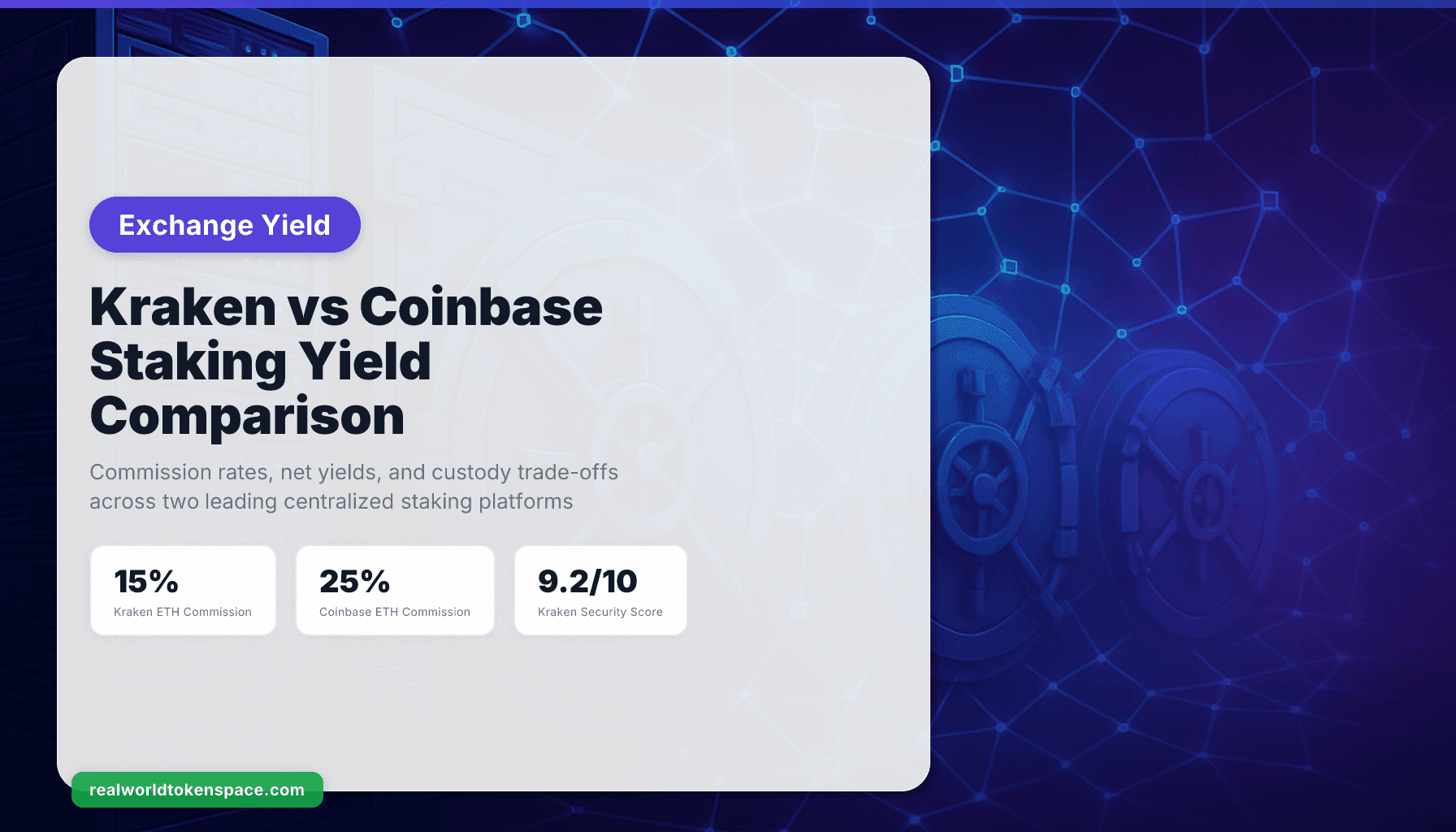
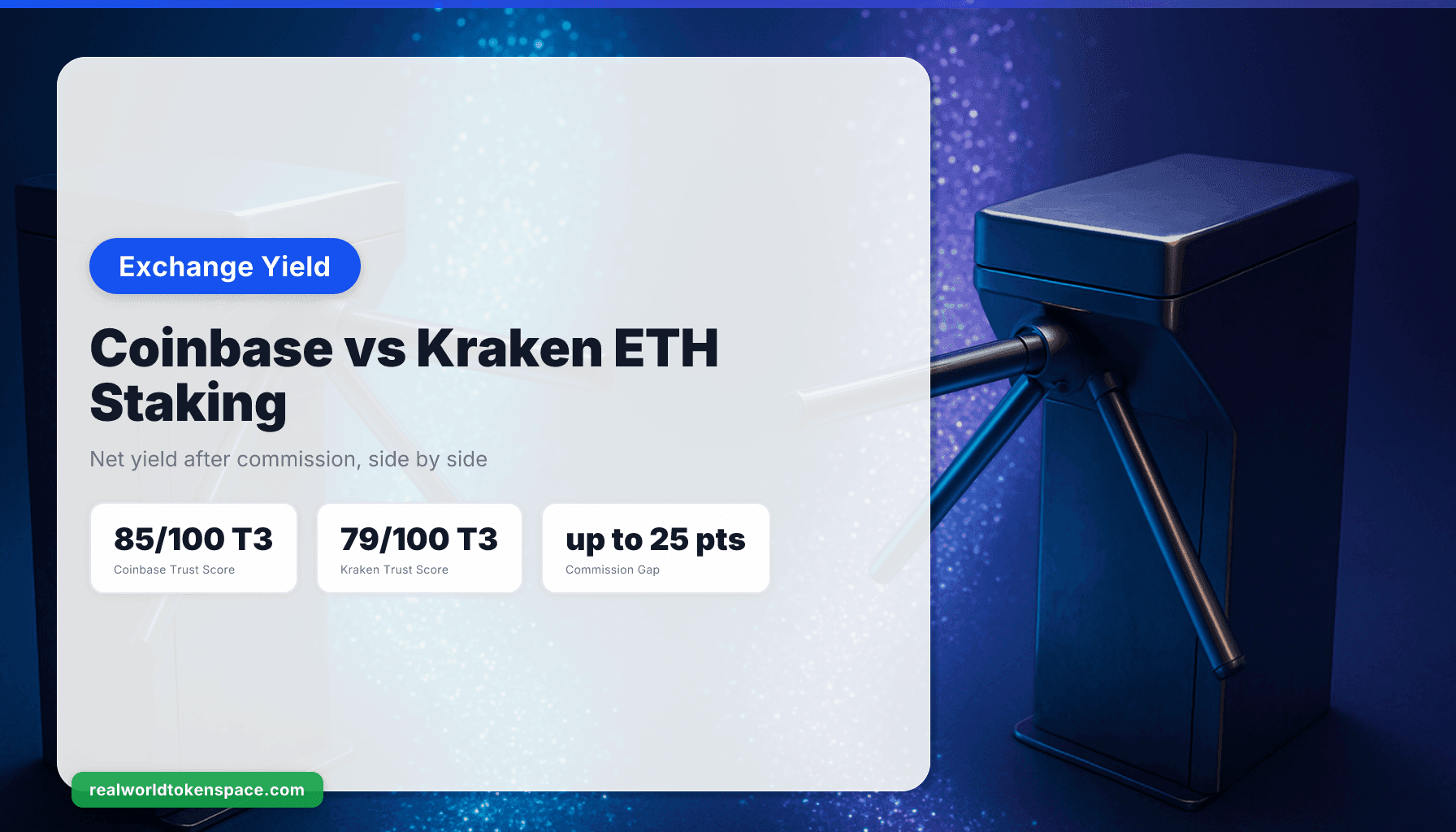
CryptoSlate's 2026 security scoring places Kraken at 9.2/10, Binance at 9.1/10, Coinbase at 8.7/10, and OKX at 8.6/10. Security matters, but for allocators comparing exchange staking platforms, net yield after commissions is the primary decision variable. On ETH staking, Kraken charges approximately 15% commission (yielding ~3.4% net on a 4.0% gross rate), while Coinbase charges 25% commission (yielding ~2.6% net on a 3.5% gross rate).
On a $50,000 ETH position, the 25-percentage-point commission gap between Coinbase at 35% and Lido at 10% costs approximately $400 per year in foregone yield. That figure compounds materially over a multi-year holding period. For retail allocators evaluating where to stake, deriving net APY before comparing platforms is the only financially sound starting point.
This guide compares Kraken and Coinbase across commission rates, net yields, supported assets, security architecture, and custody trade-offs. For liquid staking alternatives (Lido, Rocket Pool), see our ETH yield comparison. For the RWTS methodology on how we evaluate staking products, see the methodology page.
Commission Rates: The 15% vs 25% ETH Staking Gap
Coinbase generally keeps 25% of staking yields, whereas Binance takes 10% as commission. By comparison, Kraken's commission averages 15%, depending on the asset. The commission structure matters more than headline APY because it directly reduces your net return.
Net staking yield equals gross APY multiplied by one minus the commission rate: a 20% gross APY paired with a 40% platform commission produces only 12% net income for the staker. Commission rates across major centralized exchanges range from 10% at Lido Finance to 39.95% at Binance, a 30-percentage-point spread that overwhelms any headline APY difference between platforms.
For SOL staking, Coinbase staking APYs include Solana (SOL) at 5.85% APY, with Coinbase charging a commission of 25.0% on staking rewards earned. Kraken's SOL staking commission is also approximately 15%, yielding higher net returns on the same gross rate.
Kraken supports over 20 assets and offers both flexible and bonded staking options with transparent commission fees and APY tracking. Coinbase is designed for simplicity, staking begins automatically once eligibility requirements are met, though the platform charges a relatively high staking commission depending on the asset.
Supported Assets and Flexibility
Kraken lists 500-plus cryptocurrencies on its platform-wide listings hub and markets pages, while Coinbase shows about 341 listed assets on its public listed assets directory, meaning Kraken offers roughly 45 percent more listed coins. For staking specifically, both platforms support ETH, SOL, ADA, DOT, ATOM, and other major proof-of-stake assets, but Kraken's asset coverage is broader.
Kraken offers more supported assets, higher flexibility, and greater reward potential than competitors. Users can stake over 20 assets and choose between flexible and bonded options. Staking rewards on Kraken are paid out once per week, with weekly rewards issued as unstaked ETH, fully unlocked and able to stake, trade or withdraw after the Shapella upgrade.
Coinbase supports trading in over 250 cryptocurrencies on Coinbase Advanced, including major Layer-1 assets, Layer-2 ecosystem tokens, DeFi blue-chips, and stablecoins. Kraken supports more than 200 cryptocurrencies for trading, deposit, and withdrawal, plus 7 national fiat currencies (USD, EUR, GBP, CAD, AUD, CHF, JPY).
For US customers, Coinbase covers 9 more US states than Kraken at the MTL layer, although Texas operates under a no-action letter rather than a standard MTL. US-based users can stake crypto on platforms like Coinbase and Kraken, though regulations may differ by state. Many platforms, including Coinbase and Kraken, allow US-based users to stake cryptocurrencies, though availability may vary by state and regulation.
Security, Custody, and Regulatory Standing
Coinbase prioritizes security and compliance, including New York State licensing, SOC 2 Type 2 certification and robust custody practices. The Wyoming State Banking Board granted Kraken Financial (Kraken Bank) a Special Purpose Depository Institution (SPDI) charter on September 16, 2020, making it the first cryptocurrency-native SPDI institution to receive bank-level approval in the United States. The SPDI charter authorizes Kraken Bank to receive deposits and conduct activities incidental to the business of banking, including custody, asset servicing, and fiduciary asset management, but the institution may not make loans of customer fiat deposits and must maintain 100% reserves against demand deposits at all times.
Kraken's most recent Proof of Reserves audit, completed in April 2026, covered Bitcoin, Ethereum, USDC, USDT, and 23 additional supported assets totaling over $24 billion in client balances. Coinbase reported Q1 2026 subscription and services revenue of $698 million, which includes staking, custody, blockchain rewards, and other recurring sources.
Centralized exchange staking packages validator infrastructure management, reward distribution, custody, and liquidity into a single platform relationship; the operational simplicity is its core value proposition. CryptoSlate's 2026 security scoring places Kraken at 9.2/10, Binance at 9.1/10, Coinbase at 8.7/10, and OKX at 8.6/10. These scores reflect infrastructure security and reserve practices; they are independent of yield quality.
Kraken vs Coinbase vs Liquid Staking Alternatives
Exchange staking (Kraken, Coinbase) is operationally simpler than liquid staking (Lido, Rocket Pool), but it trades composability for convenience. Liquid staking (Lido stETH, Rocket Pool rETH, and others) lets any amount of ETH be staked in exchange for a liquid token that can be transferred or used in DeFi protocols. stETH and rETH can be used as collateral, liquidity, or margin in DeFi, exchange-staked ETH cannot.
Liquid staking adds smart contract risk on top of base staking risk. Lido (stETH/wstETH) and Rocket Pool (rETH) are the most established liquid staking protocols with multi-year records. For allocators who want staking yield without DeFi composability, exchange staking is cleaner. For allocators who want to use staked ETH as collateral elsewhere, liquid staking is the only path.
The analytical framework for crypto staking in 2026 reduces to three verifiable steps: derive net APY by subtracting the platform's commission from gross yield, assess liquidity requirements against asset-specific unbonding periods, and match custody architecture to portfolio size and technical competence. The data is unambiguous on the yield hierarchy: Rocket Pool and Lido deliver the best net ETH yield in the protocol tier; Jito leads for SOL; Kraken holds the strongest position in the CEX tier by combining the sector's highest security score with the lowest commission rate.
RWTS Rating: Kraken vs Coinbase
RWTS does not rate centralized exchanges in the same Trust Score framework we apply to tokenized assets. Exchange staking is custody-based, not asset-backed. You are trusting the platform to manage validators, distribute rewards, and return your principal. That trust is evaluated on security architecture, regulatory standing, and historical performance, not on vault attestation or redemption mechanics.
Kraken's 9.2/10 security score, Wyoming SPDI charter, and 15% ETH staking commission position it as the yield-optimized choice for allocators who prioritize net APY. Coinbase's 8.7/10 security score, automatic staking, and simpler user experience position it as the ease-of-use choice for allocators who prioritize simplicity over yield optimization.
For the full methodology on how RWTS evaluates staking products, see the methodology page. For liquid staking comparisons, see our wstETH vs stETH guide. The data matters. The commission matters. You decide.