"Is stETH safe?" is the wrong question asked alone. The right question is: safe relative to what, and at what yield? stETH and Rocket Pool's rETH are the two most battle-tested liquid staking tokens, and they answer that trade-off differently. RWTS isn't bullish or bearish on either. We rate. You decide.
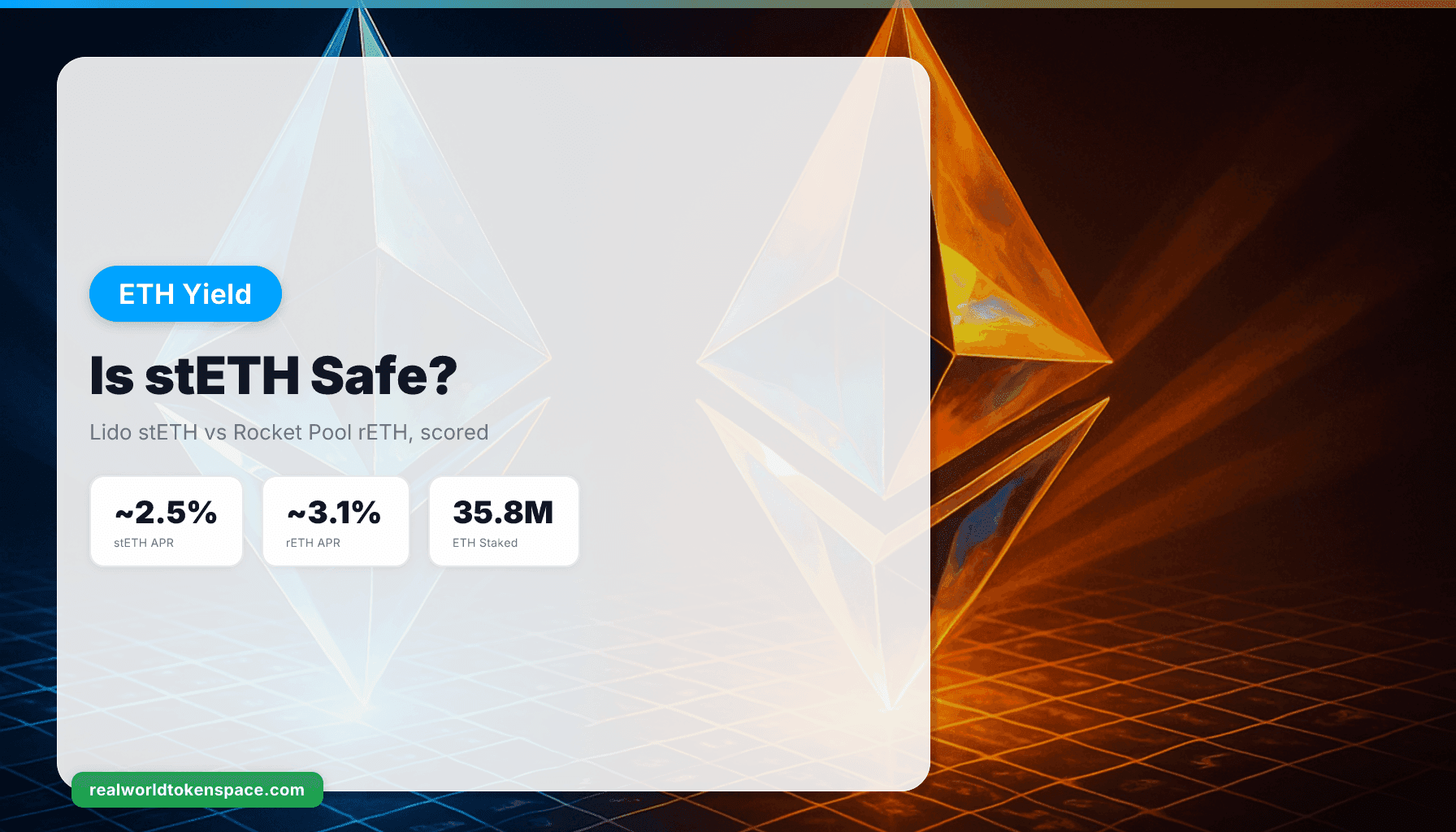
Start with the yield baseline, because it frames everything else. As of 2026, roughly 35.8 million ETH is staked, representing about 28.9% of total supply, while validators earn an average yield near 3.3%. Liquid staking tokens pass through that base rate minus a protocol fee. Lido's official calculator listed an Ethereum staking APR of about 2.38% on April 13, 2026, while Rocket Pool provides a more decentralized alternative with permissionless node operation and rETH liquid staking tokens yielding around 3.1% APR. The gap is real but small, and it inverts when you weigh decentralization against liquidity.
The mechanism: where the yield comes from, and the risk that rides with it
ETH yield has two layers. Yield comes from two primary sources: first, Ethereum consensus layer rewards, where staking validators earn ETH from block rewards and MEV; and second, DeFi lending, where liquid staking tokens can be lent for additional interest on top of the base staking yield. Holding stETH or rETH captures the first layer automatically. Looping them through lending markets captures the second, and that is where the risk profile changes shape.
Liquid staking does not remove risk; it stacks new risk on top of base staking. Liquid staking adds smart contract risk on top of base staking risk. Lido and Rocket Pool are the most established protocols with multi-year records, newer tokens carry more uncertainty, and vaults using staked ETH as collateral amplify risk if the liquid staking token de-pegs from ETH. That de-peg scenario is not hypothetical.
The peg question: the heart of "is stETH safe"
stETH is not a hard peg. It represents one ETH of staked principal plus accrued rewards, and its market price can drift from that value when liquidity dries up. The historical reference point matters: while stETH theoretically maintains a 1:1 value relationship with ETH, secondary market trading often shows price deviations, and during the May 2022 Terra/Luna collapse and subsequent market stress, stETH traded as low as 0.93 ETH. It later restored full parity. The lesson is mechanical, not moral: redemption guarantees parity over time, but the secondary market can price fear in the interim.
Rocket Pool's rETH carries the same category of risk with a different shape. Its more distributed operator set lowers concentration concerns, but thinner liquidity can mean wider discounts when sellers rush the exit. If you intend to hold to redemption, depth matters less. If you may need to sell into stress, depth matters a great deal.
Lido's withdrawal path softens the worst case. The process has two steps (request withdrawal, then claim ETH) and under normal conditions Lido says the wait time is often 1 to 5 days; if you want faster liquidity you can swap stETH on the open market, though the price may not match ETH exactly. That phrase, "may not match ETH exactly," is the entire safety conversation in five words.
stETH vs rETH: the Trust Score angle
On the RWTS framework, both sit in Tier 2, credible, audited, multi-year track records, but with structural concentrations a careful allocator should name. stETH scores on deep liquidity, a daily-rebasing reward model, and the largest staked base in the category. Lido Finance dominates this segment with over 9.2 million ETH staked, offering approximately 3.2% APR while issuing stETH tokens that maintain liquidity and composability across DeFi protocols. The offsetting concern is operator concentration, a single dominant protocol is a single large surface.
rETH trades that surface for distribution. Rocket Pool's distributed validator network reduces centralization risks compared to Lido's operator set, though lower total value locked results in slightly reduced liquidity for the rETH derivative token. For methodology purists, that is a cleaner decentralization story at the cost of exit depth.
A note for DeFi integrators: most protocols prefer wstETH, the wrapped, non-rebasing version. wstETH maintains a fixed token quantity while increasing in value relative to ETH, so stETH suits straightforward holding and reward accrual, while wstETH suits integration with DeFi protocols that do not support rebasing tokens. The difference is accounting, not credit risk, both share Lido's underlying exposure. For the full mechanics of wrapping, see our prior breakdown, wstETH vs stETH: Liquid ETH Staking Comparison.
How we score, and what to watch
Our Trust Score weighs custody and redemption mechanics, peg history, operator concentration, audit depth, and liquidity, the full rubric lives in our methodology. For a wider tour of the cluster, including looping vaults and restaking, start at the ETH yield hub.
Two humility variables decide which token wins for you. First, your holding intent: if you redeem through the protocol and never touch the secondary market, rETH's thinner liquidity barely matters. Second, your stress posture: if a 2022-style liquidity crunch would force you to sell, stETH's depth is worth the concentration trade-off. If stETH holds within a few basis points of fair value and Lido withdrawals stay inside the 1-to-5-day window, the safety thesis holds. If a stress event reopens a meaningful discount, the fork is whether you can wait for redemption or must sell at the gap.
Neither token is risk-free, and neither is a savings account, staking is not a savings account; it is yield tied to network performance and operational discipline. RWTS rates the structure. You decide which trade-off fits your book.
Stay Ahead of the Yield Curve
Subscribe to The Yield Report for weekly yield intelligence.
Subscribe Now