Stablecoin Yield Explained: Where It Comes From and the Real Risks
Where stablecoin yield actually comes from: T-bill float, savings rates, and basis trades. A risk ladder plus the RWTS Trust Scores for sUSDe, USDS, and USDY.
Verdict: stablecoin yield is not one thing. It is at least three different engines wearing the same wrapper, and each carries its own risk. The yield-bearing dollars we track range from sUSDe at 61/100 (Tier 4), through USDS at 72/100 (Tier 3), up to USDY at 81/100 (Tier 2). The pattern is consistent: the more the yield depends on a market bet rather than a Treasury coupon, the lower the score. Before you chase a rate, learn which engine is turning underneath it. We rate. You decide.
Most savers meet stablecoin yield as a single APY number on a dashboard. That number tells you almost nothing about safety. A 4% dollar backed by allocated Treasury bills and a 12% dollar backed by an open derivatives position are not the same product, even when both say "stable." This explainer walks the three yield sources and the risk ladder they sit on.
Where the yield actually comes from
There are three dominant engines. Nearly every yield-bearing dollar uses one of them, or a blend.
Free guide
Reading this far? Get the Top 10 in your inbox.
One weekly email with the updated Trust Score leaderboard, the biggest moves, and a deeper dive on one asset. Independent ratings only — no sponsored content.
One email a week. Unsubscribe anytime. We never sell your email.
1. Treasury bill float. The issuer holds your dollars in short-dated US government debt and passes most of the coupon back to you. This is the simplest and most transparent engine. The yield is whatever the short end of the curve pays, minus a management fee. USDY runs on this model, which is a large part of why it sits at 81/100 (Tier 2) with a backing score of 22/16 worth of allocated, disclosed reserves.
2. Protocol savings rate. A lending protocol sets a rate by governance and funds it from borrower interest plus reserve buffers. The rate is a policy decision, not a market coupon, so it can be adjusted up or down by vote. USDS uses this savings-rate model and scores 72/100 (Tier 3). We cover the mechanics in detail in sDAI Yield Explained: Why $2B Migrated to sUSDS.
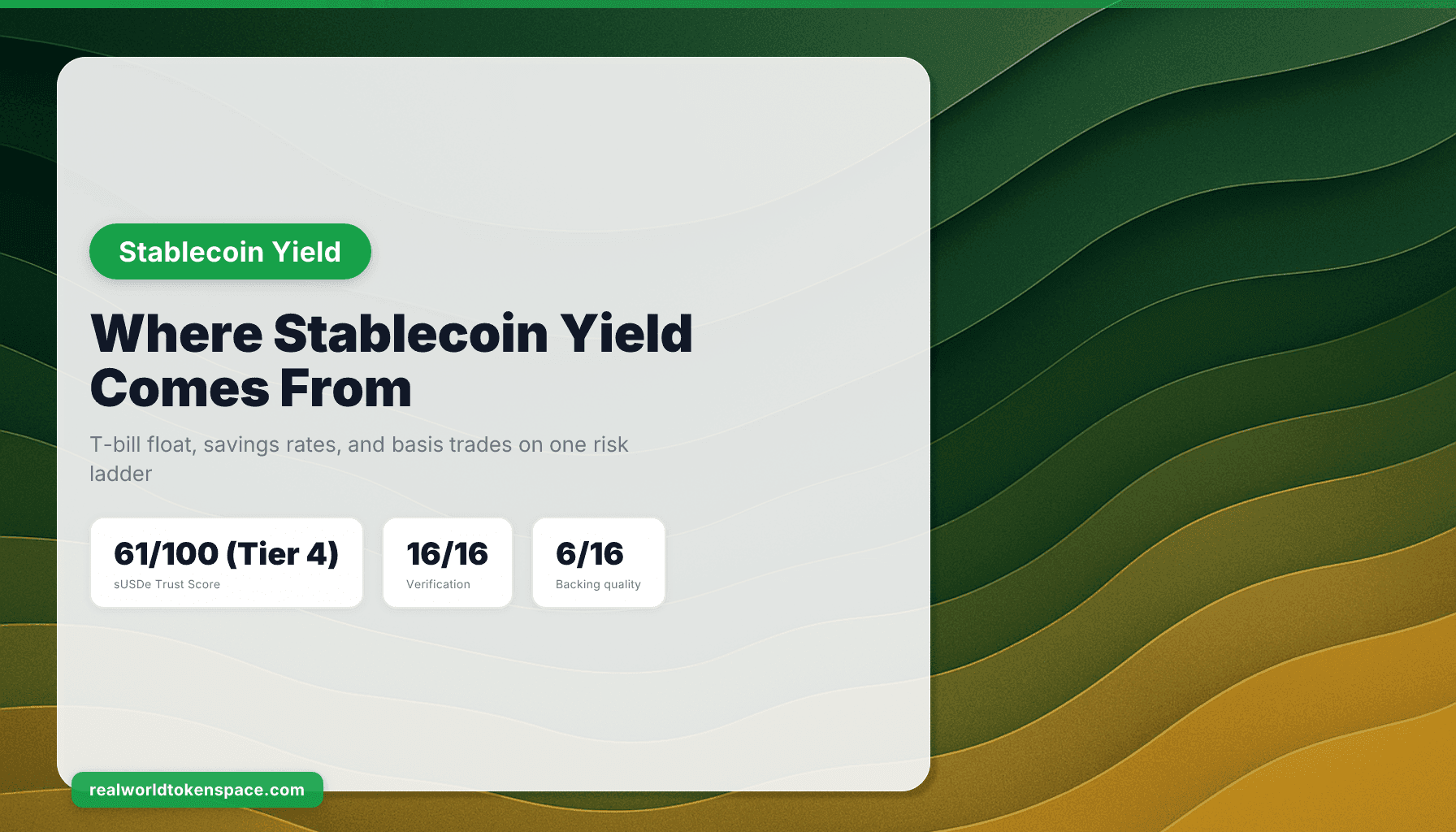
3. Derivatives basis trade. The issuer holds spot assets and shorts an equal amount of perpetual futures, capturing the funding rate that longs pay to shorts. When markets lean bullish, that funding rate is positive and the yield is high. When funding turns negative, the trade pays nothing or costs money. This is the sUSDe engine, and it is why sUSDe scores 61/100 (Tier 4): strong verification, weaker backing quality.
Put the three side by side and the rule is plain. Compared with a bank savings account near 0.5% and physical cash earning nothing, all three offer more. But the extra return over a T-bill dollar is not free money. It is compensation for a specific risk you are now carrying.
The Trust Score, dimension by dimension
sUSDe's 61/100 is the sum of six weighted dimensions. Source: RWTS Trust Score methodology.
Dimension
sUSDe
Max
Asset backing quality
6
25
Reserve verification
16
20
Redeemability
13
15
Audit and security
12
15
Regulatory standing
7
15
Track record
7
10
Total
61
100 · Tier 4
sUSDe is the clearest teaching case because its dimensions are so uneven. Verification scores a full 16/16: the collateral and hedging positions are observable and independently checkable, which is genuinely strong. Redemption and audit are mid-pack. Backing quality, though, is only 6/16, and that is the honest number. The reserve behind sUSDe is not a pile of Treasury bills. It is a live market position whose value depends on funding markets staying favorable. High transparency about a riskier engine is still a riskier engine. That combination is exactly what produces a 61/100 (Tier 4) result.
T-bill float (lowest risk): the main risks are issuer custody, redemption friction, and the rare event of the US short end itself being disrupted. USDY at 81/100 (Tier 2) sits here.
Protocol savings rate (middle): add governance risk (the rate is voted, not earned) and smart-contract risk. Reserve buffers absorb shocks until they do not. USDS at 72/100 (Tier 3) sits here. For a deeper look at its structure, read Is USDS Safe? Sky's DAI Successor Trust Score Breakdown.
Derivatives basis trade (highest): add funding-rate risk (yield can go to zero or negative), exchange counterparty risk on the short leg, and collateral-liquidation risk in a sharp move. sUSDe at 61/100 (Tier 4) sits here.
A useful discipline: never read a rate on its own. Always frame it against what a T-bill dollar pays for the same period. If a product offers double the T-bill rate, the gap is the price of the extra risk on this ladder. That is the trade, stated plainly.
Is stablecoin yield safe?
Safety is a property of the engine, not of the word "stablecoin." A Treasury-backed dollar with allocated, audited reserves and clean redemption is a fundamentally different risk than a synthetic dollar whose yield rides a funding rate. The Trust Score exists to separate the two: it rewards disclosed backing, independent verification, and reliable redemption, and it does not care about the headline APY. That is why USDY (81/100, Tier 2) outranks sUSDe (61/100, Tier 4) even though sUSDe often quotes a higher number.
Two limitations worth stating before anyone acts. First, every rate here is variable; a snapshot today tells you nothing about next quarter. Second, a high verification score, as with sUSDe, means you can see the position clearly, not that the position cannot lose value. Transparency is not the same as safety.
Stablecoin yield is real, but it is earned differently in each product, and those differences are the whole story. A T-bill dollar pays you a government coupon. A savings-rate dollar pays you a policy decision. A basis-trade dollar pays you for holding a market position. Match the engine to your own tolerance, read the backing dimension before the rate, and treat every APY as variable. The Trust Scores here (sUSDe 61/100 Tier 4, USDS 72/100 Tier 3, USDY 81/100 Tier 2) are the shortcut, not the conclusion.
Get the always-updated leaderboard delivered to your inbox. Independent ratings across gold, treasuries, stablecoin yield, and DeFi vaults — methodology + data, no hype.
One email a week. Unsubscribe anytime. We never sell your email.
Frequently asked questions
What is stablecoin yield and where does it come from?
Stablecoin yield most often comes from three engines: short-term Treasury bill float, on-chain savings rates set by a protocol, and derivatives basis trades. On the RWTS Trust Score scale the yield-bearing dollars we track range from sUSDe at 61/100 (Tier 4) up to USDY at 81/100 (Tier 2). Higher yield usually maps to a more complex, lower-scoring engine. We rate. You decide. Not financial advice.
Is stablecoin yield safe?
It depends entirely on the engine. A T-bill backed dollar like USDY (81/100, Tier 2) carries different risk than a basis-trade dollar like sUSDe (61/100, Tier 4). Read the backing and redemption dimensions before the headline rate.
Why does sUSDe pay more than a Treasury-backed stablecoin?
sUSDe yield is funded primarily by a delta-neutral basis trade (long spot, short perpetual futures), which pays a funding rate when markets lean long. That funding rate can go negative, which is why sUSDe scores 61/100 (Tier 4) on backing quality despite strong verification.
Do yield-bearing stablecoins pay a fixed rate?
No. Almost all stablecoin yield is variable. Savings-rate dollars adjust by protocol vote, T-bill dollars track the short end of the curve, and basis-trade dollars move with funding markets. Treat any quoted rate as a snapshot, not a promise.
Which yield-bearing stablecoin has the highest Trust Score?
Of the three main yield-bearing dollars we cover here, USDY scores highest at 81/100 (Tier 2), ahead of USDS at 72/100 (Tier 3) and sUSDe at 61/100 (Tier 4). See each entry in the RWTS directory for the dimension breakdown.
Disclaimer: This article is for informational purposes only and does not constitute financial advice. Always do your own research before making investment decisions.
Stay Ahead of the Yield Curve
Subscribe to The Yield Report for weekly yield intelligence.