Tokenized Treasuries: Is BlackRock BUIDL Safe? Trust Score Breakdown
Tokenized treasuries are the fastest-maturing corner of the real-world asset market. According to RWA.xyz treasury data cited across the industry, BlackRock's BUIDL holds about $2.8 billion in assets, or 18.5% of the $15.1 billion market, with the rest, USYC included, splitting the remaining 81.5%. The category is real, large, and increasingly institutional. But size is not safety. This is a Trust Score breakdown, not a sales page.
RWTS is not bullish or bearish on any tokenized treasury fund. We are the credit-rating agency for tokenized real assets. We rate. You decide.
Is BlackRock BUIDL safe?
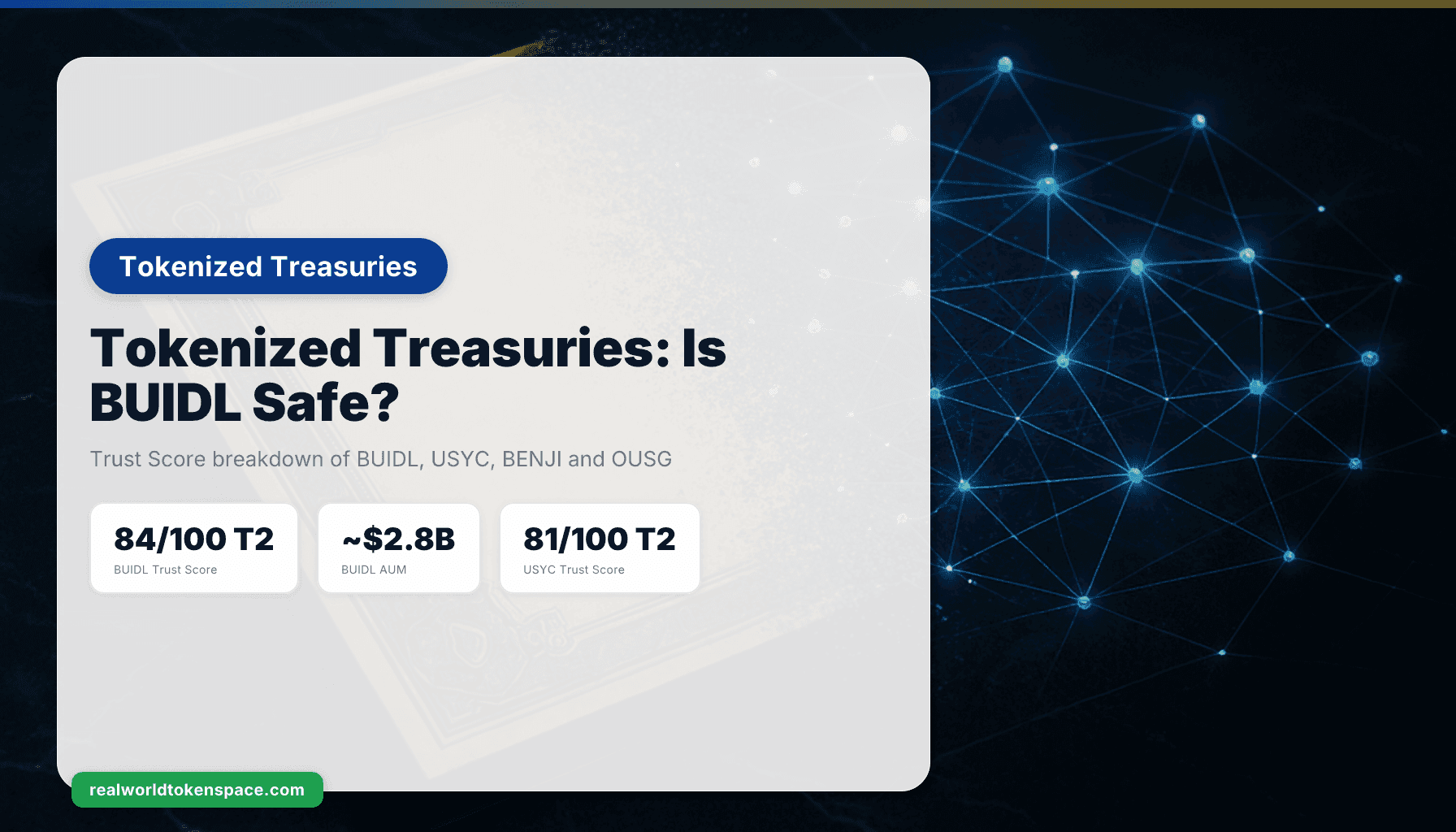
Verdict: BUIDL earns an RWTS Trust Score of T2 (84/100). It is one of the safer products in the category on backing and operator quality, and its main constraints are access, not credit.
BUIDL is the BlackRock USD Institutional Digital Liquidity Fund. It is a tokenized money market fund issued by BlackRock and operated onchain through transfer agent Securitize, launched on Ethereum on March 20, 2024. The fund holds short-dated US Treasuries, cash and repo, and passes yield to holders through a daily accrual. BUIDL lost the top spot to Circle's USYC in March 2026 before reclaiming it by late August, growing to approximately $2.8 billion in assets under management.
What the 84/100 reflects: a blue-chip manager, a regulated transfer agent, transparent Treasury backing, and daily NAV. What it does not do is make the product retail-accessible. BUIDL is gated to qualified purchasers, carries a high minimum, and transfers only between whitelisted wallets. Those are structural limits, not defects, but they matter if your use case is open composability. Read the full rating framework on our methodology page, and the live rating on the BUIDL directory page.
The underlying reality: what these funds actually hold
A tokenized treasury fund is a claim on a portfolio of US government debt, wrapped as an onchain token. BlackRock's BUIDL fund converts a traditional portfolio of US Treasury bills, cash, and repos into blockchain-based claims for qualified investors. The token is not the yield source; the T-bills are. If Treasury yields fall, distributions fall with them, the yield is a pass-through, not a promise.
That mechanism is the reason these products earn higher Trust Scores than most DeFi yield: the collateral is the safest paper in the world, and the issuer names are legible. The risks that remain are operational and structural (transfer-agent execution, redemption windows, wallet gating, and smart-contract surface) rather than credit risk on the underlying bond.
BUIDL vs USYC vs BENJI vs OUSG: the Trust Score table
For a full side-by-side, see our tokenized treasuries comparison hub. The headline scores:
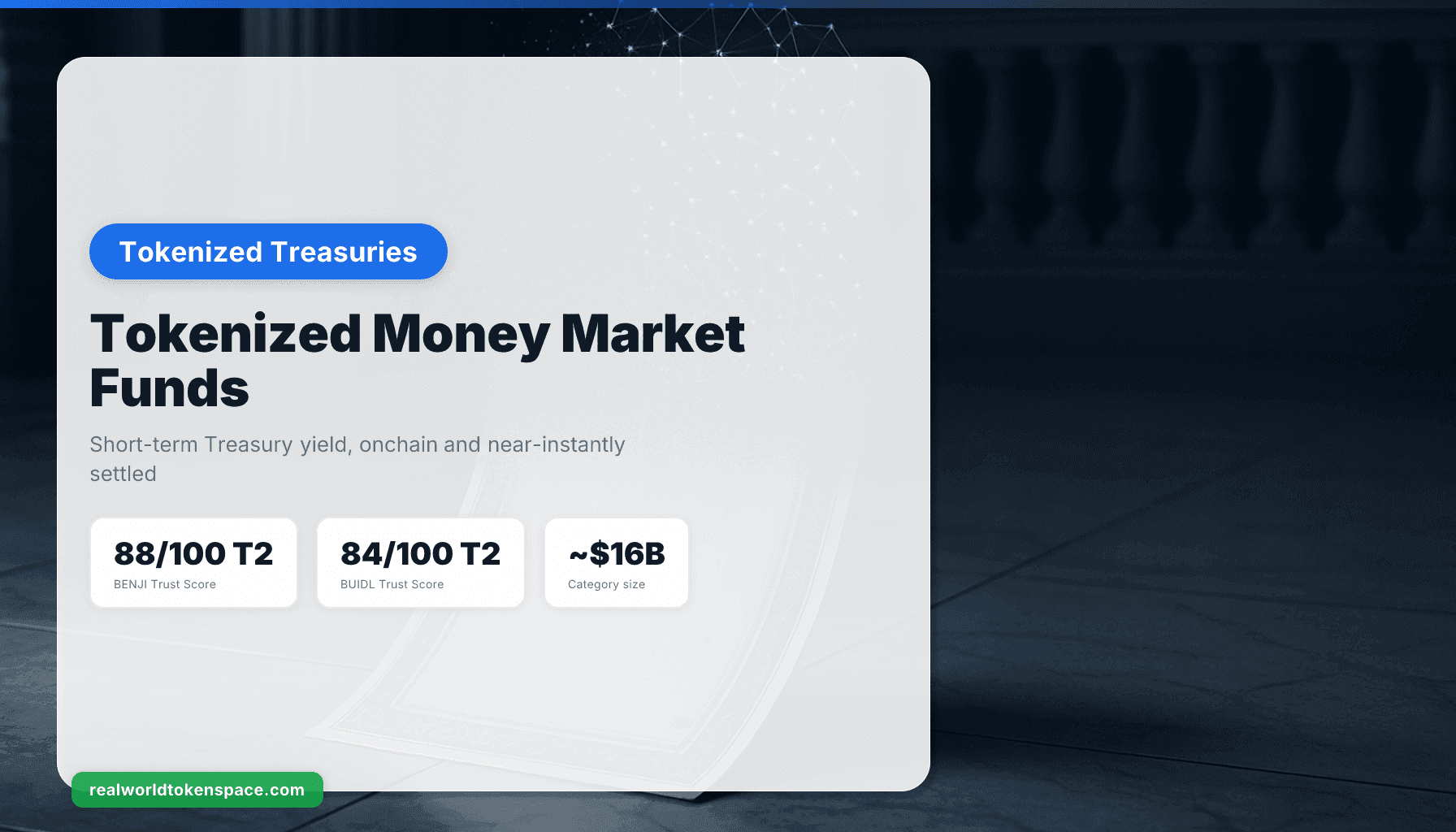
- BENJI (Franklin Templeton): T2 (88/100). The highest-scored tokenized treasury product we cover, backed by a decades-old asset manager with its own onchain transfer-agency record.
- BUIDL (BlackRock / Securitize): T2 (84/100). The largest by AUM, strongest brand, gated access. See BUIDL.
- USYC (Circle / Hashnote): T2 (81/100). BUIDL's closest rival by size, with faster onchain settlement mechanics. See USYC.
- OUSG (Ondo Finance): T2 (77/100). A crypto-native issuer that predates the incumbents in this category, non-US qualified-purchaser gated.
Two takeaways. First, biggest is not highest-rated: BUIDL leads on AUM but BENJI leads on Trust Score. Second, the whole cohort sits in Tier 2, a tighter, higher band than stablecoin-yield or ETH-yield products, which reflects the quality of the underlying collateral.
How to read a tokenized treasury Trust Score
Three questions decide most of the score:
- What backs it, and who audits it? Short-dated Treasuries and cash are the gold standard here. The question is attestation cadence and whether the transfer agent is regulated.
- How does redemption actually work? BUIDL redemptions run through Securitize; USYC settles faster onchain. A fund can be perfectly backed and still trap you in a slow redemption window during stress.
- Who can hold it, and how does it transfer? Whitelisted-wallet gating and a $5M minimum are not risks to your principal: but they are constraints on liquidity and composability that the score has to weigh.
If those three check out, the credit question is nearly closed, because the collateral is sovereign paper. That is the structural reason tokenized money market funds cluster higher than almost everything else we rate.
Where the category is heading
Institutional supply keeps arriving. On May 8, 2026, BlackRock filed with the SEC for two new tokenized funds plus onchain shares for a $7 billion money-market fund, signaling acceleration rather than experimentation. If the pattern holds (incumbents deepening rather than exiting) the tokenized treasury market widens and the competitive pressure moves to redemption speed, chain coverage and fees. Below that, the constraint remains investor eligibility: these are still, for now, qualified-purchaser products.
For the deposit-token version of this same trade-off (where the yield comes from and where it breaks) read our companion piece, Stablecoin Yield Explained: Where It Comes From and the Risks.
The bottom line
Is BlackRock BUIDL safe? On the metrics that decide default risk (collateral, operator, attestation) it scores T2 (84/100), near the top of the category. Its limits are about who can hold it and how fast they can exit, not whether the bonds are there. BENJI edges it on our score, USYC trails it, OUSG sits a tier below on operator profile.
RWTS rates tokenized real assets independently. We are not talking you into or out of any fund. We rate. You decide.
Related on RWTS
Stay Ahead of the Yield Curve
Subscribe to The Yield Report for weekly yield intelligence.
Subscribe Now