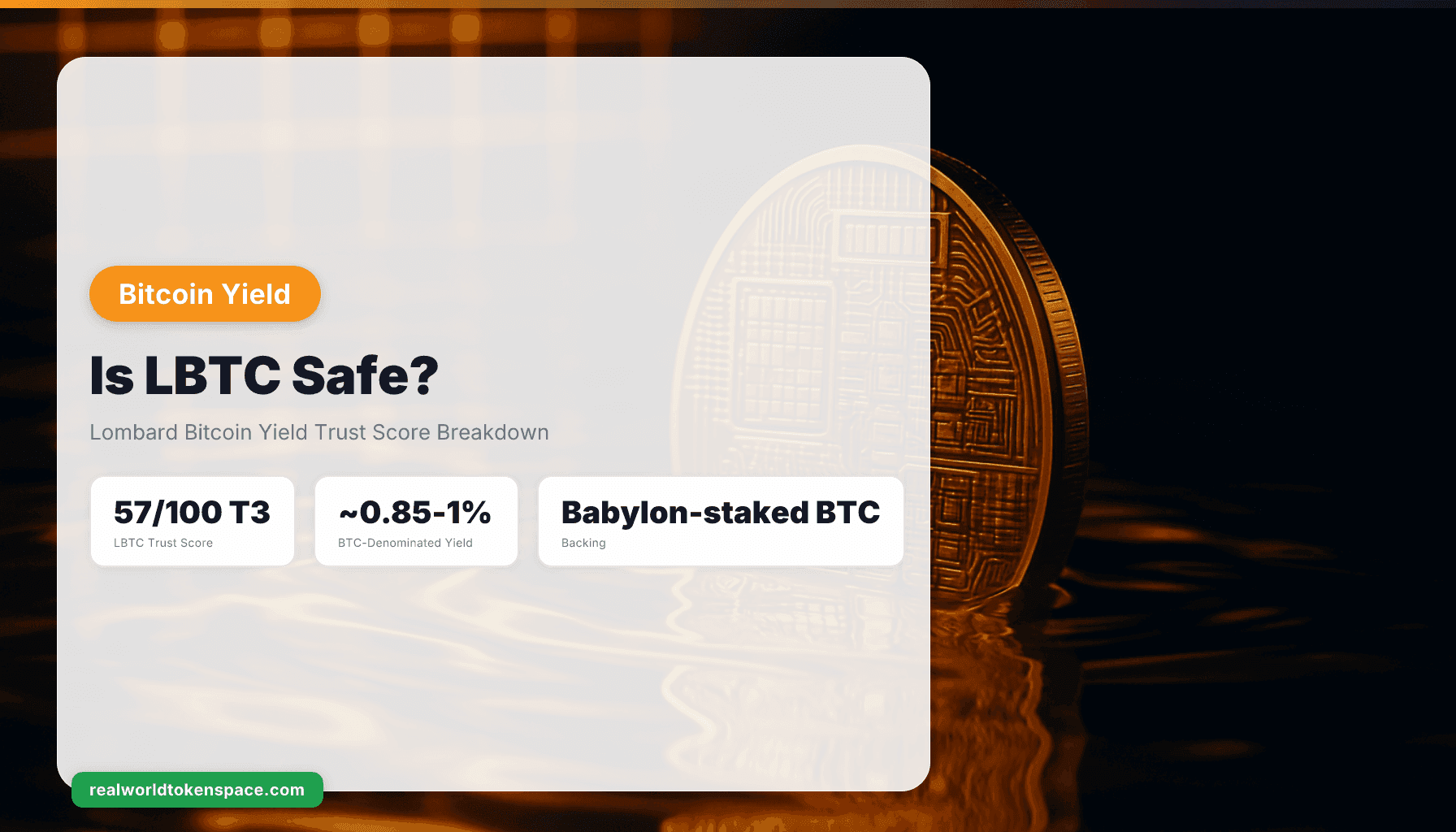
Is LBTC safe? The bitcoin behind it is there: on 20 November 2026 Lombard reported 6,372 BTC backing 6,333 LBTC, exactly what its exchange rate of 1.0060 BTC per token requires. What changed in 2026 is how it earns: since August a covered-call options strategy run by Bitwise has replaced Babylon staking, it is paying 0.98% against a 2.5% target, and it can lose bitcoin in a sharp rally.
This guide explains how LBTC works now, who holds the bitcoin, how you get out, what can go wrong, and how the RWTS Rating scores it. Every figure is dated.
How LBTC works now
LBTC is a receipt for bitcoin that earns in bitcoin. You deposit BTC with Lombard and receive LBTC on Ethereum, Base, Solana, Sui or another supported chain. Lombard says LBTC is not available to people located or resident in the United States or the United Kingdom (Lombard transparency). Your token count never changes. What changes is the exchange rate: each LBTC redeems for slightly more BTC as yield accrues. On 19 November that rate was 1.0060, so 1 LBTC redeemed for about 1.006 BTC, and the same figure is readable on-chain from the token contract's getRate function (Etherscan).
Until August 2026 the yield came from staking bitcoin through Babylon. Lombard's own explanation for leaving is blunt: bitcoin staking "has failed to develop" and its yield was near zero (Lombard FAQ). From the week of 17 August the yield source became a covered-call strategy managed by Bitwise Investment Manager, starting with a $10M pilot and scaling up from September (Lombard, 13 Aug 2026).
A covered call is simple to describe. Bitwise sells another party the right to buy bitcoin at a fixed price, usually 1.5 to 2 standard deviations above the market, by a fixed date, mostly six to eight weeks out. The buyer pays a premium up front. Every option is backed by bitcoin already held, settled in cash, with no borrowing. The premiums, minus a 20% fee on gains above a high-water mark, are added to the backing and lift the exchange rate (Lombard fees).
Two things set how much that earns. The first is how much of the backing is deployed: Lombard targets 50 to 60%, and on 20 November it was 45% (Lombard transparency). The second is how much buyers will pay for options, which tracks bitcoin's implied volatility. Lombard says premiums compress below about 30% implied volatility. Deribit's DVOL index, the market's standard gauge of it, was near 35 in mid-August and 46 on 19 November (Deribit), so the market has been paying more for options, not less.
The result so far is below target. Lombard's 30-day net APY was 0.98% on 20 November. Measured from the exchange rate, LBTC gained about 0.11% in BTC terms between 22 August (1.0049) and 20 November (1.0060), roughly 0.45% a year. Lombard says yield runs below 2.5% until deployment reaches scale (Understanding Yield).
What backs it and who holds it
Lombard splits the backing into two sleeves, published on its transparency page (20 November 2026, snapshot 08:04 UTC):
| Sleeve |
BTC |
Share of backing |
Held by |
Job |
| Active allocation |
2,864.71 |
45% |
Anchorage Digital Bank 1,259.80; Kraken Financial 702.69; 902.22 pending settlement |
Covered-call strategy |
| Buffer allocation |
3,506.81 |
55% |
Lombard Security Consortium |
Idle, pays redemptions |
| Total |
6,371.51 |
100% |
|
Backs 6,333.30 LBTC at 1.0060 |
The active sleeve sits in Lombard-owned, segregated, bankruptcy-remote accounts under tri-party agreements. Bitwise has trading authority only: it cannot withdraw, transfer or lend the bitcoin (Lombard FAQ; Kraken, on its custody role). Options trade over the counter with Kraken Institutional, Anchorage Digital Bank and FalconX. The buffer stays with Lombard's Security Consortium, where any critical action needs 10 of its 14 member institutions (consortium members).
Most of the bitcoin is held by institutions signing together; the rest is with two named custodians, plus coins in transit. Bitwise also publishes signed daily risk metrics: on 19 November the book had no leverage, held only net short calls and carried an average 5.1 weeks to maturity.
How you get out
There are two exits, and they behave differently under pressure.
- Redeem through Lombard. Burn LBTC in the Lombard app and receive native BTC within up to 10 days, for a fixed 0.0001 LBTC fee, at the current exchange rate. Redemptions are paid from the buffer first. If a wave of exits outgrew the buffer, Lombard says it would unwind active positions in an orderly way, which is what the 10-day window is for.
- Sell on a DEX. This is instant, at whatever price the pool gives. On 19 November the RWTS directory counted about $11.6M of LBTC liquidity across four pools, mostly LBTC against cbBTC and WBTC on Uniswap, down from $14.8M across six pools on 4 November (LBTC directory page).
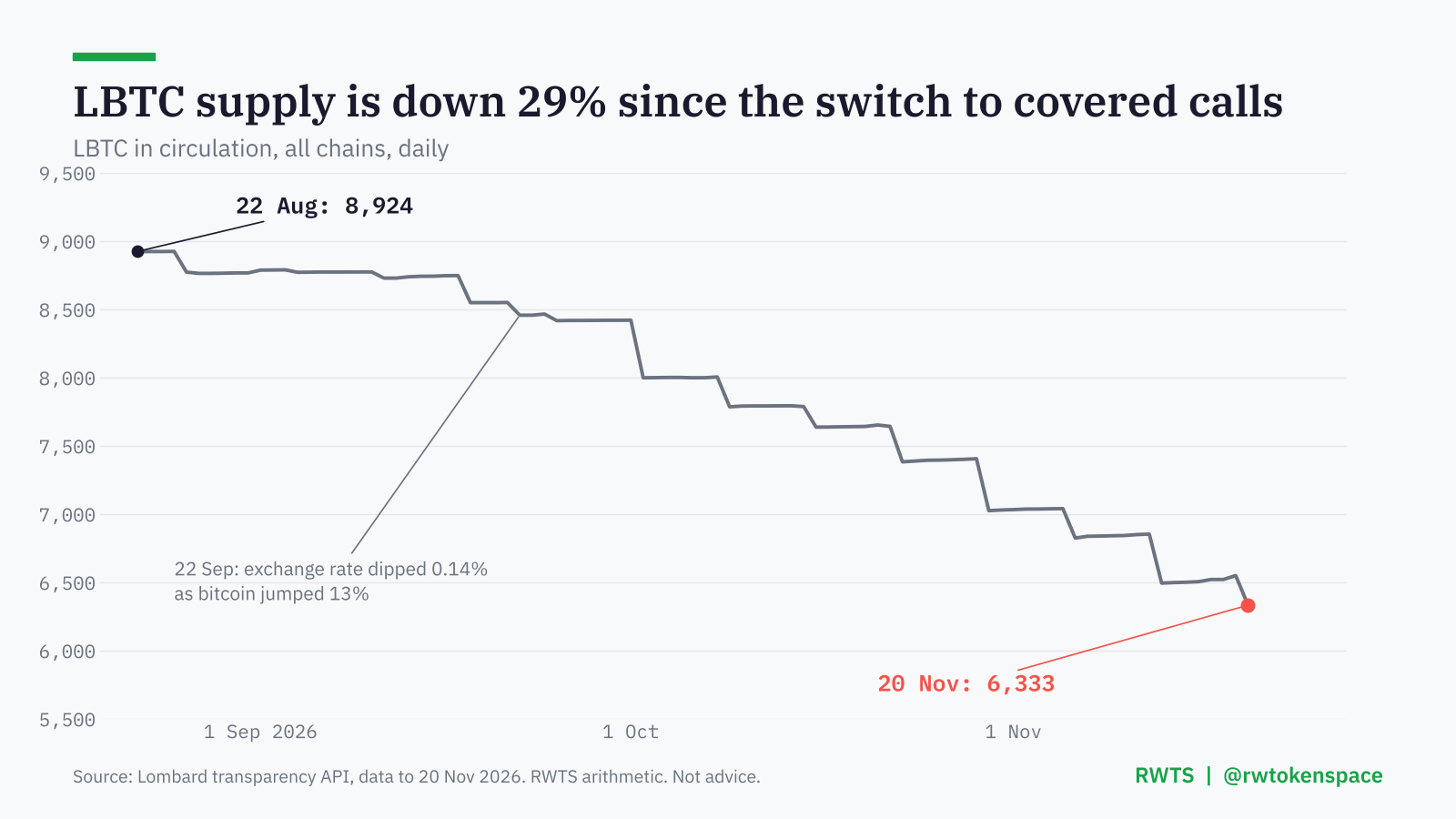
Holders have been using the first route. LBTC supply fell from 8,924 on 22 August to 6,333 on 20 November, down 29%, in steps that line up with Lombard's redemption cycle (Lombard transparency series). Every redemption was paid, and the exchange rate kept rising through the period.
What can go wrong
A fast bitcoin rally. This is the strategy's main risk, and it has already shown up once. Between 18 and 22 September 2026 LBTC's exchange rate fell from 1.00509 to 1.00367, about 0.14%, as bitcoin jumped about 13% in four days, from about $76,400 to $86,600, its highest level since at least late May (CoinGecko). The rate was back above 1.0050 by mid-October. Lombard's risk disclosure says losses in the active sleeve "could be substantial and could exceed the income the strategy has generated".
A falling bitcoin price. Covered calls do not protect the dollar value. LBTC's yield is measured in bitcoin, so when BTC fell from about $80,350 on 5 November to about $62,800 on 19 November (CoinGecko), LBTC's dollar value fell with it.
Counterparties and custodians. The options are bilateral contracts. A trading counterparty that failed, or a custodian outage, could cost the active sleeve money or time. The buffer shares none of that exposure.
The yield stays below target. If deployment stays short of 50%, or premiums thin out, the 2.5% target is not met. That is an income risk, not a backing risk.
Admin powers. The Ethereum contract can be upgraded, and its admin is a timelock with a 24-hour delay (read on-chain, 19 November). Separate roles can pause transfers, pause minting and burning, and switch BTC redemptions off through a toggleRedeemsForBtc function. On 19 November transfers were not paused and redemptions were on. RWTS could not confirm on-chain who holds the pause roles this run; the directory's source, a Yearn risk report, lists a 2-of-11 multisig.
What is gone: Babylon slashing and staking-reward risk. LBTC no longer depends on Babylon, and the dependency map no longer lists it there.
How RWTS scores LBTC
LBTC scores 59/100 (C, Tier 3) on its live directory page: backing 10/25, verification 12/20, redeemability 11/15, security 12/15, regulation 7/15, track record 7/10. That score was set on the Babylon model, and the page flags it as under review against the new structure.
The review has two sides. Points in LBTC's favour: 55% of the bitcoin now sits idle and earns nothing, which removes staking risk from most of the backing, and Lombard publishes daily custodian balances and signed risk metrics. Points against: 45% now carries options and counterparty risk, the strategy has about three months of history on LBTC, and it has already had one drawdown. Redeemability holds at 11 for now: the right still runs through Lombard (4 of 8), and the exit-route half (7 of 7) was last assessed on 1 September, before DEX liquidity thinned.
How LBTC compares
Scores from live RWTS directory pages, read 19 November 2026.
| Token |
Trust Score |
Yield source |
Exit by contract |
Main risk |
| LBTC |
59 (C, Tier 3) |
Covered calls on 45% of backing; 0.98% 30-day net |
Up to 10 days via Lombard |
Strategy loss in a rally; under review |
| FBTC |
56 (C, Tier 3) |
None |
KYC'd merchants only, not US persons |
Only approved merchants can redeem |
| SolvBTC |
49 (D, Tier 4) |
None on SolvBTC; yield via xSolvBTC |
Request, claim after about 7 days |
Stacked wrappers in reserves |
| stETH (ETH, for contrast) |
74 (B, Tier 3) |
Ethereum validator rewards |
Lido queue |
Contract and slashing risk |
stETH is there for contrast: Ethereum pays validators, Bitcoin does not, so every BTC yield comes from outside the chain. Our stETH breakdown covers that side. For who holds the coins behind WBTC, cbBTC, tBTC and FBTC, read the wrapped bitcoin comparison. Every rated BTC product is on the Bitcoin yield hub.
FAQ
Is LBTC safe to hold?
LBTC is fully backed: on 20 November 2026 Lombard reported 6,372 BTC behind 6,333 LBTC, matching its exchange rate of 1.0060 BTC per LBTC. It is not risk-free. Since August 2026 part of the backing runs a covered-call options strategy that can lose bitcoin in a sharp rally, redemption takes up to 10 days, and the token can be paused by admin roles. RWTS scores LBTC 59/100 (Tier 3), a score set on its earlier Babylon model and now under review.
Where does LBTC's yield come from now?
From a covered-call options strategy managed by Bitwise Investment Manager on the active part of LBTC's backing, which Lombard targets at 50 to 60% (45% on 20 November 2026). Buyers pay a premium for the right to buy bitcoin at a price well above the market. LBTC no longer earns Babylon staking rewards; that model ended in August 2026.
How long does it take to redeem LBTC for BTC?
Up to 10 days through the Lombard app, paid from the idle buffer first, for a fixed 0.0001 LBTC fee. You receive BTC at the current exchange rate, not one for one. Holders who need to leave faster sell on a DEX; on 19 November 2026 the RWTS directory counted about $11.6M of LBTC liquidity across four pools.
Why is LBTC's yield below its 2.5% target?
Lombard says the 2.5% is the expected net yield at full deployment, and deployment is still short of it: 45% of the backing was in the strategy on 20 November 2026 against a 50 to 60% target. Lombard's 30-day net APY was 0.98% that day. Option premiums also move with bitcoin's implied volatility.
Can LBTC holders lose bitcoin?
Yes, in BTC terms, through the strategy. If bitcoin rallies quickly through the strikes the strategy has sold, the options lose value. Between 18 and 22 September 2026, when bitcoin jumped about 13% in four days, LBTC's exchange rate fell about 0.14% before recovering by mid-October. Lombard says losses are confined to the active allocation, capped at 60% of backing.
Figures as of 20 November 2026 unless stated (Lombard figures; directory, DEX and contract reads 19 November); supply, yield and liquidity change daily. Not financial advice. We rate. You decide.