Bitcoin is the largest crypto asset, but most of its supply never touches the chains where lending, collateral, and yield actually happen. Bitcoin's market cap sits well above a trillion dollars, yet only a small slice of that supply moves through Ethereum, Solana, or any of the chains where lending, perps, and yield happen. Wrapped Bitcoin is how BTC gets there. Choosing a wrapper is, first and last, a custody decision. The yield comes later, and it always adds risk on top of the wrapper itself.
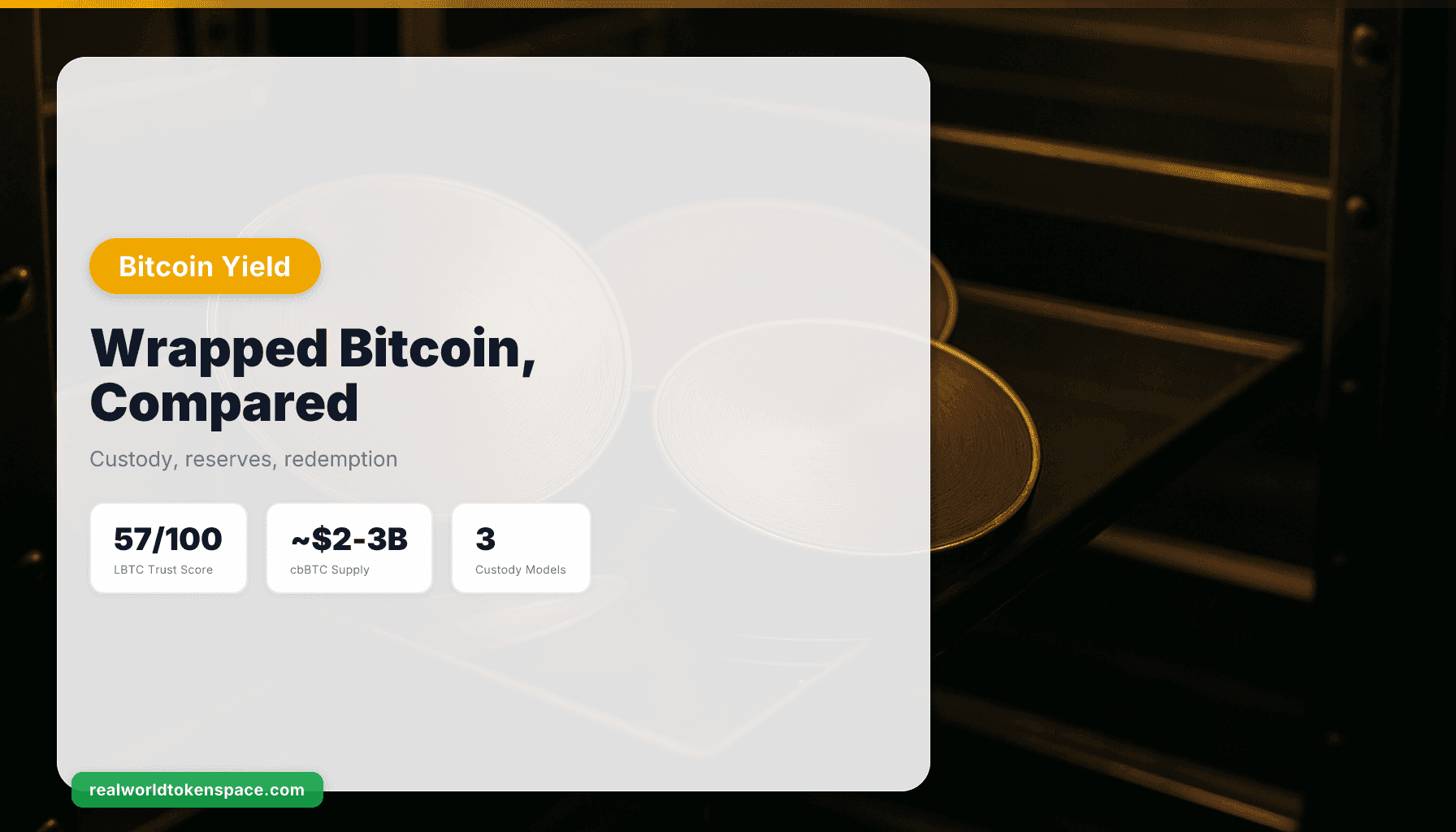
RWTS does not tell you to chase BTC yield or avoid it. We rate the structures and you decide. This is a custody-first comparison of three common ways to hold Bitcoin on-chain: wBTC, cbBTC, and LBTC. For the full scoring framework, see the Trust Score methodology.
Three custody models, three risk profiles
The headline distinction is who holds the keys and how reserves are proven.
wBTC is the incumbent. It carries the deepest liquidity of any wrapped Bitcoin and is integrated across nearly every major DeFi venue. For deepest liquidity today, wBTC still wins. Its history is not without friction: WBTC had served DeFi well, but its custodian transition in 2024 created enough governance noise that DeFi protocols, including Sky and Aave, paused or reconsidered exposure. Verification rests on attestations that link custodied BTC addresses to on-chain supply rather than a fully trustless proof.
cbBTC is Coinbase's wrapper, and it has become the default representation of Bitcoin on Base. Coinbase wrapped assets are tokens that are backed 1:1 and held by Coinbase. Coinbase customers can unwrap and redeem a corresponding amount of the underlying asset simply by depositing the wrapped asset into their Coinbase accounts. cbBTC grew quickly on Base, where it became the dominant BTC representation, and is integrated into Aave, Morpho, and Compound as collateral. The trade-off is that holders rely entirely on Coinbase as custodian, with no merchant federation or on-chain attestation beyond Coinbase's own reporting. Supply gives a sense of scale: per DeFiLlama, cbBTC supply sits in the roughly two to three billion USD range as of 2026, with Base and Ethereum holding most of the float and Solana growing. The concentration is the point to weigh, a single public exchange is both the custodian and the proof.
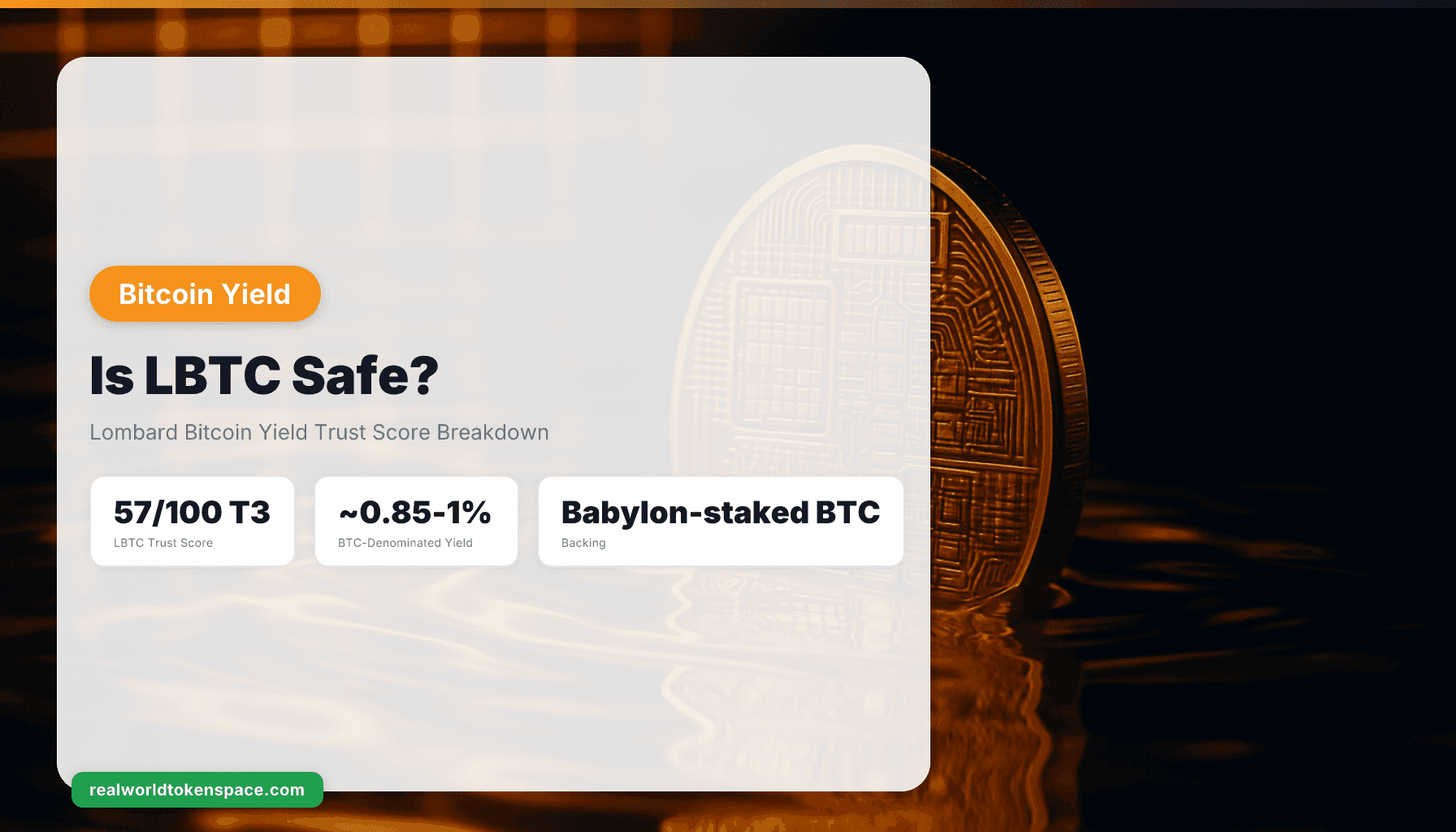
LBTC is a different animal. It is Lombard's liquid-staked Bitcoin, and it does not sit still. It routes Bitcoin into Babylon staking to generate yield, which means a holder is layering protocol, validator, and slashing-style considerations on top of the underlying custody. That extra machinery is reflected in its score: LBTC holds an RWTS Trust Score of 59/100 (T3). A plain wrapper and a yield-bearing staked wrapper are not the same risk, even though both say "BTC" on the label.
For comparison within the yield-bearing tier, SolvBTC (a structured Bitcoin yield product) scores lower at 49/100 (T4), reflecting additional complexity in how its backing is assembled.
The reserve question
Proof of reserves separates marketing from mechanism. cbBTC publishes a reserves page, and Coinbase has, at points, disclosed specific Bitcoin addresses to support it. Since cbBTC relies on Coinbase as the custodian of the underlying Bitcoin, users should be aware that this introduces custodial risk. Coinbase is a regulated entity with strong security practices, but this centralized custody model differs from Bitcoin's decentralized nature. Coinbase maintains transparency regarding the backing of cbBTC through regular attestations that verify the 1:1 backing of all cbBTC tokens with actual Bitcoin holdings.
The competitive frontier is moving toward on-chain proof rather than periodic attestation. Unlike cbBTC, Circle has stated reserves for its new cirBTC will be verifiable on-chain rather than only through periodic attestation. cirBTC will launch on Ethereum and Arc first, with additional chain support to follow subject to regulatory approval. Until those contracts ship and are audited, that is a stated direction, not a delivered feature, but it signals where the bar is heading.
How to choose
The practical institutional pattern is not to pick one and forget it. cbBTC concentrates exposure on a single public exchange. cirBTC concentrates exposure on a single stablecoin issuer. Diversification across both, alongside WBTC and tBTC, is the practical institutional pattern.
A simple decision frame:
- Need the deepest liquidity? wBTC remains the venue of record, with the caveat that its custodian history warrants ongoing attention.
- Building on Base or want a US-regulated exchange as custodian? cbBTC is the default, with concentration on Coinbase as the cost.
- Want yield, and willing to accept staking-layer risk? LBTC is the liquid-staked route: and at 59/100 (T3), its score tells you the extra machinery is real, not cosmetic.
Remember the core mechanism: a wrapper alone pays nothing. Yield arrives only when the token is supplied to lending markets, posted as collateral, or routed into staking. Each step adds a risk line item. For the broader picture of how Bitcoin yield products are scored, see our piece Is Bitcoin Yield Safe? Wrapped BTC Lending and the Trust Score, and the Bitcoin yield hub for every rated product.
Wrapped Bitcoin is plumbing, not magic. The label is the same; the custody, the proof, and the yield mechanism are not. We rate. You decide.
Related on RWTS
Stay Ahead of the Yield Curve
Subscribe to The Yield Report for weekly yield intelligence.
Subscribe Now