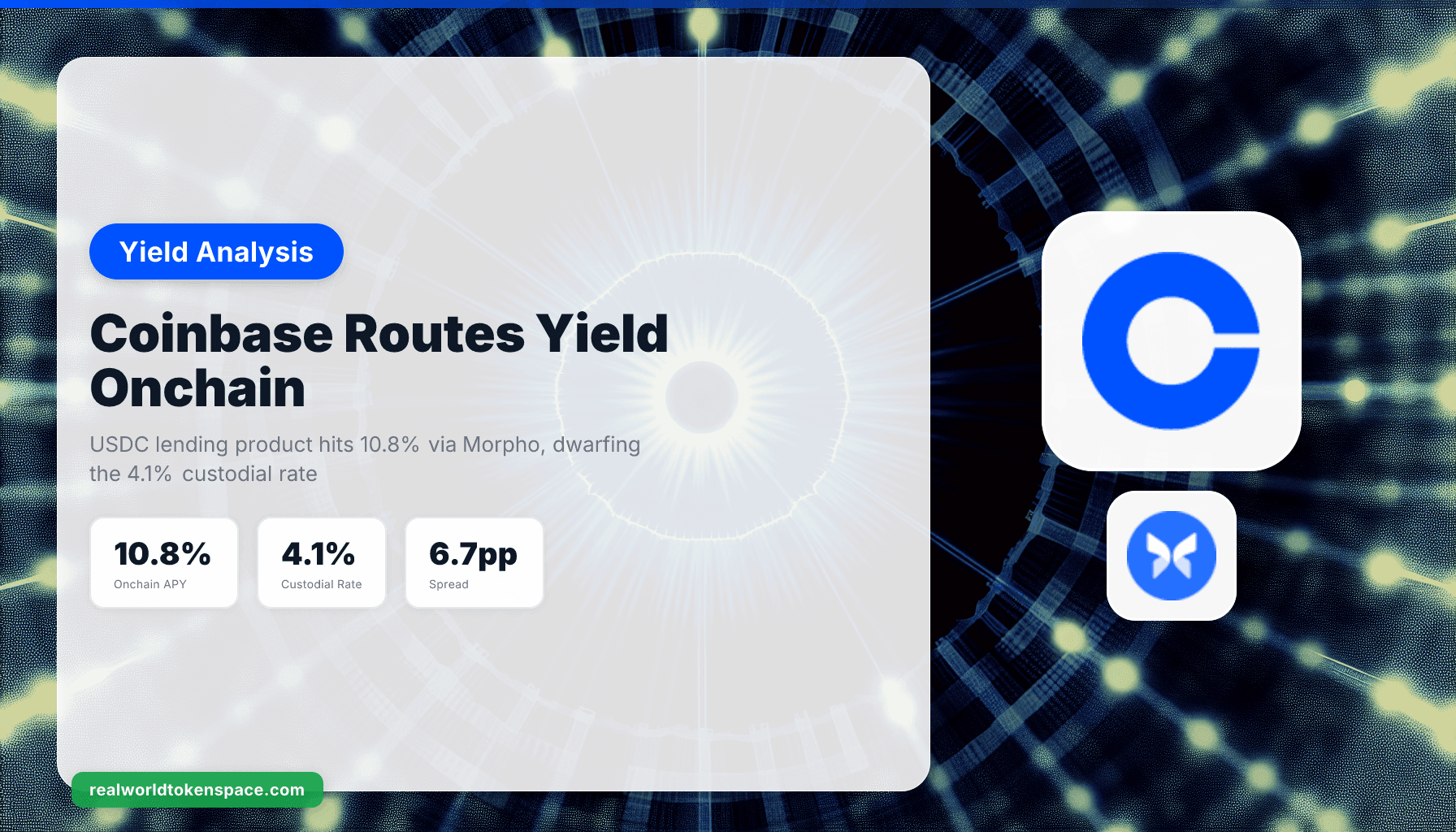
Coinbase has begun rolling out a new feature that lets retail users lend their USDC stablecoin holdings directly onchain, with current yields reaching up to 10.8%. Per The Block's reporting, the product routes user deposits through Morpho lending vaults on Base, Coinbase's own L2, where the USDC is matched against borrowers paying variable rates against ETH and BTC collateral. The feature is materially different from Coinbase's long-running custodial USDC reward program, which currently pays around 4.1% APY and 4.5% APY for Coinbase One members per Coinbase's USDC product page.
The 6.7-percentage-point spread between the two products is not a marketing trick. It is the entire bull case for why centralized exchanges are starting to act as front-ends for DeFi rather than walled gardens, and why the next phase of stablecoin yield competition will not be fought between Coinbase and Kraken but between custodial yield and curated onchain yield.
How the Pipeline Actually Works
The mechanics are worth walking through, because they explain both the higher yield and the structurally different risk profile. When a user opts into onchain lending, the USDC moves from Coinbase's custodial balance sheet into a Morpho vault on Base. The vault is curated, meaning a third party (in this case primarily Steakhouse Financial and Gauntlet for the initial set of vaults) sets the loan-to-value caps, oracle sources, and which markets the USDC can be lent into.
The borrowers on the other side of the trade are mostly DeFi-native: leveraged longs on cbBTC and cbETH, basis traders on Pendle PT collateral, and looped positions in tokenized Treasury wrappers. Those borrowers pay variable rates that move with utilization. When demand for USDC borrow is high, lenders earn more. The 10.8% headline number reflects current utilization across the curated vault set, not a guaranteed rate.
The custodial 4.1% product, by contrast, is essentially Coinbase paying a flat rebate from its own treasury operations, which themselves are largely backed by Circle's USDC reserve interest pass-through. Circle currently passes through roughly the federal funds rate minus operating costs, which lands the gross pool somewhere in the high 3s to low 4s.
In other words, Coinbase has stopped competing with Circle on the custodial product and started routing customers to a fundamentally different yield source. The 10.8% is not Coinbase's money. It is the borrowers' money.
Why This Is Bigger Than It Looks
Three structural shifts are buried in the launch.
First, regulatory framing. The SEC's 2023 enforcement actions against centralized lending products (Gemini Earn, BlockFi, Celsius) effectively killed the U.S. CeFi yield category for retail. Coinbase's onchain product is not Coinbase taking custody of USDC and lending it out. The user retains a nonsovereign claim against an onchain smart contract, with Coinbase acting as a routing front-end. That is materially closer to a brokerage offering DeFi access than to a CeFi lender. Whether the SEC agrees is the open question, but the structure has been deliberately built to look more like a self-directed brokerage than the 2022-era yield products.
Second, distribution economics. Coinbase has roughly 8 to 9 million monthly transacting users in 2026, an order of magnitude larger than any DeFi front-end. Routing even 10% of idle USDC through Morpho vaults could move billions of dollars onchain in a quarter. Morpho has already crossed $5.8 billion in TVL across its curated vault set per DefiPrime's vault guide, and Coinbase rails could plausibly double that over 2026 if adoption ramps as expected.
Third, yield competitive pressure on tokenized Treasuries. A Coinbase user can now choose between USDC at 4.1% custodial, USDY at 4.7% via secondary markets, BUIDL at 4.5% institutional, or onchain Morpho-routed USDC at up to 10.8%. The tokenized Treasury thesis was always that the user wanted Treasury-grade reserve quality with stablecoin convenience. Onchain lending breaks that thesis for the cohort that does want yield and is willing to accept smart-contract and credit risk to get it.
The Risks Retail Users Should Actually Understand
The 10.8% is genuine, but it is not free. Three risks are layered into the product that the 4.1% custodial rate does not carry.
Smart contract risk: Morpho's core lending contracts have been audited extensively and have an excellent operating record, but they are still smart contracts. A bug, oracle exploit, or governance attack on a vault parameter could result in losses that the custodial product cannot suffer.
Curator risk: Each curated vault sets its own LTV ratios, accepted collateral, and liquidation parameters. Steakhouse and Gauntlet are reputable, but a poorly parameterized vault could take losses if the underlying collateral asset (say, a tokenized credit product) goes bad. Users who do not know what their vault holds are not really earning 10.8% safely.
Variable rate risk: 10.8% is today's number. If borrow utilization drops, so does the rate. There is no contractual minimum, and historically Morpho USDC vault yields have ranged from 3% to 12% across cycles.
For a financially literate user routing 10% of idle balance into the product, the risk-adjusted math is favorable. For a retail user who reads "10.8%" and assumes it is a savings account, the gap between marketing and mechanics is the consumer-protection question regulators will be watching closely.
RWTS Trust Score: Tier 2 Routing, Tier 1 Underlying USDC
The Coinbase onchain USDC product carries a split rating on RWTS Trust Score. The underlying USDC remains Tier 1, with Circle's reserves attested monthly and held in cash and short-duration Treasuries at BNY Mellon and Customers Bank. Coinbase as a routing front-end is a regulated U.S. entity with strong custody infrastructure.
The yield-generating layer (Morpho vaults plus curators) is Tier 2. The protocol has matured significantly since 2024 and operates with bankruptcy-remote vault structures, but the smart contract risk and curator parameterization risk are real and not eliminated by Coinbase's routing role. Users should treat this as a DeFi position behind a familiar interface, not as a higher-yield savings account.
What to Watch in Q2 and Q3 2026
Two questions will define how this plays out. The first is whether Kraken, Binance, OKX, and other major exchanges launch comparable onchain routing products. Kraken's current 1.75% to 3.75% custodial USDC rate is now visibly uncompetitive against Coinbase's onchain 10.8%, and the Kraken+ tier in particular needs a response or it will lose yield-seeking deposits. Per Kraken's blog, the platform has been investing in stablecoin yield products throughout 2026, but has not yet deployed an onchain routing equivalent.
The second is regulatory. The SEC under the current commission has signaled a more permissive stance toward self-directed onchain access via regulated front-ends, but the Coinbase product is the first major U.S. retail launch to test that line in earnest. If the structure holds up under scrutiny, expect a wave of follow-on products from Robinhood, eToro, and the larger neobanks. If it does not, the entire category gets repriced.
Either way, the 4.1% custodial USDC reward is now a floor, not a ceiling. The yield wars have moved onchain.
Related research
For the cross-protocol comparison the 10.8% number lives inside, see the best USDC yield 2026 ranking and the 2026 stablecoin yield comparison. For the Aave USDC market freeze that reshaped the same week's lending picture, see the Aave frozen pool analysis. The RWTS Trust Score methodology is on the RWTS Rating page.
Sources: