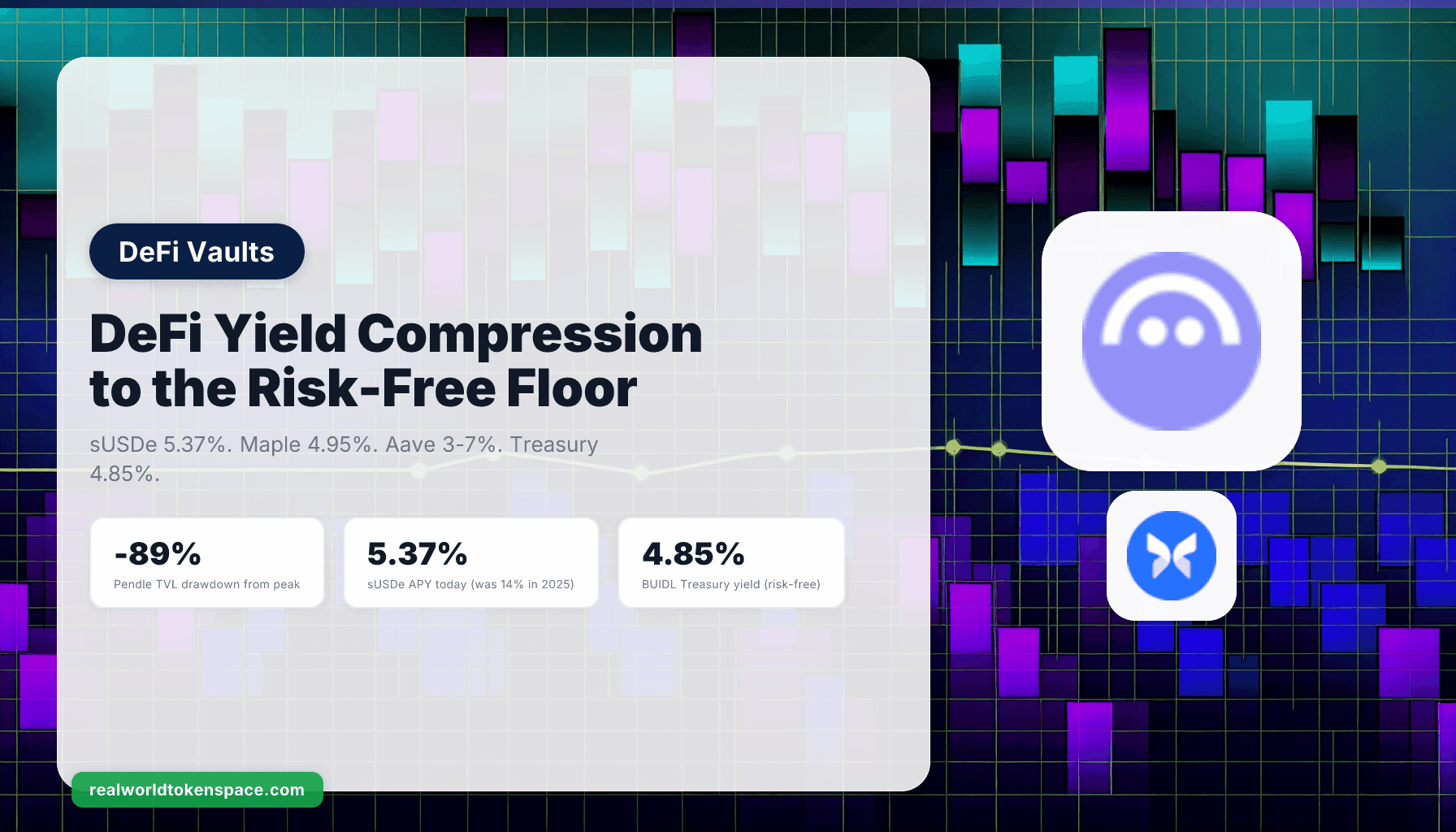
The map of DeFi stablecoin yields in early May 2026 has a feature that did not exist twelve months ago: the floor and the ceiling are almost the same number. sUSDe sits at 5.37% with a 30-day average of 4.06% (down from 14% in 2025). Maple's syrupUSDC pool prints 4.95% with a 30-day average of 4.53%. Aave V3's USDC supply rate runs 3% to 7% depending on utilization. BUIDL distributes approximately 4.85%, the risk-free Treasury rate. Pendle's TVL has compressed from a September 2025 peak of $13.1 billion to roughly $1.5 billion as of late April, an 89% drawdown that captures the rotation in one number.
The story behind these numbers is not that DeFi yield is dying. It is that the marginal borrower disappeared, and when the marginal borrower disappears, supply APY converges with the risk-free rate.
The Mechanism: What Pays The Yield
Stablecoin yield in DeFi has always been borrower-funded. Lenders supply USDC to a market. Borrowers post collateral and pay an interest rate to draw USDC against it. The protocol takes a slice and passes the rest through to lenders. The supply APY is the borrow APY times utilization, minus the protocol take. There is no other source of stablecoin yield in this structure.
That structural fact has one consequence allocators forget: stablecoin yield in DeFi is a function of how much leverage there is in the system. When crypto leverage expands (perpetual basis is positive, looping strategies are profitable, leveraged longs are paying to be long), borrow demand for stablecoins expands and yields rise. When crypto leverage contracts (basis flat or negative, looping unprofitable, leveraged longs unwinding), borrow demand contracts and yields compress.
In 2025, the leverage cycle was expansionary. Funding rates ran consistently positive. Pendle's PT-sUSDe and other yield-tokenized assets were profitable to lever. Looping strategies on Morpho and Aave were generating spreads that justified pulling in fresh supply. sUSDe was clearing 14% APY because the Ethena basis trade was capturing both staked ETH yield and a strongly positive perpetual funding component, and because the leveraged demand for sUSDe pulled fresh capital into the strategy.
By early May 2026, that cycle reversed. Ethena's USDe redemptions hit $1.6 billion through April. Pendle's TVL collapsed by 89% from peak. sUSDe yield compressed to 5.37%. The lever, in one sentence, is that crypto leverage unwound across the cycle, the marginal borrower disappeared, and the entire stablecoin yield curve in DeFi compressed toward the risk-free Treasury rate.
The Cross-Protocol Picture, In Numbers
A snapshot of the major USD-stablecoin yield pools as of early May 2026:
Aave V3 USDC supply rate runs 3% to 7% APY, with the actual rate at any moment a function of utilization in the relevant market. The May 2026 PT-USDe and PT-sUSDe collateral onboarding (Aave Proposal 442) added a marginal new borrowing channel, but the aggregate USDC borrow demand on Aave is materially below 2025 peaks. Aave's structure is the cleanest read on pure DeFi borrow demand because the protocol is the largest and the rate-setting mechanism is transparent.
Maple's syrupUSDC pool sits at 4.95% APY with a 30-day average of 4.53% and approximately $2.67 billion in TVL. Maple's yield comes from over-collateralized institutional credit lines rather than retail leverage, which is why its yield held up better through the leverage unwind. The structural floor for Maple's yield is wherever institutional credit demand sits, and that floor is currently a few basis points above the risk-free rate. The integration of syrupUSDC onto Morpho (now live, curated by Gauntlet and MEV Capital) preserved the product's distribution but did not change its underlying yield mechanics.
Ethena's sUSDe sits at 5.37% APY with a 30-day average of 4.06% and approximately $2.14 billion in TVL. The variance is the story here. The product was paying double-digit APY through 2025 because the perpetual funding component of the basis trade was strongly positive. With funding compressed in early 2026, the basis trade clears closer to the staked ETH component alone, and the headline APY converged with the underlying staking yield plus a small basis premium.
Morpho's curated vault TVL sits at approximately $5.8 billion against total protocol TVL of roughly $7.2 billion as of early May. The vault APY ranges depending on the curator and the underlying market, but the median curated USDC vault is paying inside the same band as Aave: 3% to 6% APY with periodic spikes when a specific market goes high-utilization.
Pendle's TVL has compressed from $13.1 billion at September 2025 peak to $1.5 billion as of late April 2026, an 89% drawdown. The protocol's PT and YT structure depends on a forward yield curve that traders are willing to pay to speculate on. With sUSDe yield compression, the forward curve flattened, and the speculative demand for yield tokenization collapsed. Pendle is reorganizing its tokenomics around its sPENDLE buyback model and vePendle revenue capture, which is the right defensive response to a TVL drawdown of that size, but the recovery will track whatever the next leverage cycle looks like.
What This Means On The Risk-Adjusted Frame
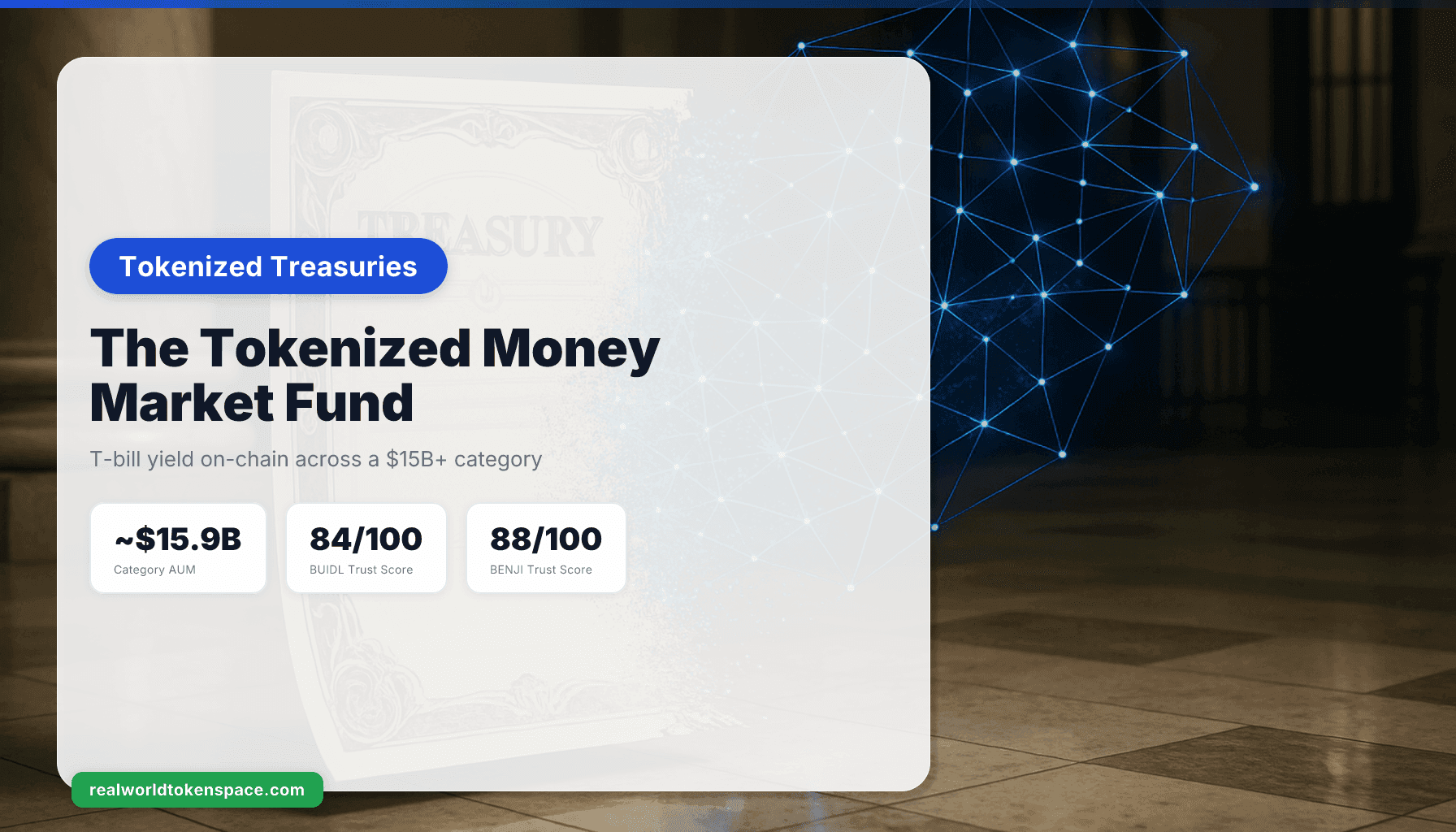
The risk-free benchmark for stablecoin allocators is BUIDL at 4.85% (the BlackRock tokenized Treasury fund yields the actual short-duration Treasury bill rate, minus the management fee). Tokenized Treasury supply just crossed $15.07 billion across all chains, with Circle's USYC at $2.9 billion and BlackRock's BUIDL at $2.58 billion as the supply leaders. USDY at 4.80% and OUSG at the same range round out the institutional-grade cohort.
When DeFi stablecoin yields are 4.95% (Maple), 5.37% (sUSDe), or 3% to 7% (Aave) against a risk-free benchmark of 4.85%, the implicit risk premium for DeFi exposure has compressed to a fraction of a percent. That premium is doing the same work it always did (paying allocators for smart contract risk, oracle risk, liquidation risk, and protocol governance risk), but the per-basis-point compensation for taking those risks is the lowest it has been in the cycle.
The RWTS Trust Score view on the cohort gives allocators a way to read this. BUIDL at 88 is the highest-quality risk-free baseline. USDY at 83 is retail-accessible Treasury exposure at the same yield level. syrupUSDC at 78 (Tier 3) is a step up in risk for a small premium on the 30-day average. sUSDe at 74 (Tier 3) is the highest-variance product in the cohort and the one most exposed to the funding-rate cycle reversing again.
If a USDC allocator's choice in early May 2026 is between Maple's syrupUSDC at 4.95% (Trust Score 78) and BUIDL at 4.85% (Trust Score 88), the risk-adjusted answer is that the 10-basis-point premium on syrupUSDC is barely paying for the structural step down in operational quality. The allocator who picks BUIDL is not giving up meaningful yield. The allocator who picks syrupUSDC is taking the institutional credit risk for a margin that has compressed to the noise floor.
The Conditional Frame
If Fed funds stay at 3.50% to 3.75% through the next FOMC and oil prices remain elevated (Brent above $90 sustainably), the risk-free Treasury rate stays in the 4.7% to 4.9% range and the DeFi yield compression we are reading today is the durable picture. If the Fed cuts in June or July as Stephen Miran's dissent at the April meeting suggested, the risk-free rate compresses further and DeFi yields compress with it. The marginal lender pulls capital out at every step down, and the equilibrium TVL for stablecoin DeFi shrinks accordingly.
If, on the other hand, crypto leverage rebuilds (perpetual funding turns strongly positive again, Pendle TVL recovers, looping strategies become profitable), the marginal borrower returns and the yield curve steepens. That is a real scenario, but the precondition is a cycle in crypto risk appetite that we cannot forecast and would not want to.
What Allocators Should Do Now
The practical takeaway is that the risk-adjusted case for tokenized treasuries over DeFi stablecoin yield is the strongest it has been in the cycle. The DeFi premium has compressed to a level that does not compensate cleanly for the additional operational risk on most allocator profiles. Three actions worth considering:
Allocators with material DeFi stablecoin exposure should consider rotating a portion to tokenized treasuries (BUIDL if qualified, USDY if retail) to lock in the risk-free rate without paying the operational premium. The tradeoff is liquidity and composability, both of which favor staying in DeFi for active strategies. For passive yield, the case is weak.
Allocators staying in DeFi stablecoin yield should look at the 30-day APY rather than the headline rate. The sUSDe 30-day average is 4.06% versus a headline of 5.37%. The Maple 30-day average is 4.53% versus a headline of 4.95%. The headline overstates the realized yield because of the recent volatility in both products.
Allocators considering Pendle as a way to lock in fixed yield should be aware that the structural drawdown in the protocol's TVL changes the liquidity profile of the PT secondary markets. The fixed-yield product is still useful for hedging, but the size that can be put on without market impact has shrunk roughly in proportion to the TVL.
The Bottom Line
DeFi stablecoin yield converged with the risk-free Treasury rate because the marginal borrower disappeared, and the marginal borrower disappeared because the leverage cycle reversed. The mechanism is durable as long as crypto leverage stays compressed. The recovery requires a leverage cycle we cannot forecast.
In the meantime, the risk-adjusted case for tokenized treasuries is the strongest it has been in the cycle. RWTS isn't bullish or bearish on any of these protocols. We rate. You decide. The current rates are what they are.
Not financial advice.
Related research