For instance, on Aave suppliers provide liquidity, borrowers access liquidity by providing overcollateralized positions, and interest rates adjust with supply and demand.
The highest Wrapped Bitcoin lending rate is 6.25% APY on Nexo. WBTC staking rewards reach 6.25% APY on Nexo. DeFi lending markets like Aave offer lower but more transparent rates. Borrow against WBTC from 0.64% APR on Aave.
The yield comes from borrower demand. When traders want to long ETH against BTC collateral or market makers need short-term WBTC liquidity, they pay interest. When demand drops, so does the yield. Unlike Ethereum staking, which has a baseline validator reward, Bitcoin lending yield is entirely market-driven.
Wrapped Bitcoin Tokens: WBTC, cbBTC, tBTC
WBTC remains the largest wrapped Bitcoin token by market cap, with over 125,000 BTC wrapped as of early 2026. Each WBTC is backed 1:1 by Bitcoin held by custodians (primarily BitGo).
Coinbase's wrapped Bitcoin offering has grown rapidly, now holding approximately 73,000 BTC (around $6 billion). cbBTC offers similar functionality to WBTC but with Coinbase as the custodian, which some users prefer due to the exchange's regulatory compliance and institutional reputation.
The main difference: WBTC just "moves" BTC onto other chains—no yield, no rewards. LBTC generates real staking rewards, so 1 LBTC can be worth more than 1 BTC (principal plus earned interest).
For lending purposes, WBTC and cbBTC function identically. You deposit the wrapped token into Aave, Morpho, or Compound, and borrowers pay you interest. The custodian holds your underlying BTC. You trust the wrapper's solvency and the lending protocol's smart contracts.
The risk is not only borrower demand. A lending position can face smart contract risk, oracle risk, liquidation design risk, utilization spikes, withdrawal constraints, and wrapped-asset risk. If the supplied BTC is WBTC, cbBTC, or another representation, the user also depends on the wrapper or bridge.
Bitcoin Staking via Babylon: Earning Yield on Native BTC
Babylon's native staking keeps your BTC on the Bitcoin network without any wrapping or bridging. You maintain complete control while earning yield. Lombard's LBTC or similar liquid staking tokens let you earn Babylon staking rewards while still using your position in DeFi protocols.
Babylon is a protocol that lets Bitcoin secure proof-of-stake blockchains. Instead of staking ETH to validate Ethereum or SOL to validate Solana, you stake BTC to validate other networks. The BTC is time-locked on the Bitcoin blockchain through a cryptographic commitment. If the validator misbehaves, the staked BTC can be slashed.
Unlike traditional "wrapped" Bitcoin, which simply moves BTC across chains, Lombard actually stakes the underlying Bitcoin using the Babylon protocol. This approach earns a genuine staking yield, which is reflected in LBTC's value. By early 2026, Lombard has become a key player in Bitcoin Liquid Staking (LiST), with billions in TVL and partnerships with more than 70 major DeFi protocols—including Aave and Morpho.
In its announcement, Lombard said it represents the "fastest-growing yield-bearing token" in crypto, with LBTC reaching over $1 billion TVL in 92 days. The token currently has a total value locked of over $1.5 billion, according to DeFiLlama.
When you deposit BTC, it's secured in a vault and staked via Babylon. In return, you get LBTC (on Ethereum, Solana, or other networks), fully backed 1:1 by your Bitcoin plus staking rewards.
Lombard LBTC: The Liquid Wrapper
LBTC represents BTC staked on Babylon through Lombard, is backed by native BTC, and can be used across multiple chains as collateral, trading liquidity, or DeFi capital. Lombard's user documentation also makes the exit trade-off clear: withdrawing BTC can take about 9 days because of Babylon's unbonding period and Lombard's rebalancing cycle.
Lombard's LBTC generates yield from Babylon's Bitcoin Staking Protocol, another Binance venture bet focused on Bitcoin staking, with LBTC representing Babylon-stake Bitcoin.
This model improves capital efficiency. A user can earn staking-linked rewards while still using a BTC-backed token in DeFi. The risk is layered. The user now depends on Babylon, Lombard, the token contract, supported chains, bridges, oracles, and exit liquidity.
Lombard's operation revolves around the Security Consortium, a decentralized body that mints and redeems LBTC. This Consortium includes top institutional nodes like Galaxy, Wintermute, and OKX, preventing any single entity from controlling staked Bitcoin.
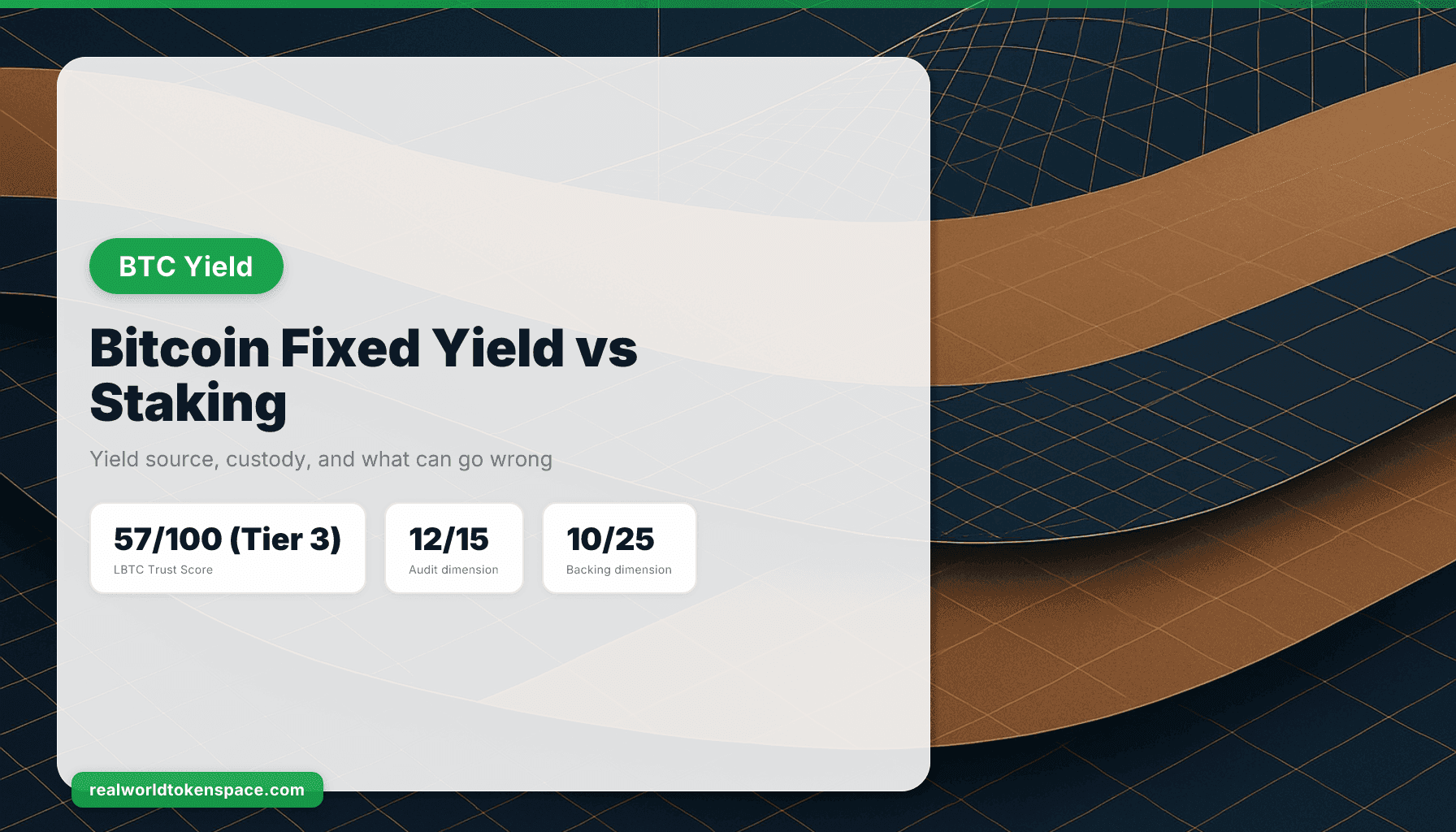
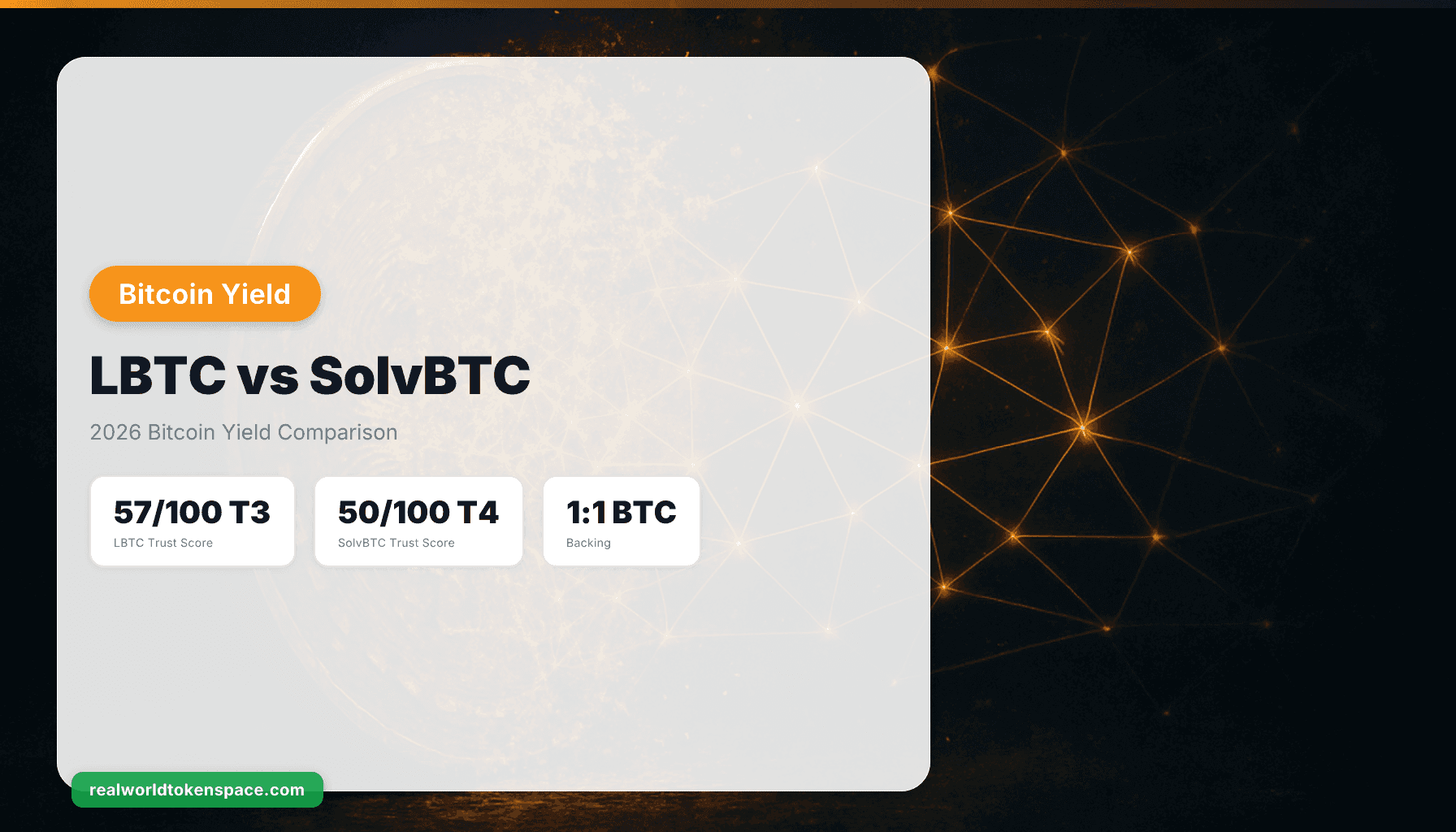
RealWorldTokenSpace rates LBTC at 82 Trust Score, Tier 2. The rating reflects the protocol's multi-layer dependency: Babylon's novel staking mechanism, Lombard's vault custody, and cross-chain bridge risk. For comparison, WBTC scores 84, Tier 2, and cbBTC scores 85, Tier 2. The Trust Score methodology penalizes additional smart contract layers and newer protocols.
See the full RWTS Methodology breakdown for how we weight custody, bridge risk, and operational history.
Wrapped BTC Strategies: Lending, Collateral, and Vaults
Wrapped BTC strategies use tokenized BTC inside DeFi. WBTC, cbBTC, tBTC, rBTC, and sBTC let Bitcoin exposure move into smart contract ecosystems. The user can lend wrapped BTC, borrow stablecoins against it, provide liquidity, use it as collateral, or enter vaults.
The simplest strategy: deposit WBTC into Aave, earn the supply APY. Best Wrapped Bitcoin (WBTC) lending options compared: Highest Rate: Nexo offers 6.25% APY. Maximum yield currently available. Best DeFi Option: Aave offers 0.03% APY. Non-custodial, no counterparty risk.
The trade-off is clear: centralized platforms pay higher rates but require custody. DeFi platforms pay lower rates but let you control your keys. The yield difference reflects the custodial premium.
More complex strategies involve looping: supply WBTC as collateral, borrow USDC against it, buy more WBTC, repeat. This amplifies exposure and yield but introduces liquidation risk. If BTC price drops, the loan-to-value ratio rises, and the position can be liquidated.
Users should start with the BTC path. Native BTC in a wallet, wrapped BTC on Ethereum, BTC staked through Babylon, LBTC on an EVM chain, and SolvBTC inside a strategy are not the same risk. Next comes the yield source. Lending interest, staking rewards, token incentives, funding-rate capture, and vault strategies all behave differently.
Comparing Yields: LBTC Staking vs WBTC Lending
Bitcoin's liquid staking market is around $2.5 billion, still early-stage. Ethereum's liquid staking leads with about $38 billion locked. Approximated Bitcoin staking ratio: 0.29%, or about 58.5K BTC staked.
Estimates suggest the BTC staking market may approach $6.5–$7 billion, depending on valuation methods.
LBTC staking through Babylon typically yields around 1% APY in BABY tokens (Babylon's governance token) plus potential appreciation if LBTC trades above its BTC-denominated NAV. WBTC lending on Nexo yields up to 6.25% APY but requires trusting a centralized custodian. WBTC lending on Aave yields 0.03% APY but is non-custodial.
The right choice depends on your risk tolerance and liquidity needs. If you want to hold BTC long-term and earn a small yield while maintaining self-custody, LBTC through Babylon makes sense. If you're comfortable with centralized custody and want higher rates, Nexo or similar platforms work. If you want to keep BTC in DeFi and don't care about low yields, Aave is the safest decentralized option.
Then comes exit timing. A yield product with a 9-day withdrawal process, redemption batching, or thin secondary markets should not be compared with liquid spot BTC.
Bitcoin Yield Risks: What Can Go Wrong
Lombard is designed for maximum security—but all DeFi carries some risks: Smart Contract Risk: Lombard relies on complex code. Even with multiple audits (by OpenZeppelin and others), bugs or vulnerabilities can't be ruled out entirely. Slashing Risk: Your staked BTC helps secure other networks—if their validators act maliciously, "slashing" can happen. Lombard reduces this risk by picking trusted validator sets. Liquidity Risk: During major market turbulence, the 1:1 peg between LBTC and BTC might wobble, but arbitrage traders usually restore balance quickly.
For WBTC lending, the risks are different: custodial failure (BitGo or Coinbase becomes insolvent), smart contract exploit in Aave or Morpho, and utilization lock (if 100% of the lending pool is borrowed, you can't withdraw until someone repays).
Finally, users should size exposure carefully. Long-term cold-storage BTC and active yield BTC should be separate buckets.
How to Access Bitcoin Yield: Step-by-Step
For WBTC lending on Aave:
- Convert BTC to WBTC via a bridge or exchange
- Connect your wallet to Aave on Ethereum or a supported L2
- Supply WBTC to the lending pool
- Earn variable APY paid in WBTC
- Withdraw anytime, subject to pool utilization
For LBTC staking via Lombard:
- Visit Lombard Finance and connect your wallet
- Deposit BTC (Lombard handles the Babylon staking)
- Receive LBTC at a 1:1 ratio (minus a small fee)
- Hold LBTC to earn staking yield, or use it as collateral in DeFi
- Redeem LBTC for BTC (9-day unbonding period)
Both paths are accessible to retail users, but the learning curve differs. WBTC lending is simpler if you're already familiar with Aave. LBTC staking is newer and requires understanding Babylon's mechanics.
For more on Bitcoin yield strategies and how they compare to Ethereum staking, visit the BTC Yield hub. For broader DeFi vault strategies, see our coverage of Morpho USDC vaults and Aave collateral options.
RWTS doesn't recommend one strategy over another. We rate the underlying protocols and tokens. You decide which yield path fits your risk budget and liquidity needs.