XRP has no native staking, so most XRP yield is lending risk in disguise. How to earn yield on XRP through fixed-term returns funded by metals arbitrage, not lending. We rate. You decide.
Verdict: If you want to earn yield on XRP, start with one uncomfortable fact: XRP has no native staking, so almost every XRP yield offer is lending your tokens to someone else and calling it something nicer. The alternative we rate highest routes through Kinesis Earn, where the eligible assets KAU (gold) and KAG (silver) both score 90/100 (Tier 1) on the RWTS Trust Score, and the returns are funded primarily by physical bullion arbitrage rather than by lending your holdings. Capital is at risk, terms lock, and the headline rate is time-bounded. We rate. You decide.
Why XRP yield is usually lending in disguise
The XRP Ledger settles payments. It does not use proof-of-stake, so there is no protocol-level reward for holding XRP the way there is for staking ETH or SOL. That single fact reframes every XRP yield product you will see.
If a platform pays you to hold XRP, the money has to come from somewhere. In nearly every case, it comes from lending your XRP to a trading desk, a market maker, or another borrower. That is counterparty risk. If the borrower defaults, your yield and potentially your principal are exposed. Several high-profile collapses in the last cycle were, at their core, XRP and stablecoin lending programs that ran out of borrowers who could pay back.
Free guide
Reading this far? Get the Top 10 in your inbox.
One weekly email with the updated Trust Score leaderboard, the biggest moves, and a deeper dive on one asset. Independent ratings only — no sponsored content.
One email a week. Unsubscribe anytime. We never sell your email.
So the honest question is not "what is the APY" but "who is borrowing my XRP, and what happens if they cannot repay." A rate quoted without that answer is a rate you cannot assess.
Frame it against the alternatives. A bank savings account pays roughly 0.5%. XRP sitting in a wallet or on an exchange pays 0%. A lending program might pay more, but the extra return is compensation for lending risk you may not want to take. The goal of this article is a fourth option: yield that does not lend your assets at all.
The Trust Score, dimension by dimension
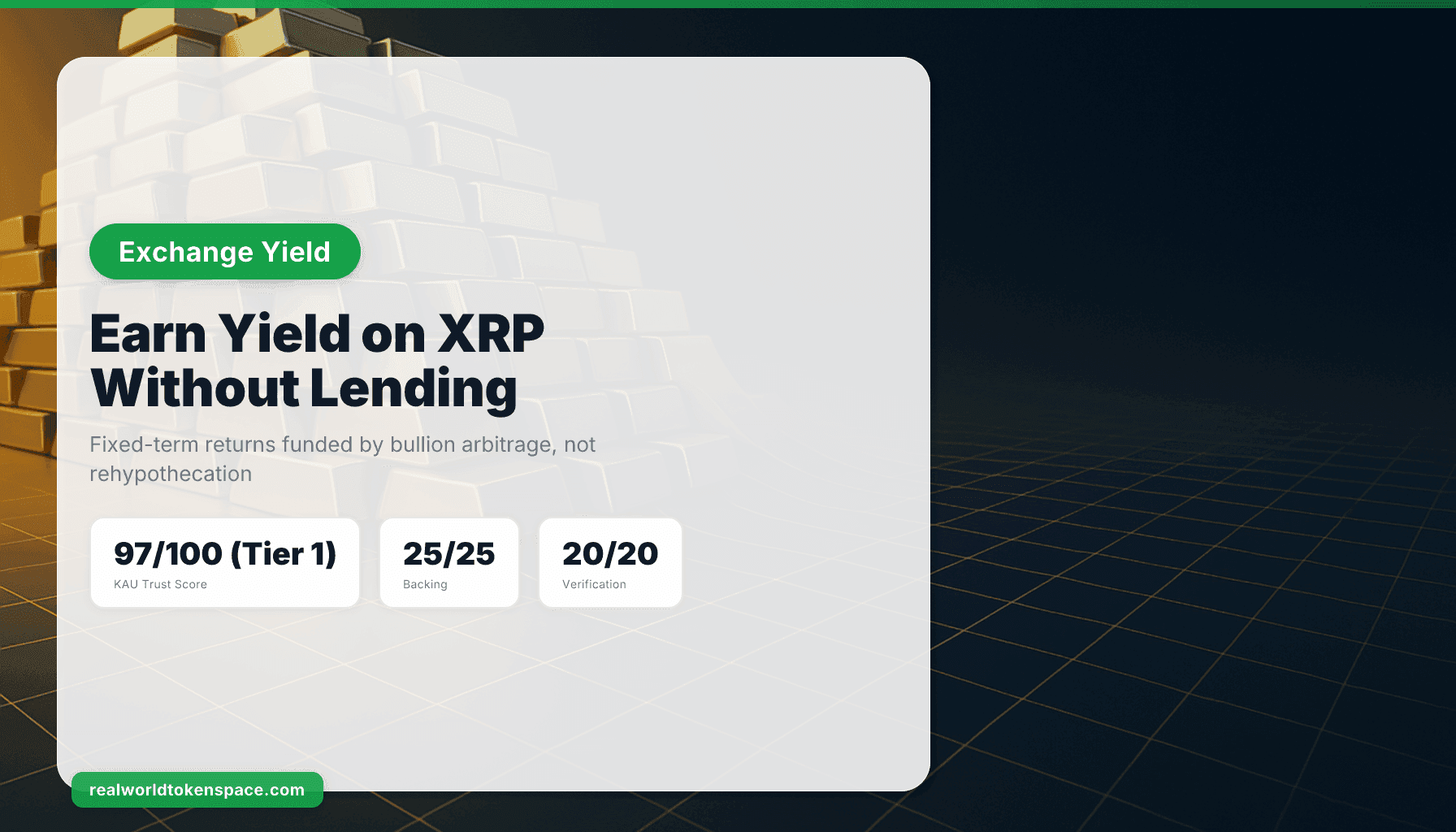
The two assets eligible for the program we rate, KAU and KAG, both carry a 90/100 (Tier 1) RWTS Trust Score. Here is the primary asset, KAU, scored across the six dimensions our methodology uses.
KAU's 90/100 is the sum of six weighted dimensions. Source: RWTS Trust Score methodology.
Dimension
KAU
Max
Asset backing quality
25
25
Reserve verification
20
20
Redeemability
8
15
Audit and security
12
15
Regulatory standing
15
15
Track record
10
10
Total
90
100 · Tier 1
KAU earns full marks on backing (25/25) and verification (20/20). That matters because the yield engine depends on real, allocated, audited metal, not on a promise. KAG (silver) scores identically at 90/100 (Tier 1); you can see its full breakdown at /directory/kag. Both sit in Tier 1, the highest band we assign.
Where the yield actually comes from
This is the part that separates the Kinesis Earn program from lending platforms. The returns are funded primarily by Kinesis's own physical gold and silver arbitrage, executed through the Allocated Bullion Exchange (ABX) it operates. In plain terms: Kinesis makes money moving allocated metal across markets and shares part of that revenue with holders who commit to a fixed term.
Your assets are not lent to a third party. They are not rehypothecated. The yield is a share of a separate trading business, not interest paid by a borrower who might default on you. That is a materially different risk shape from a lending product, and it is the reason we treat this route as an alternative to XRP lending rather than a version of it.
We should be direct about the relationship here: the founder of RWTS consults for Kinesis. That is exactly why we hold this topic to a higher accuracy bar than usual and lead with limitations rather than rates.
Is XRP yield safe?
It depends entirely on the source. Lending-funded XRP yield carries default and counterparty risk that no rate can offset if the borrower fails. Arbitrage-funded yield does not lend your assets, which removes the borrower-default exposure, but it is not risk-free.
Here are the real limitations, stated plainly:
Capital is at risk. No yield product removes market and operational risk. Metal prices move; businesses carry execution risk.
The rate is time-bounded and capped. Per the public figures at kinesis.money/earn, the introductory rates of 12%, 9%, and 7% for the 12, 6, and 3-month terms apply only to the first $75M pledged. After that pool fills, rates revert to standard levels of 10%, 8%, and 6%. The higher numbers are an opening allocation, not a permanent rate.
Terms lock the yield, not the principal. You can withdraw at any time, but if you exit before the term ends you forfeit that term's yield. Your principal is accessible; the return for that period is the cost of leaving early.
Minimum entry is $1,000.
Terms are subject to final Kinesis documentation. Read it before committing.
Set the numbers in the comparison frame. Bank savings sits near 0.5%. Physically vaulted gold or silver pays 0% and often costs storage. XRP in your wallet pays 0%. Against that backdrop, a fixed-term rate that does not lend your assets is worth understanding, but only after you have absorbed every limitation above.
Earn yield on XRP without lending it out: the honest summary
Your XRP earns nothing where it sits. That is the loss most holders overlook. The common fix, lending it out for yield, swaps zero return for counterparty risk. The route we rate keeps your assets unlent, funds returns through bullion arbitrage, and backs the whole thing with metals that score 90/100 (Tier 1) on the RWTS Trust Score.
It is not a free lunch. Capital is at risk, the best rates are capped to the first $75M and time-limited, and early exit costs you that term's yield. If those trades are acceptable to you, this is a structurally cleaner way to put idle XRP to work than lending it.
A simple plan if you decide to proceed:
Create a Kinesis account and complete verification.
Pre-register with your Holder Identification Number (HIN) so allocation is ready before the introductory pool fills.
XRP has no native staking. Most XRP yield is lending risk wearing a yield label. The Kinesis Earn route pays from metals arbitrage instead of lending your assets, and its eligible backing (KAU and KAG) both score 90/100 (Tier 1). Capital is at risk, the top rates are capped and time-bounded, and early withdrawal forfeits that term's yield. Weigh those facts, not the headline number.
Get the always-updated leaderboard delivered to your inbox. Independent ratings across gold, treasuries, stablecoin yield, and DeFi vaults — methodology + data, no hype.
One email a week. Unsubscribe anytime. We never sell your email.
Pre-registration for the introductory rates is open now
Kinesis Earn pays up to 12% APY* on pledged gold, silver, stablecoins and major digital assets, paid in the asset you pledge. The introductory rate is reserved for the first $75M pledged, then it steps down. From $1,000. Open Kinesis Earn through this link, create your account from that page, then pre-register with your HIN to lock the intro rate.
How can I earn yield on XRP without lending it out?
The clearest route we track is Kinesis Earn, where KAU (gold) and KAG (silver) both score 90/100 (Tier 1) on the RWTS Trust Score. You pledge into a fixed-term program whose returns are funded primarily by physical gold and silver arbitrage, not by lending or rehypothecating your assets. Capital is still at risk and terms lock, so read the full picture below.
Does XRP have native staking?
No. The XRP Ledger has no proof-of-stake mechanism, so there is no native staking yield for XRP. Any product advertising XRP yield is doing something else with the tokens, most commonly lending them out. Always ask where the yield actually comes from before you commit.
Is XRP yield safe?
It depends entirely on the source of the yield. Yield funded by lending your XRP carries counterparty and default risk. Yield funded by a separate revenue stream such as metals arbitrage does not lend your assets, but capital is still at risk and fixed terms lock your funds. There is no risk-free yield anywhere in crypto.
What happens if I withdraw before the term ends?
On the Kinesis Earn program you can withdraw at any time, but you forfeit that term's yield if you exit early. Your principal is not locked away, but the return for that period is lost. This is the trade you accept in exchange for the fixed rate.
What is the minimum to earn yield on XRP through Kinesis?
The published minimum entry is $1,000. Introductory rates of 12%, 9%, and 7% for the 12, 6, and 3-month terms apply to the first $75M pledged, then revert to standard rates of 10%, 8%, and 6%. Figures are published at kinesis.money/earn and are subject to final Kinesis documentation.
Tags
#xrp#yield#kinesis#exchange-yield#trust-score
Disclaimer: This article is for informational purposes only and does not constitute financial advice. Always do your own research before making investment decisions.
Stay Ahead of the Yield Curve
Subscribe to The Yield Report for weekly yield intelligence.