Bitcoin Fixed Yield vs Staking: The Honest BTC Yield Matrix
Bitcoin fixed yield vs staking, compared honestly. Yield source, custody, and what can go wrong for LBTC restaking, exchange earn, and fixed-term programs, anchored to the RWTS Trust Score.
Verdict: If you are hunting for bitcoin fixed yield, start by separating three very different products that get lumped together. Wrapped and restaked BTC such as LBTC scores 59/100 (Tier 3) on the RWTS Trust Score: strong on audits, thinner on backing transparency, and its yield floats with network conditions. Exchange earn hands your coin to a counterparty. Fixed-term programs lock a stated rate for a set period and penalize early exit. None of these is a savings account, and all put capital at risk. Know which one you are buying before you move a satoshi. We rate. You decide.
Why "fixed yield" is not what most people assume
The word "fixed" does a lot of quiet work. It implies safety. It should imply commitment. A fixed-yield term pays a known rate because you agree to leave your capital in place for a defined window. Exit early and you typically forfeit that term's yield. That is the trade.
Compare the frame honestly. A bank savings account pays roughly 0.5 percent and is insured in many jurisdictions. Vaulted gold sitting in an allocated account earns 0 percent while it waits. A fixed-term crypto yield pays more than either because it carries more risk and less flexibility, not because it has found free money. If a rate is shown to you without that comparison, treat it as marketing, not information.
Free guide
Reading this far? Get the Top 10 in your inbox.
One weekly email with the updated Trust Score leaderboard, the biggest moves, and a deeper dive on one asset. Independent ratings only — no sponsored content.
One email a week. Unsubscribe anytime. We never sell your email.
Our How Bitcoin Yield Works breakdown walks through the mechanics of wrapping, restaking, and lending in more depth. This piece is the decision matrix.
The Trust Score, dimension by dimension
LBTC's 59/100 is the sum of six weighted dimensions. Source: RWTS Trust Score methodology.
Dimension
LBTC
Max
Asset backing quality
10
25
Reserve verification
12
20
Redeemability
9
15
Audit and security
12
15
Regulatory standing
7
15
Track record
7
10
Total
59
100 · Tier 3
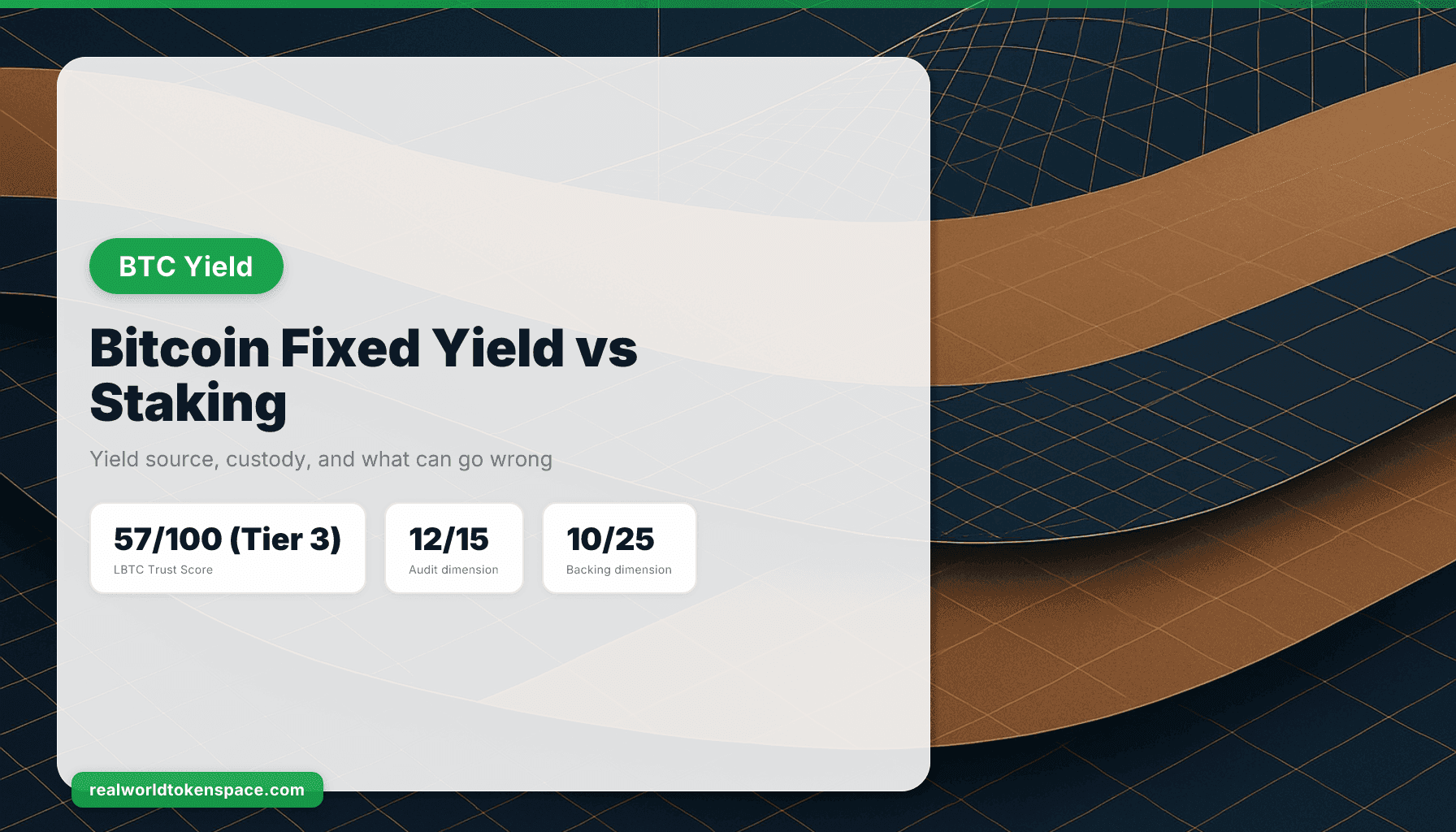
LBTC earns 59/100 (Tier 3). The audit dimension is a genuine strength at 12 of 15, and verification sits reasonably at 12 of the available points. Where it loses ground is backing, at 10 of 25. That is the number to sit with. For restaked BTC, the honest question is always: what exactly stands behind the token, and can you verify it independently? For the full custody-and-safety analysis, see Is LBTC Safe?.
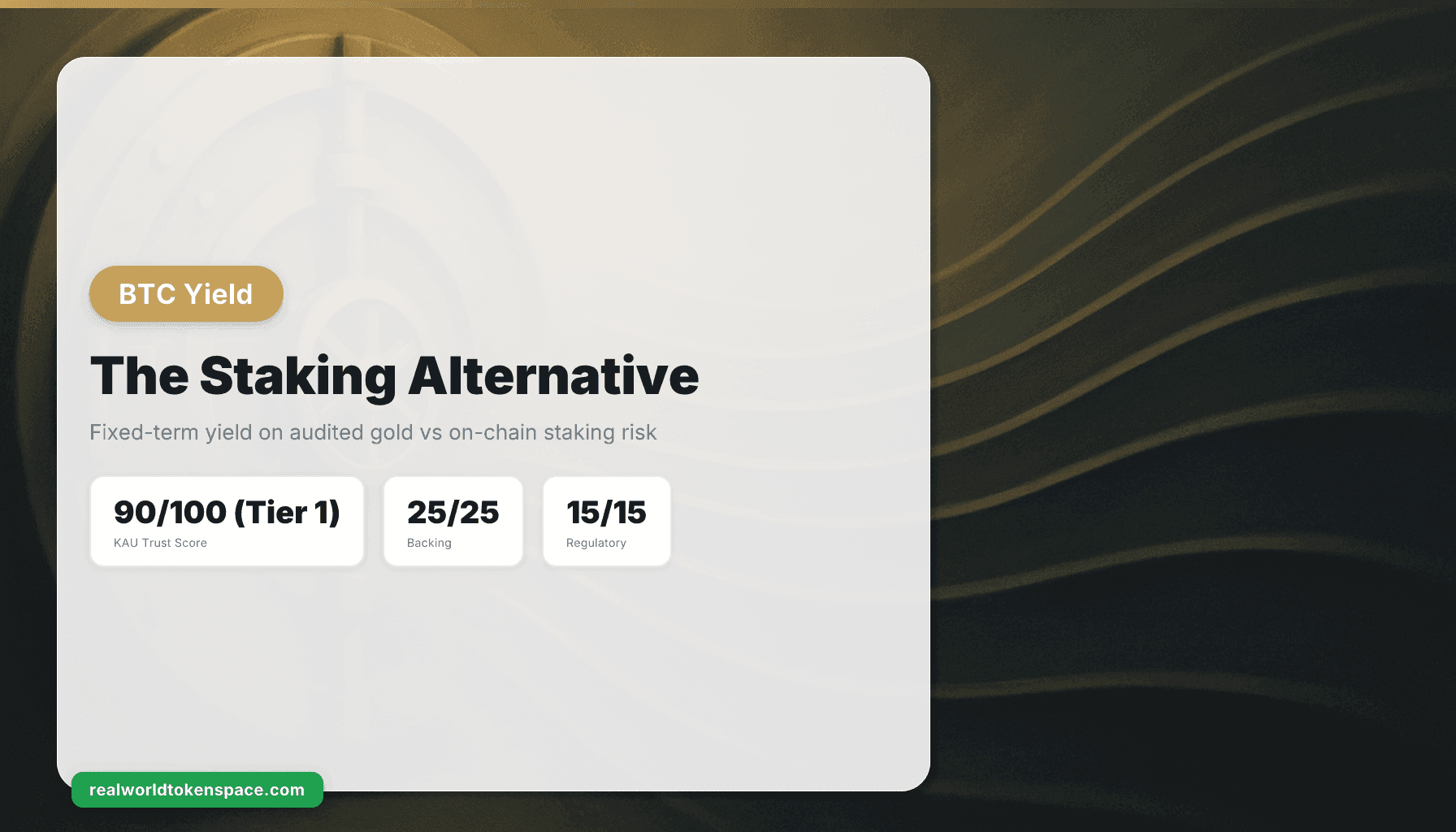
For contrast within our directory, the gold token KAU scores 90/100 (Tier 1) with 25 of 25 on backing. That gap is instructive. It shows what full backing verification looks like, and it explains why a program funded by physical bullion arbitrage sits on a different footing than one funded by network incentives.
The honest BTC yield matrix
Three routes, three risk profiles.
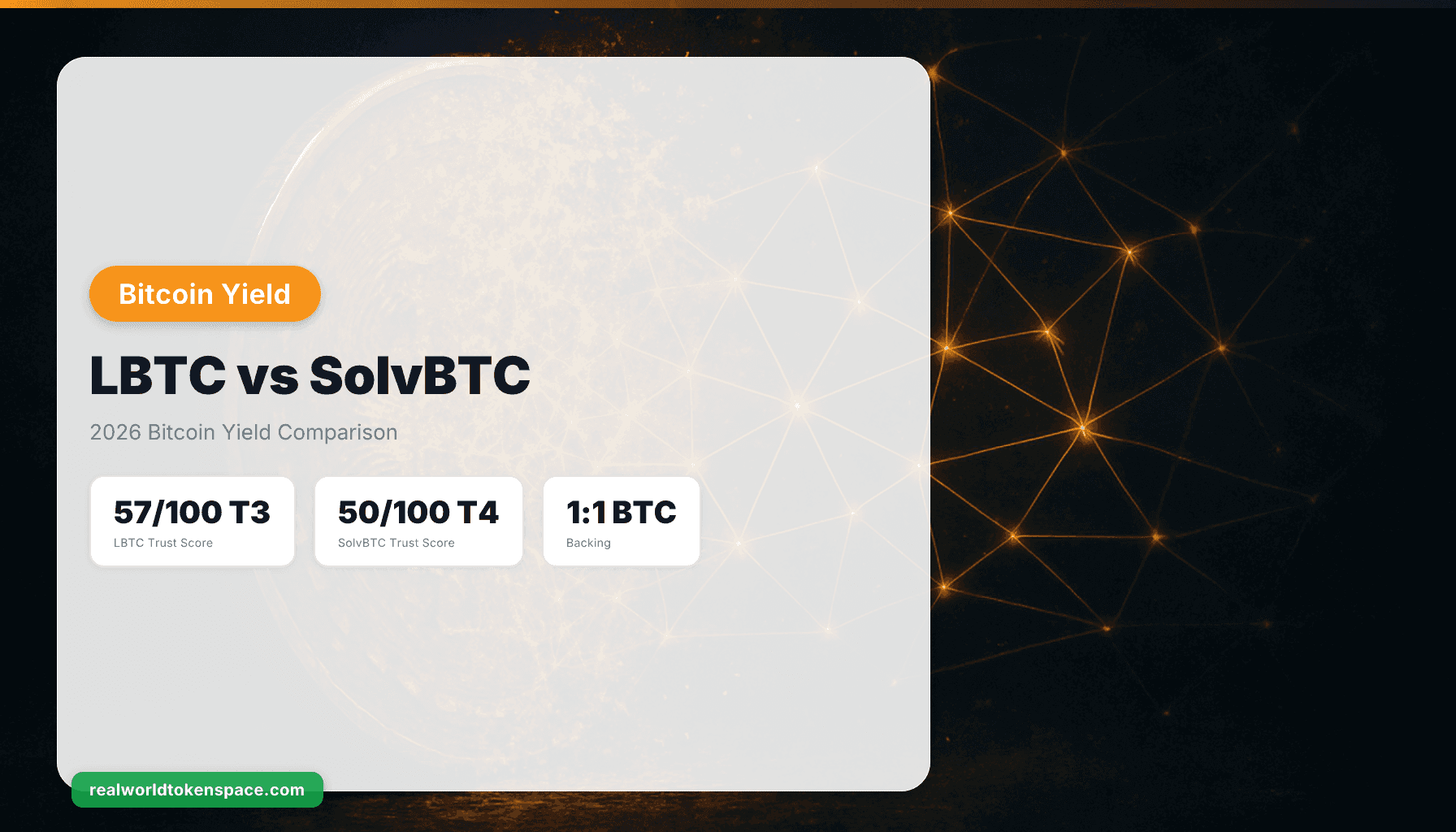
Wrapped and restaked BTC (for example LBTC). Your bitcoin is converted into a token that helps secure external networks. The yield floats. The risks are smart contract failure, slashing, validator misbehavior, and custody of the underlying coin. Upside: you can usually exit on-chain at will. Downside: the rate is not promised, and backing transparency varies. See our wrapped bitcoin comparison and the LBTC vs SolvBTC matchup for how the leading wrappers differ.
Exchange earn. You deposit BTC and the platform pays a rate. The core risk is counterparty exposure. In many earn products your coin can be lent out or rehypothecated, meaning it is working somewhere you cannot see. Read where the yield comes from. If the answer is "lending," you are a creditor, not just a saver.
Fixed-term programs. You commit for a defined period and receive a stated rate. This is where "fixed" earns its name and its penalty. You can withdraw anytime, but doing so forfeits that term's yield. Capital remains at risk. The clarity you get is a known number for a known window.
Where does the yield come from? The essence question
The single most important line in any yield product is the funding source. If your yield is paid by lending your asset, your risk is the borrower. If it is paid by rehypothecating it, your risk is a chain of counterparties you cannot audit.
The Kinesis Earn model answers this differently. Its yield is funded primarily by physical gold and silver arbitrage executed through the ABX exchange, not by lending out your holdings or rehypothecating them. That is a meaningfully different risk shape: the return is generated by trading bullion spreads rather than by putting your capital into someone else's balance sheet. It also answers the gold stacker's core objection directly. Your metal, or your BTC-eligible position, is not the thing being lent.
That does not make it risk-free. It makes the risk legible. Read the funding mechanism in every product you consider and confirm it against primary documentation.
The fixed-term numbers, stated plainly
Per the public Kinesis Earn page, the introductory rates are 12 percent for a 12-month term, 9 percent for 6 months, and 7 percent for 3 months. These are introductory figures, capped and bounded. Once the first 25 million dollars is pledged into the pool, rates revert to a standard 10, 8, and 6 percent. The minimum entry is 1,000 US dollars of eligible value. You can withdraw anytime, but early withdrawal forfeits that term's yield.
Three limitations belong right next to those figures. First, capital is at risk. Second, the introductory rate is capped by the 25 million dollar pool and time-limited, so it is not a permanent number. Third, all terms are subject to final Kinesis documentation, which is the version that governs, not any summary. The gold tokens behind the wider Kinesis system, KAU and KAG, both score 90/100 (Tier 1) on the RWTS Trust Score, which speaks to backing quality but does not remove the term-commitment risks above.
Is fixed yield or staking better for bitcoin holders?
It depends on what you value. Choose restaking (like LBTC) if you want to keep on-chain flexibility and can accept a floating rate plus smart contract risk. Choose a fixed-term program if you want a known rate for a set period and can commit the capital without needing early access. Avoid open-ended exchange earn unless you have read exactly how your coin is deployed and accept the counterparty exposure.
Read our full methodology to see how each of these dimensions is scored, so you can weigh them against your own risk tolerance rather than a headline rate.
Closing verdict
Fixed yield is a commitment, not a savings account. Restaked BTC floats and carries protocol risk. Exchange earn makes you a creditor. Fixed-term programs give you a number in exchange for time and an early-exit penalty. The prudent move is to match the route to your tolerance, confirm the funding source, and read the disclosures before you allocate.
A simple plan for a fixed-term route: 1. create an account and complete verification. 2. pre-register your holding with your HIN before committing, then read the final documentation in full.
Get the always-updated leaderboard delivered to your inbox. Independent ratings across gold, treasuries, stablecoin yield, and DeFi vaults — methodology + data, no hype.
One email a week. Unsubscribe anytime. We never sell your email.
Pre-registration for the introductory rates is open now
Kinesis Earn pays up to 12% APY* on pledged gold, silver, stablecoins and major digital assets, paid in the asset you pledge. The introductory rate is reserved for the first $75M pledged, then it steps down. From $1,000. Open Kinesis Earn through this link, create your account from that page, then pre-register with your HIN to lock the intro rate.
What is the best bitcoin fixed yield option in 2026?
There is no single best. On the RWTS Trust Score, LBTC restaking sits at 59/100 (Tier 3), reflecting strong audits but thinner backing transparency. Fixed-term programs trade flexibility for a rate you lock. The right route depends on whether you prize withdrawal freedom, custody clarity, or a known number for a set period.
Is fixed yield the same as a savings account?
No. A fixed-yield term is a commitment. You typically forfeit that term's yield if you exit early, and your capital is at risk. A bank savings account is insured in many jurisdictions and pays roughly 0.5 percent. Fixed yield pays more precisely because it carries more risk and less flexibility.
How does BTC staking differ from fixed-term BTC yield?
Restaking routes like LBTC generate a variable yield from securing external networks and carry smart contract and validator risk. Fixed-term yield locks a stated rate for a defined period. One is market-driven and floating, the other is a bounded contract with early-exit penalties.
Where does the yield in a fixed-term BTC program come from?
In the Kinesis Earn model, the yield is funded primarily by physical gold and silver arbitrage executed through the ABX exchange, not by lending out your bitcoin or rehypothecating it. Always confirm the funding source in the final program documentation before committing.
What can go wrong with each BTC yield route?
Restaking carries smart contract, slashing, and custody risk. Exchange earn carries counterparty and rehypothecation risk. Fixed-term yield carries capital-at-risk exposure, early-withdrawal forfeiture, and rate terms that are capped and time-limited. Read the disclosures before allocating.
How much do I need to start a fixed BTC yield term?
The Kinesis Earn minimum entry is 1,000 US dollars of eligible value, with introductory rates of 12, 9, and 7 percent for 12, 6, and 3-month terms respectively, reverting to 10, 8, and 6 percent once the first 25 million dollars is pledged. Figures are per the public Kinesis Earn page and subject to final documentation.
Disclaimer: This article is for informational purposes only and does not constitute financial advice. Always do your own research before making investment decisions.
Stay Ahead of the Yield Curve
Subscribe to The Yield Report for weekly yield intelligence.