Tokenized Money Market Fund: 2026 Guide and Trust Scores
A tokenized money market fund does one simple thing: it puts short-term US Treasury yield on-chain in the form of a transferable token. The fund holds T-bills, repo, and cash off-chain with a regulated custodian; the token is a share recorded on a blockchain that carries that yield to the holder. RWTS does not promote any issuer. We rate the structures, and we explain the trade-offs.
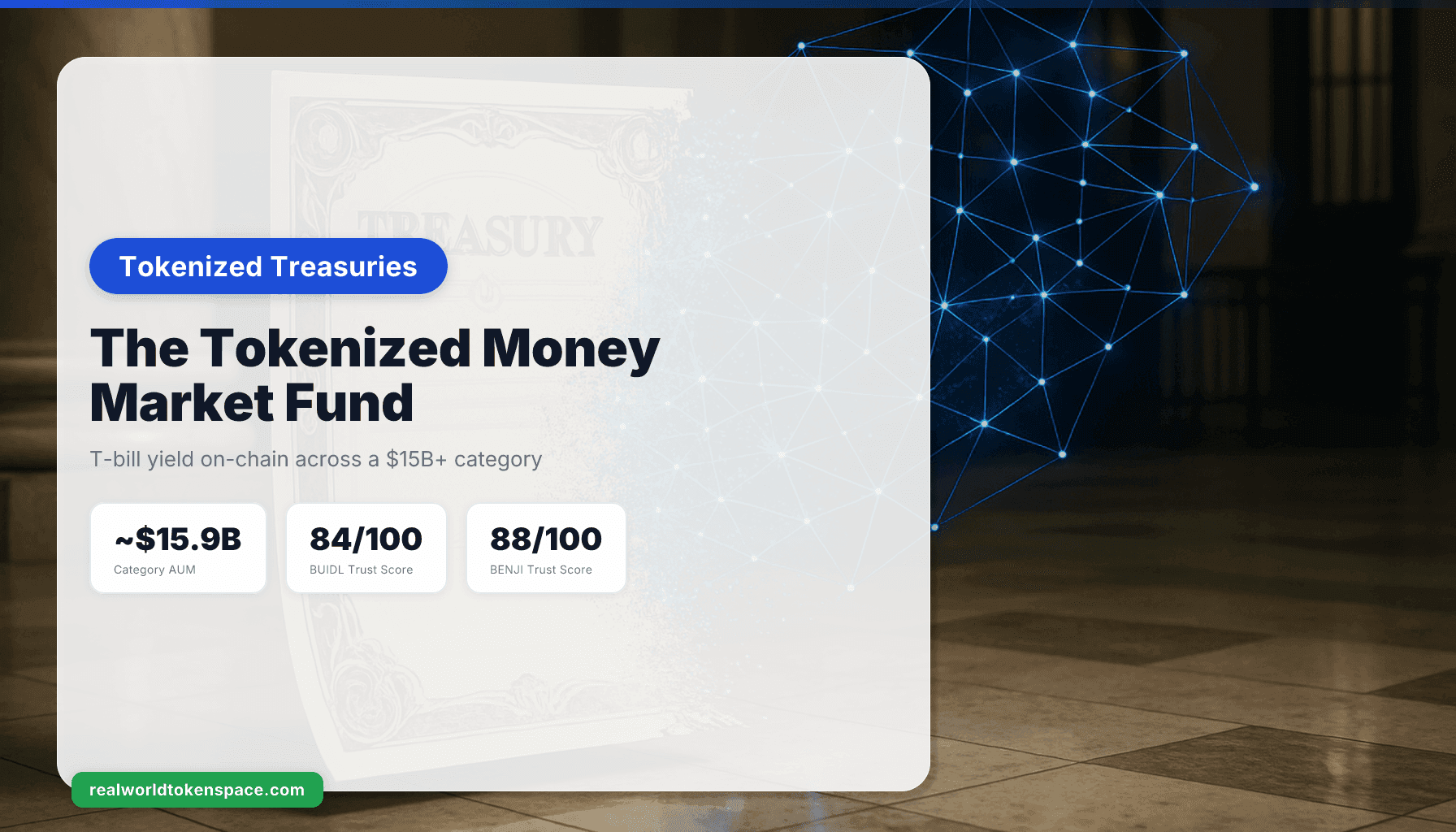
The category has scaled fast. The tokenized U.S. Treasury market reached $15.35 billion in May 2026, and by September 2026 the figure expanded to approximately $15.9 billion. The market is distributed across 76 products and roughly 58,600 holders, with a weighted average 7-day APY of 3.36% as of May 2026. Most tokenized Treasury products are structured as money market funds or close cousins of them.
How a tokenized money market fund works
Three structural types sit under the tokenized Treasury umbrella: tokenized money market funds, fund wrappers, and direct bond tokens. The money market fund version is the one with the strongest regulatory pedigree, because the underlying vehicle is a registered or regulated fund rather than an offshore note.
Yield flows from the fund's holdings. For BlackRock's product, yield flows from US Treasury bills, repurchase agreements, and cash held by BNY Mellon. The token accrues or distributes that yield depending on design. Because the holdings are short-dated, the yield tracks the front end of the curve and moves with Fed policy, the key humility variable for any forward return.
The practical gates are minimums and investor eligibility. The large institutional funds are not open to everyone. BUIDL carries a $5M minimum with a qualified-purchaser gate, OUSG a $100K minimum, and BENJI is retail-accessible in select US states. If you cannot clear the gate, the headline AUM leader may be irrelevant to you.
The products: AUM and Trust Scores
The category leaders have traded the top spot repeatedly through 2026. Circle USYC held about $2.91 billion in AUM as of May 4, 2026, ranking it the single largest tokenized US Treasury product; BlackRock BUIDL held about $2.58 billion, and Ondo USDY held about $2.14 billion as of the same date. Franklin Templeton's suite is in the same tier, with the BENJI suite at roughly $1.98 billion AUM as of 29 April 2026 per a Franklin Templeton press release.
Size and score are not the same thing. Here is how RWTS rates the three most relevant money market fund structures:
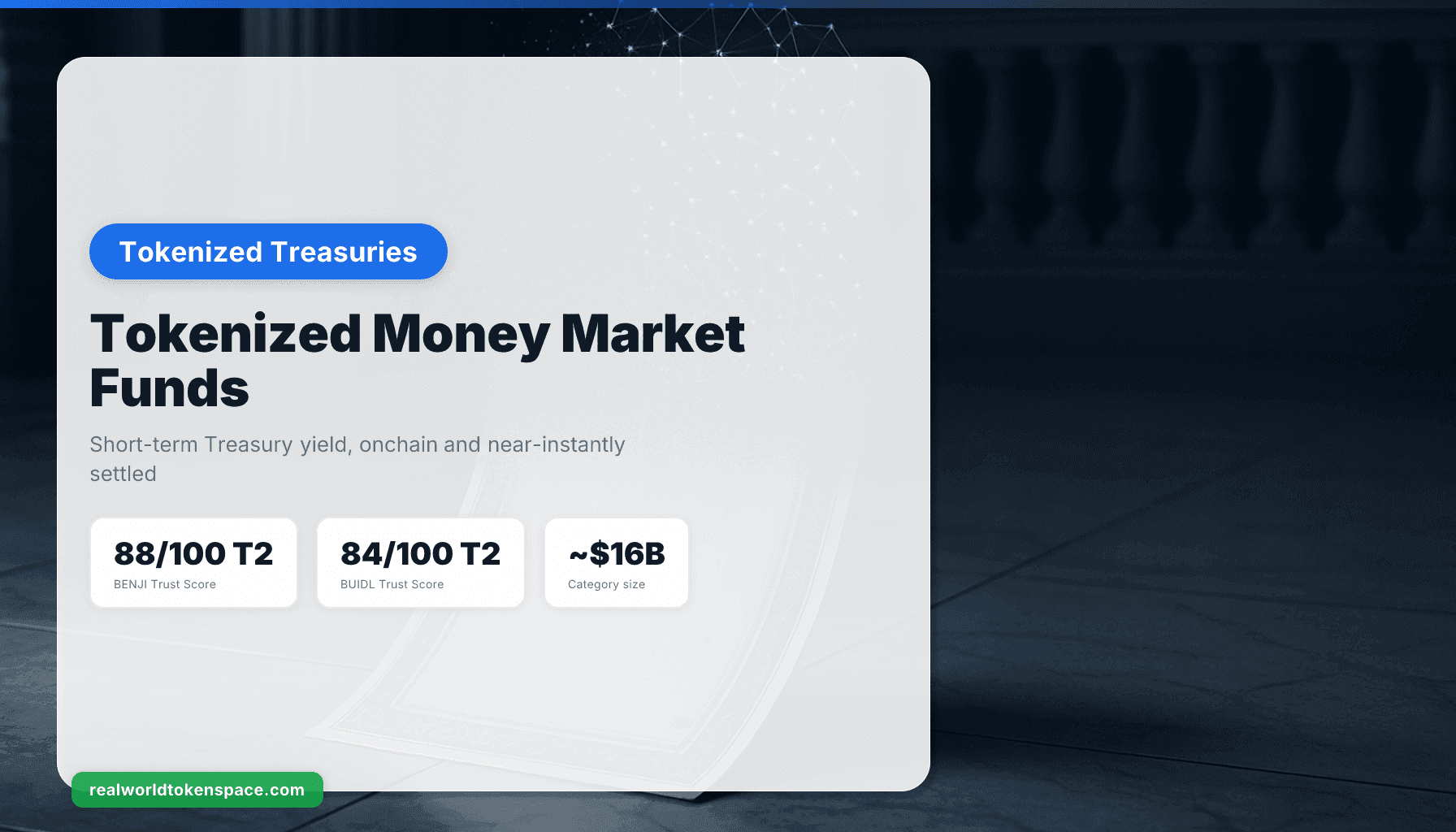
- BENJI (Franklin Templeton): T2 (88/100). The highest-rated of the three, and the most accessible to retail in select states.
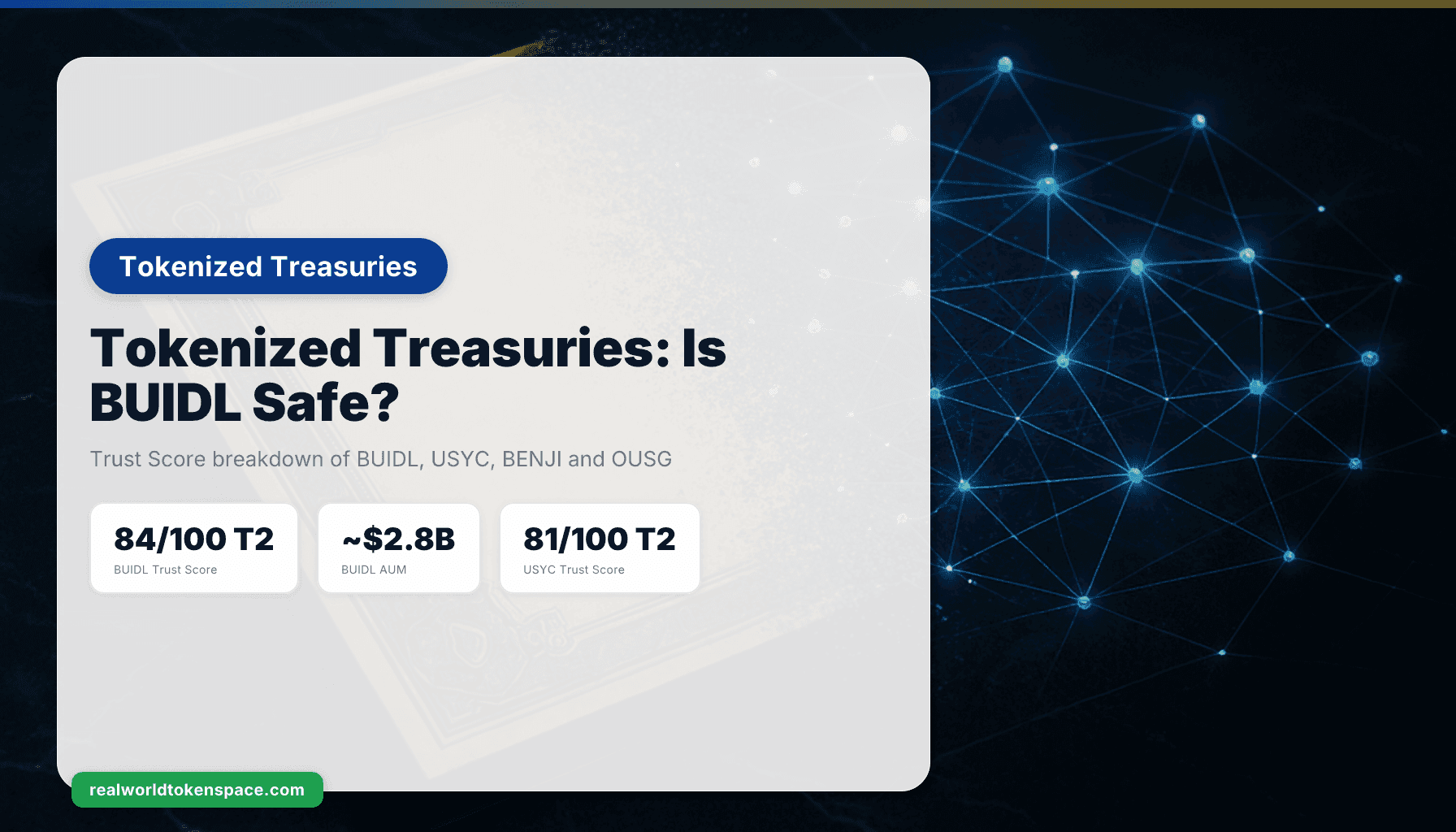
- BUIDL (BlackRock / Securitize): T2 (84/100). The incumbent-manager heavyweight, gated to qualified purchasers at a $5M minimum.
- USYC (Circle / Hashnote): T2 (81/100). Frequently the largest by AUM, structured as an offshore wrapper.
All three sit in Tier 2. That reflects strong but not flawless structures: solid custody and reporting, offset by the concentration and smart-contract risks inherent in on-chain funds. The methodology behind these numbers is in our Trust Score methodology.
The risk the AUM number hides
Scale brings concentration. Five issuers control the vast majority of the $15.9 billion market, and a custody failure, smart-contract exploit, or regulatory action affecting any single issuer could cascade across DeFi protocols that accept its tokens as collateral. That is the systemic footnote to an otherwise conservative asset class. A tokenized money market fund is built on the safest collateral in finance, but the token layer adds operational risk the T-bill itself does not carry.
Which one is right for you
The verdict is tiered by access, not by brand. If you are retail and want the highest-rated route, BENJI's T2 (88/100) and its select-state availability make it the natural starting point. If you are an institution that can clear a qualified-purchaser gate, BUIDL's issuer credit and BENJI's score are both defensible. USYC's draw is scale and redemption mechanics rather than its score.
For the full category comparison, see our tokenized treasuries hub, and for a side-by-side on specific funds, our related research, Tokenized Money Market Fund Comparison.
Yields move with the Fed, and the leaderboard moves with flows. The structure (custody, redemption, investor gate) is what endures. We rate it. You decide.
Related on RWTS
Stay Ahead of the Yield Curve
Subscribe to The Yield Report for weekly yield intelligence.
Subscribe Now