Tokenized Treasuries: 2026 Guide, Yields & Trust Scores
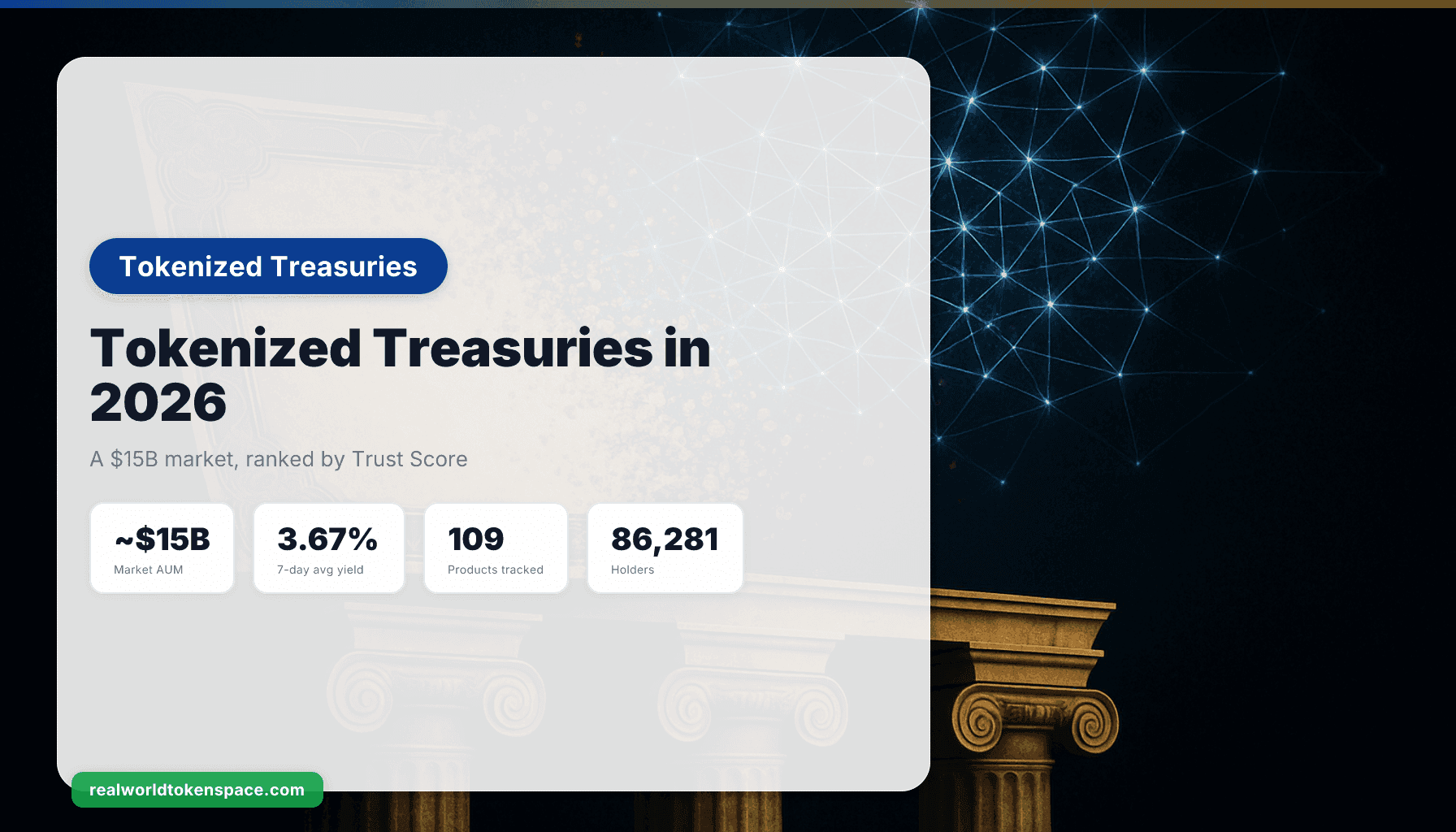
Tokenized treasuries are the largest category in the tokenized real-asset market, and the one with the clearest institutional pedigree. According to RWA.xyz, tokenized US Treasury finances totaled around USD 15 billion in distributed value as of October 7, 2026, across 109 assets and 86,281 holders. That scale matters, but size is not the same as safety. RWTS isn't bullish or bearish on any issuer. We're the credit-rating agency for tokenized real assets. We rate. You decide.
What are tokenized treasuries?
A tokenized treasury is a share in a US Treasury or government money market fund, recorded as a token on a public blockchain. They can be held in a wallet and moved like a stablecoin while earning the short-term Treasury rate. The underlying bills sit off-chain with a regulated custodian; the token is the on-chain claim.
This structure splits neatly into three types: tokenized money market funds, fund wrappers, and direct bond tokens. Three structural types exist: tokenized money market funds, fund wrappers, and direct bond tokens. The distinction drives how you redeem, who can buy, and how fast you get your dollars back.
How much do tokenized treasuries yield?
The yield is not invented. It is the short-term Treasury rate, passed through to token holders, minus a management fee. Unlike speculative cryptocurrencies, tokenized Treasuries depend on the real yield of underlying government securities or investment funds.
As of early October 2026, that worked out to a blended rate just under 4%. Tokenized US Treasury finances totaled around USD 15 billion in distributed value as of October 7, 2026, across 109 assets and 86,281 investors. The platform reported a trailing one-week annualized yield of 3.67%, consistent with a Fed funds target range of 3.50% to 3.75%.
The mechanism is important for anyone sizing a position. These funds hold short-dated bills that reprice in weeks, not years. If the Fed holds, the yield holds. If the Fed cuts in a coming meeting, expect the pass-through rate to drift lower within a month or two. Fed posture is the single humility variable here.
The largest funds, and why size is only half the story
By assets under management, the leaderboard has tightened in 2026. Circle's USYC, at $2.51 billion on 23 September 2026, followed by Ondo's USDY at $2.27 billion and BlackRock's BUIDL at $2.23 billion, according to rwa.xyz. The six largest funds concentrate most of the market. On 23 September 2026 tokenized treasury funds held $14.93 billion across 108 products, with a 7-day average yield of 3.50%, according to rwa.xyz. The six largest funds account for about $10.8 billion of that total.
Here is where the RWTS lens diverges from a league table. The biggest fund is not the best-rated one. Scores reflect backing quality, custody, redemption mechanics, and disclosure, not AUM.
The RWTS Trust Score read
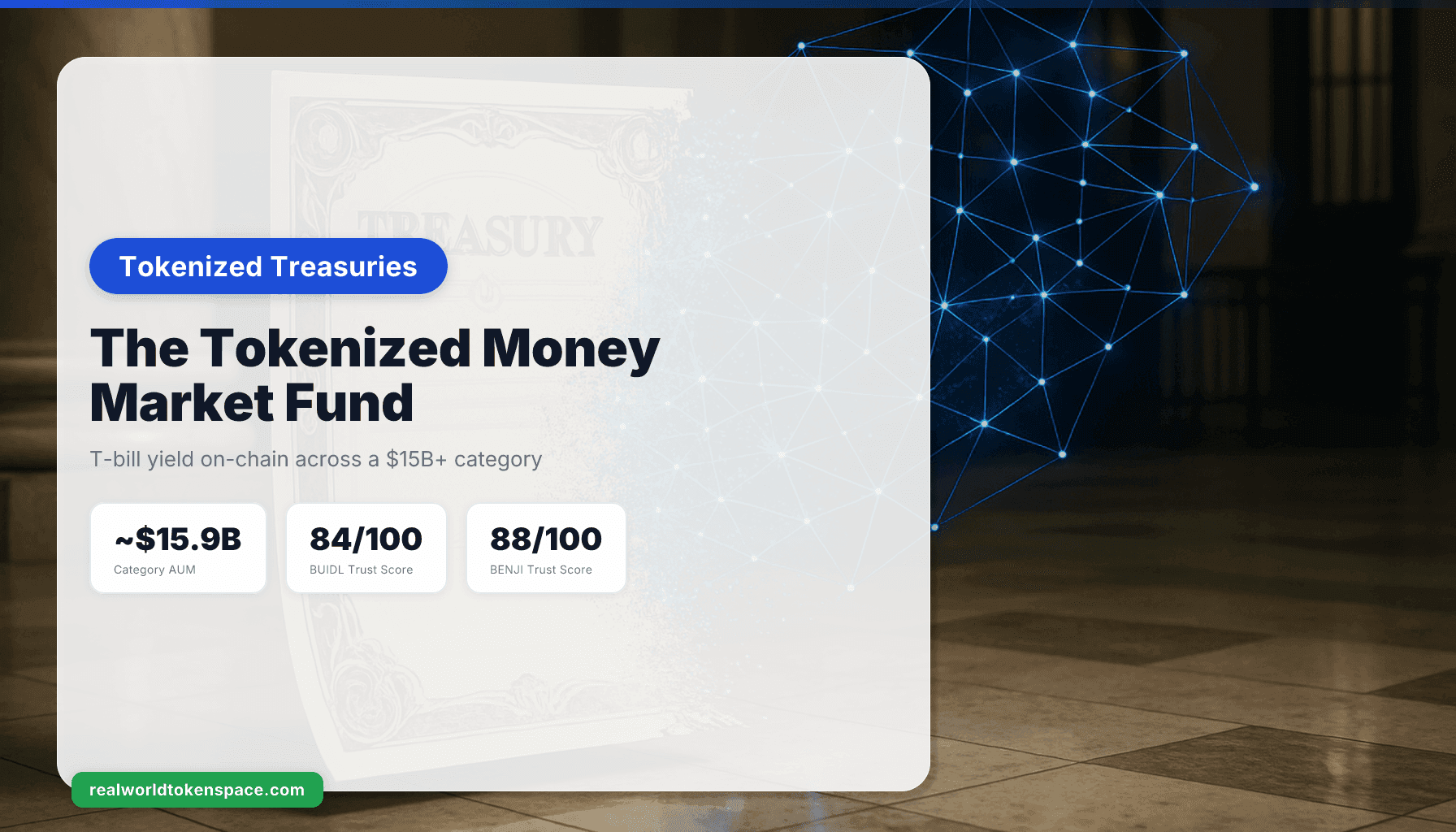
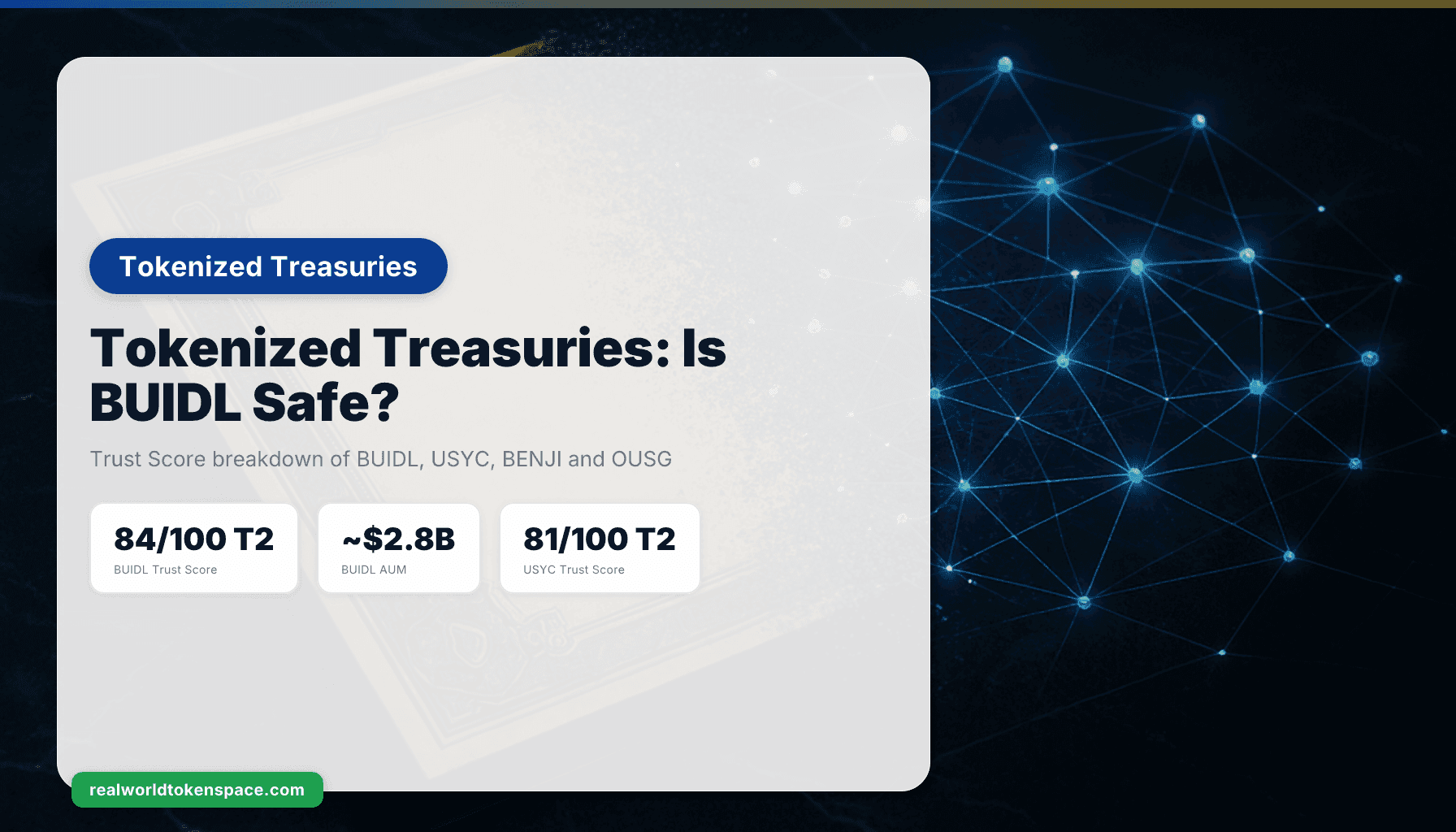
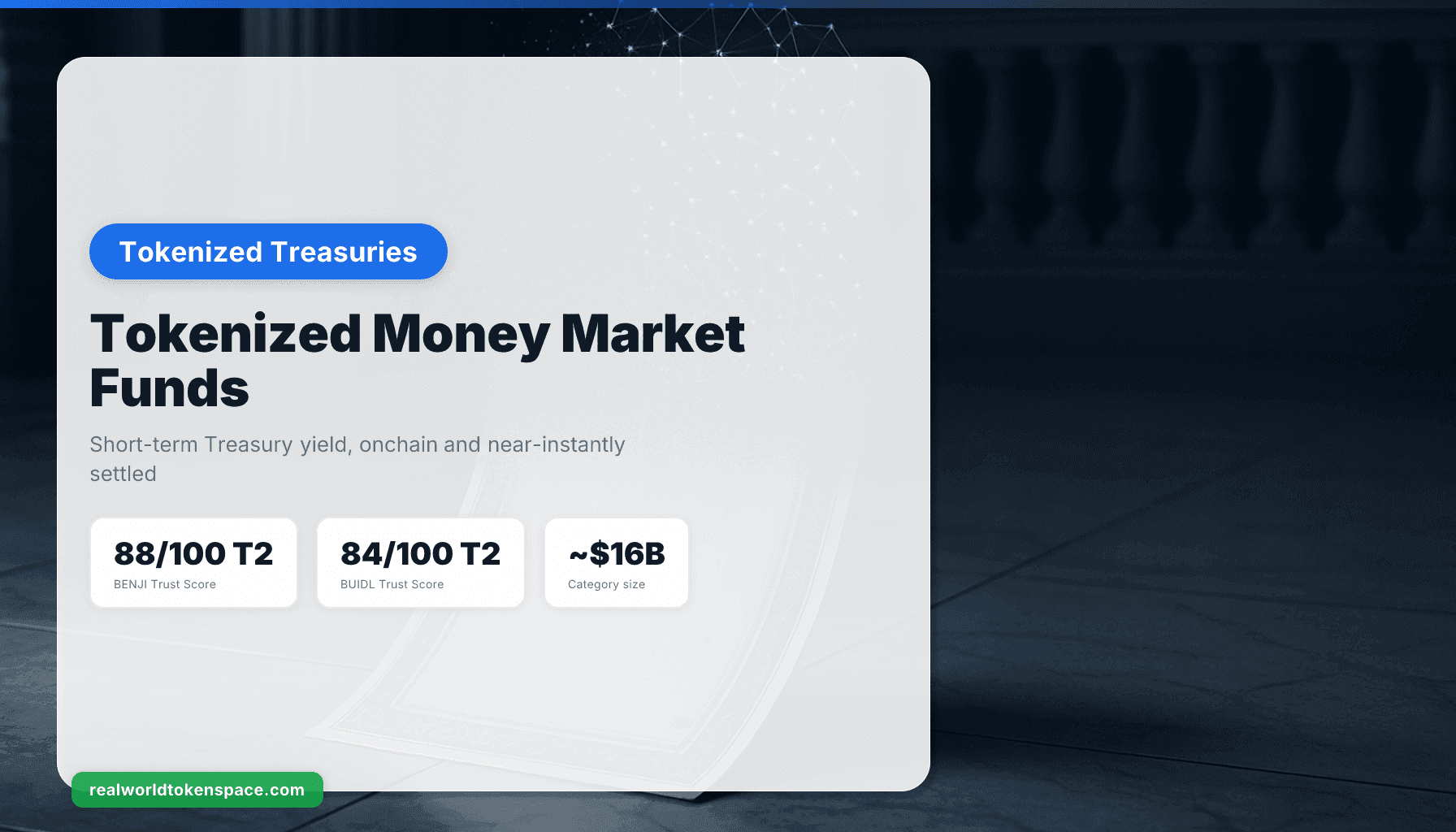
Among the tokenized treasuries we rate, the ordering by Trust Score is instructive. Franklin Templeton's BENJI leads at T2 (88/100), reflecting a long-tenured fund sponsor and a transparent on-chain share register. BlackRock's BUIDL follows at T2 (84/100), the largest-name product with institutional-grade custody but tight eligibility gates.
Circle's USYC and Ondo's USDY both sit at T2 (81/100), the current AUM leaders, strong on liquidity, scored on their specific redemption and disclosure terms rather than their headline size. Ondo's OUSG rounds out the group at T2 (77/100).
The gap between an 88 and a 77 is not noise. It encodes differences in who holds the custody mandate, how redemption settles, and how often the fund attests to its backing. Our full rubric is published at our methodology page, and we'd rather you interrogate the score than take it on faith.
Who can actually buy them
Eligibility is the detail retail readers most often miss. BUIDL limits buyers to Qualified Purchasers with $5 million minimum; FOBXX opens to retail investors. The practical consequence: the best-known product on the list is also one of the hardest for an ordinary allocator to access.
For a broader comparison of money-market-style structures and how they differ from direct bond tokens, see our companion guide Tokenized Money Market Fund Explained, which breaks down the fund-wrapper mechanics in detail.
How the category fits the wider market
Treasuries anchor the tokenized real-asset sector. Tokenized Treasuries are the largest category at roughly $10B. Private credit follows at about $8B. The growth has come from two directions at once. The growth came from two places at once: traditional asset managers tokenizing money market funds, and private credit platforms compounding existing pools. BlackRock, Franklin Templeton, Apollo, Hamilton Lane, and WisdomTree all now have live tokenized products, and rwa.xyz tracks the AUM in close to real time.
If you want the full ranked view, start at our tokenized treasuries hub, where every product we rate is listed with its live Trust Score.
The bottom line
Tokenized treasuries give you the short-term Treasury rate in a wallet-native wrapper. The yield is real, the backing is auditable, and the category has institutional weight behind it. But the scores spread for a reason: custody, redemption and disclosure vary fund to fund, and the largest product is not automatically the safest. If the Fed holds its range, the thesis stays intact. Below it, pass-through yields compress, so underwrite the issuer, not just the headline rate. We rate. You decide.
Related on RWTS
Stay Ahead of the Yield Curve
Subscribe to The Yield Report for weekly yield intelligence.
Subscribe Now