The week in one line
A December Fed hike is now priced as a near certainty, so the question for this short US week is what comes after it: Wednesday's core PCE is the last big inflation print before the 9 December decision, and it lands after a stock rout pushed Western gold funds to sell while China's central bank kept buying.
Where things stand
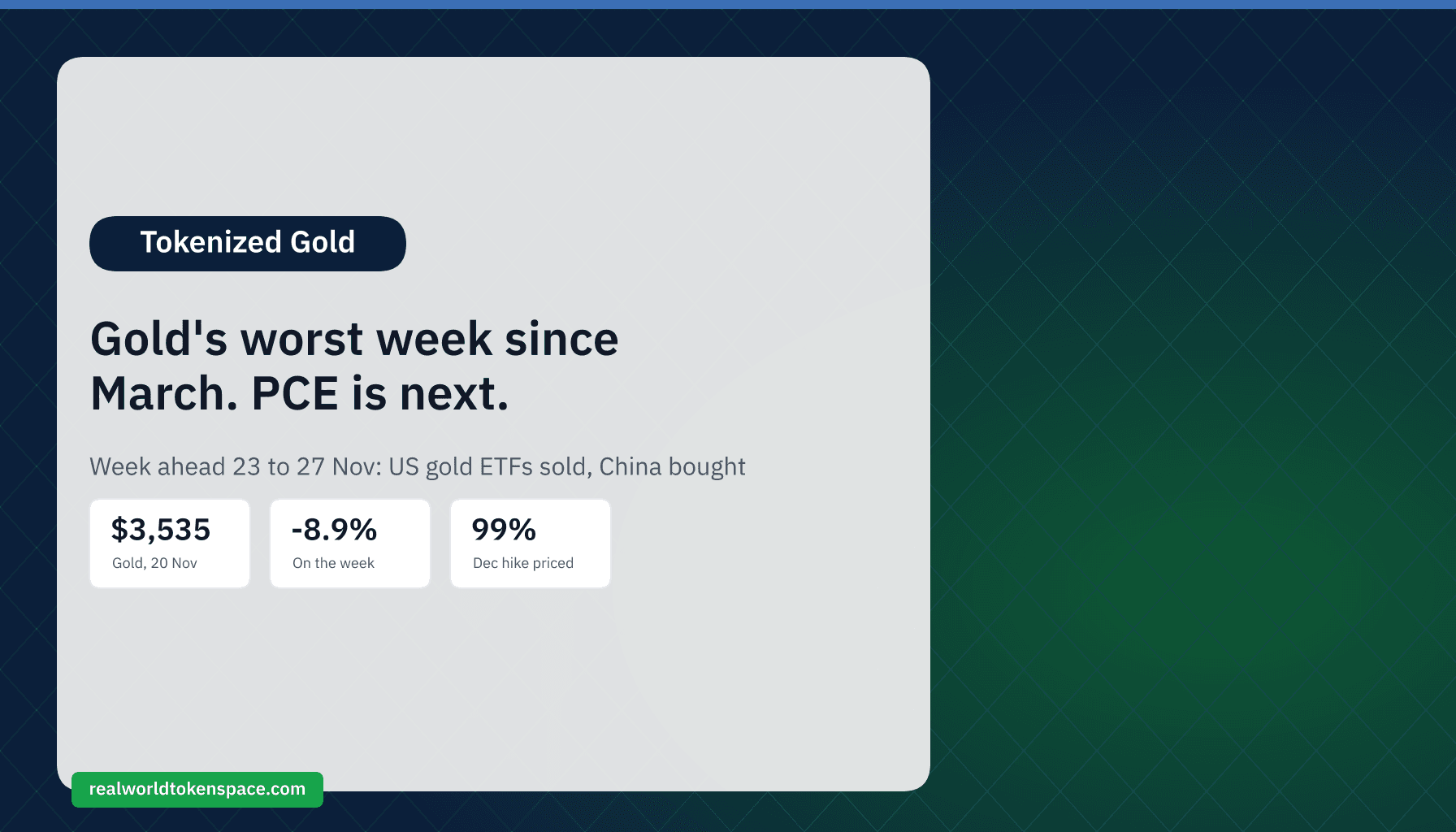
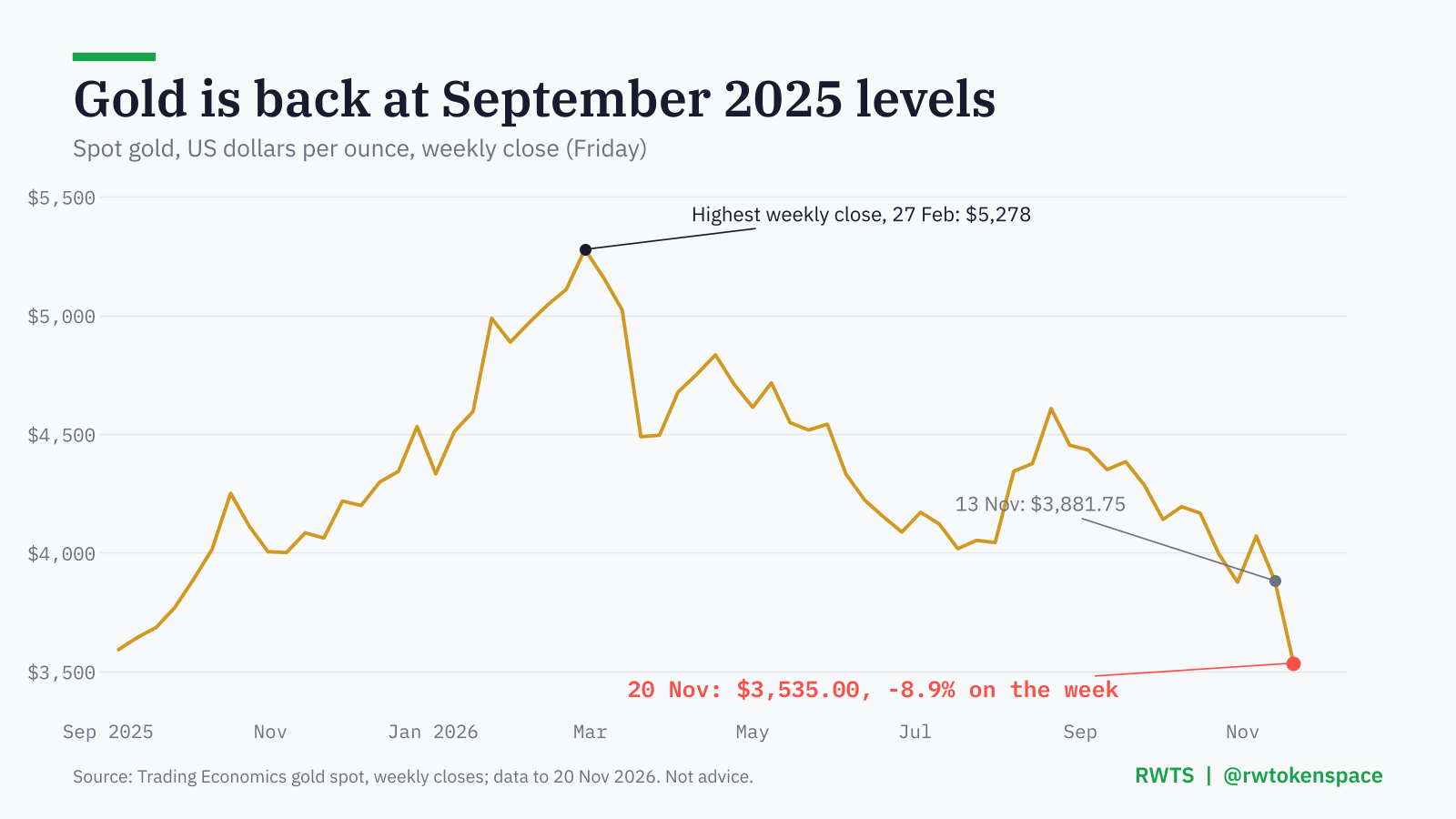
Spot gold closed Friday 20 November at $3,535.00, down 8.9% on the week, its steepest weekly fall since March and its lowest level since September 2025. Silver fell harder, by more than 13%, also to its lowest since September 2025.
| Market |
Level, Fri 20 Nov 2026 |
Week |
Source |
| Gold (spot) |
$3,535.00 |
-8.9% (from $3,881.75) |
Trading Economics |
| Silver (spot) |
$41.19 |
more than -13% |
Trading Economics |
| Gold/silver ratio |
about 85.8 |
from about 79.7 |
RWTS arithmetic from the rows above |
| Dollar index (DXY) |
103.81 |
+0.5%, fourth weekly gain |
Trading Economics |
| US 2-year yield |
4.65% |
about -0.12 points |
Trading Economics |
| US 10-year yield |
4.94% |
nearly -0.15 points, five daily falls |
Trading Economics |
| Brent crude |
$92.57 |
third weekly fall |
Trading Economics |
| Fed 9 December, 25bp hike |
99% |
from about 90% on 19 Nov |
CME FedWatch via Reuters on Kitco |
Gold's week change is RWTS arithmetic; the others are as Trading Economics describes them.
Technical note, descriptive only: gold is about 37% below its January 2026 peak of $5,608.35 and back at levels it first reached in September 2025.
The calendar
All times UK (GMT). New York is five hours behind.
| Day |
UK time |
Event |
Why it matters for gold, silver and tokenized treasuries |
| Mon 23 Nov |
14:45 |
US flash manufacturing PMI, November |
First November activity read after the sell-off. October: 54.9. |
| Mon 23 to Wed 25 Nov |
about 18:00 |
$183 billion of 2-, 5- and 7-year Treasury notes |
Shows whether buyers still want US debt at these yields. |
| Tue 24 Nov |
15:00 |
Conference Board consumer confidence |
Did the stock slide dent the consumer? October: 91.7. |
| Wed 25 Nov |
13:30 |
US core PCE (October) and Q3 GDP, second estimate |
The Fed's preferred inflation gauge, seen up 0.3% on the month and 3.2% on the year. |
| Wed 25 Nov |
evening |
Fed Beige Book |
The Fed's own survey of regional conditions before it decides. |
| Thu 26 Nov |
all day |
US Thanksgiving, markets shut; ECB minutes |
Thin trading. The ECB is expected to tighten in December. |
Sources: Newsquawk week in focus and FinancialJuice for the calendar, forecasts and US times; Newsquawk for auction sizes (18:00 UK is the usual close). Friday is an early close in New York. No Fed, Bank of England or Bank of Japan rate decision falls this week.
The tug of war
The main driver last week was not interest rates: the 10-year yield fell five days running, which would normally help bullion. What hurt gold was a hunt for cash. Asian shares were heading for their worst week since 2020 as a tech-led sell-off spread (Reuters, 20 November), and when losses pile up, funds sell what they can sell quickly. US-listed precious-metal ETFs lost about $1.5 billion over five days, $1.2 billion of it from the largest gold fund, while the category's prices fell 9.9% (ETF Action, 21 Nov). A week earlier the same funds had taken in $728 million. The dollar added weight with a fourth weekly gain.
The counterforce is slower money. China's central bank added about 26 tonnes in October, its largest monthly addition since October 2023 and its 24th straight month of buying, taking reserves to 2,435 tonnes; Chinese gold ETFs also took in 6.3 tonnes to a record 310 tonnes, per World Gold Council data reported by Business Today on 22 November. Not every central bank is a buyer: Turkey has sold close to 60 tonnes this year (Kitco commentary, 19 Nov).
The rate path itself is shifting. A 25bp hike on 9 December sits at 99%, so it is no longer news. What moved is the path beyond it: rate-hike pricing out to November 2027 fell to about 60 basis points from 87 a week earlier, according to an FxPro analyst quoted in IndexBox's weekly wrap. Traders are betting a stock rout makes the Fed stop sooner. Bullion pays no interest, so fewer future hikes lower the cost of holding it.
That is why Wednesday matters. Core PCE is forecast to rise 0.3% in October for a second month, lifting the annual rate to 3.2% from 3.1% (Newsquawk). A hot print argues that inflation, not market stress, still sets the Fed's path, and the January hike stays priced. A soft one gives the market's "stop sooner" bet more room. It lands the day before Thanksgiving, when many traders are away.
What it means for tokenized gold, silver and treasuries
Metal tokens track the metal, so the fall shows in every token's price. The RWTS Rating answers a different question: how well each token is built. On the live directory pages read on 22 November 2026, KAU and KAG each score 90/100 (A+), level with PAXG at 90, while XAUT scores 82 (A-). Bullion pays nothing, but some tokenized gold earns a return: the KAU page lists 0.50% and KAG 0.05%. Full lists: tokenized gold and tokenized silver.
On-chain, the picture differs from the ETF outflows. Tokenized commodities hold $7.02 billion, down 6.8% over 30 days, a smaller fall than gold's 14.6% monthly drop, and holder numbers rose 1.7% to about 492,000 (rwa.xyz, as of 21 November). What tokenization adds this week is the switch itself: a holder weighing gold against Treasury bills, the exact trade-off Wednesday's print reprices, can move between vaulted metal and dollar tokens on-chain in minutes, including on Thursday when US exchanges are shut, without a dealer spread or a bank transfer. Moving on into a tokenized T-bill fund then follows that fund's own subscription rules and dealing days.
Tokenized treasuries show a puzzle of their own. Their average 7-day yield has risen to 3.67%, yet the money in them fell 3.9% over 30 days to $14.09 billion, across 86,525 holders (rwa.xyz treasuries, as of 22 November). Stablecoins shrank faster, by 6.2% to $272.94 billion (rwa.xyz), which suggests cash leaving crypto as a whole rather than a verdict on the funds. These funds hold short-dated bills and keep a price near $1; a hike on 9 December lifts what they pay as bills roll over, and PCE helps decide whether January adds to it. On the tokenized treasuries hub, BENJI is the highest-rated fund at 88/100, ahead of WTGXX at 86, BUIDL at 84 and USDY at 81. A hike lifts all of them; the rating measures custody, redemption and structure, which a hike does not change. Background: the tokenized treasuries guide and last week's Week Ahead.
The one to watch
Wednesday at 13:30 UK. The number is core PCE month on month against the 0.3% forecast, and the follow-through is the hike pricing for January and through 2027 rather than December, which is already set. Watch, too, whether ETF outflows slow if stocks calm. RWTS reviews the print on Thursday morning.
FAQ
What time is US core PCE released in the UK this week?
Wednesday 25 November at 08:30 New York time, which is 13:30 in the UK. It comes out alongside the second estimate of third-quarter GDP.
Why did gold fall so hard last week if bond yields fell?
A tech-led stock sell-off pushed investors to raise cash: US-listed precious-metal ETFs lost about $1.5 billion in five days, and the dollar rose for a fourth week.
Are central banks still buying gold?
Yes. China's central bank added about 26 tonnes in October, its largest monthly addition since October 2023 and the 24th straight month of buying, according to World Gold Council data reported on 22 November.
Does a Fed rate rise change what tokenized treasury funds pay?
Over time, yes. These funds hold short-dated Treasury bills and pass the yield on after fees, so a higher policy rate feeds through as maturing bills are replaced.
The Yield Report is launching soon
Weekly yield intelligence on tokenized gold, silver, treasuries and on-chain yield. Join the early list for the first issue.
Join the early list