The best USDC yield is set by the Federal Reserve before any platform touches it: with the Fed's range at 3.75% to 4% and Treasury bills paying close to that, most USDC routes paid between about 3.2% and 4.5% on 16 November 2026. The highest-rated route a retail user can open, Coinbase USDC Rewards, paid 4.10% with a Trust Score of 82/100; the routes paying above 5% score around 60, because the extra point pays for a specific risk.
This guide explains where each rate comes from, what backs it, how you get your money out, and how the RWTS Rating scores each route. Rates move daily; every figure is dated.
How USDC yield works
USDC pays nothing on its own. Circle backs it with cash and short-dated Treasuries, and under the GENIUS Act a stablecoin issuer cannot pay holders interest for simply holding the coin (USDC directory page). Any yield on USDC therefore comes from somebody else paying you. There are four kinds of payer:
- A platform's own budget. Coinbase pays USDC Rewards "with Coinbase's own funds" as a loyalty programme and says it does not lend your USDC (Coinbase USDC Rewards FAQ). The money behind it is not mysterious: Circle's 2025 listing filing showed Coinbase receives 50% of the residual income on USDC's reserves (Decrypt).
- Borrowers. On Aave or a Morpho vault, your USDC is lent to people who post crypto collateral. They pay interest; the protocol or curator takes a cut.
- A savings rate set by governance. Swap USDC for Sky's USDS and stake it as sUSDS, and you earn the Sky Savings Rate, funded by Sky's crypto loans and Treasury holdings.
- A trade or a credit book. sUSDe earns from Ethena's hedged crypto position; Maple's syrupUSDC earns interest from loans to crypto institutions.
The first three tend to sit near the Treasury bill rate, because a lender with USDC can always swap into a tokenized T-bill fund instead; tokenized Treasuries averaged a 3.57% seven-day yield on 16 November (rwa.xyz). A rate well above that has to come from somewhere riskier.
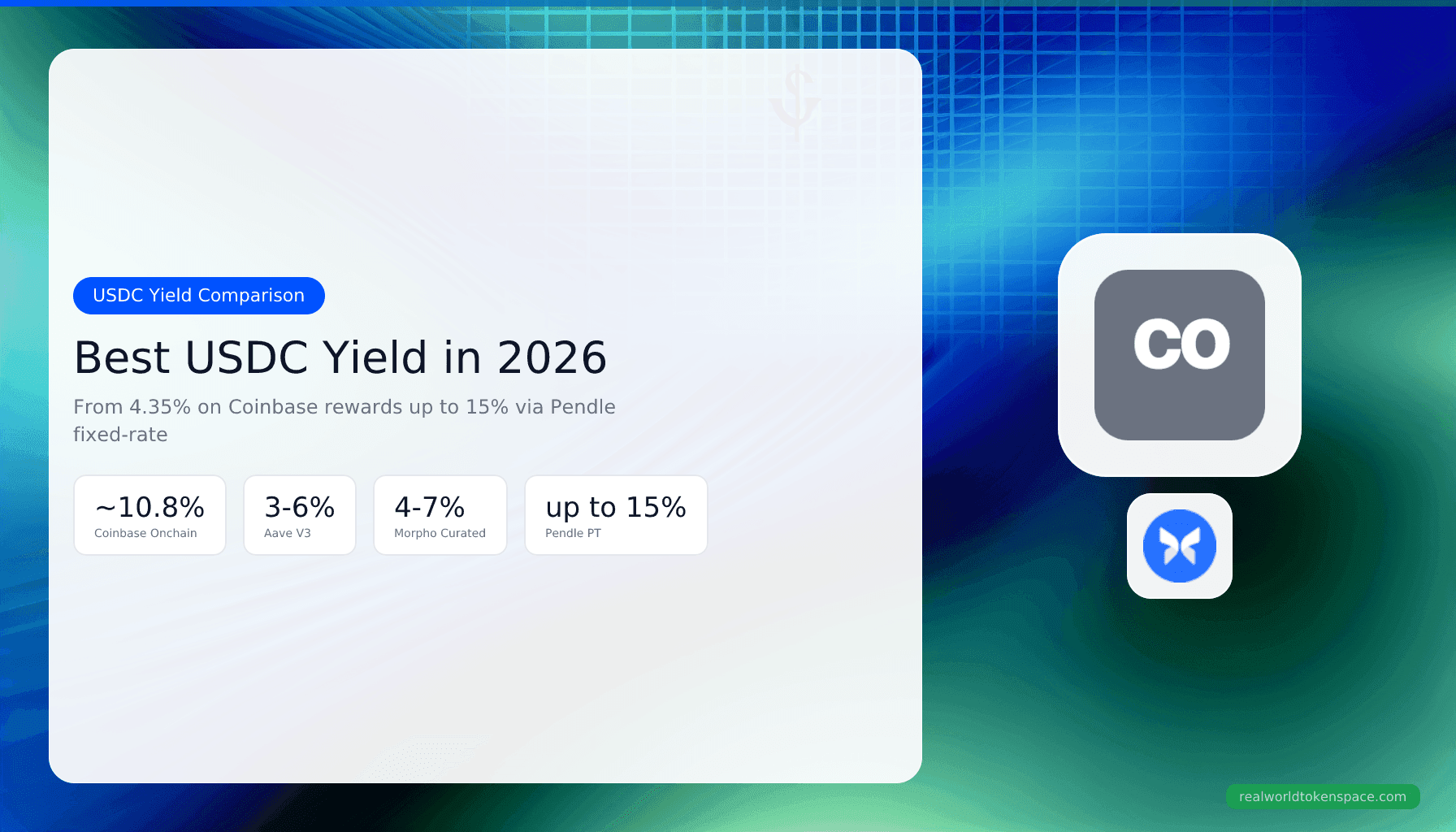
That is also why the old "10.8% on Coinbase" headline no longer applies. It was reported at the September 2025 launch of Coinbase's USDC lending through Morpho, and part of it was a temporary token incentive (Decrypt). On 16 November 2026 the two Steakhouse USDC vaults on Base paid about 4.5% (Prime) and 3.2% (High Yield, after a 25% fee) (Morpho API).
What backs each route and who holds the money
The comparison below uses live RWTS directory scores and the latest rate for each route.
| Route |
Trust Score |
Rate, 16 Nov 2026 |
What backs it |
Who holds it |
| Coinbase USDC Rewards |
82 (A-) |
4.10%* |
USDC on Coinbase; reward from Coinbase's funds |
Coinbase (custodial) |
| Steakhouse USDC, Morpho |
77 (B+) |
4.26% net |
Loans against WBTC, cbBTC, weETH, wstETH |
Morpho contracts |
| Aave V3 USDC (aUSDC) |
75 (B+) |
4.03% (Ethereum) |
Overcollateralised loans, many assets |
Aave pool contracts |
| Gauntlet USDC Prime, Morpho |
74 (B) |
4.24% net |
Loans against WBTC, wstETH, cbBTC, WETH |
Morpho contracts |
| sUSDS |
74 (B) |
3.80% |
Sky Savings Rate on USDS |
Sky contracts |
| Steakhouse Prime USDC, Base |
67 (B-) |
4.50% net |
Loans, about 90% against cbBTC |
Morpho contracts |
| Coinbase High Yield USDC vault |
64 (C+) |
3.21% net |
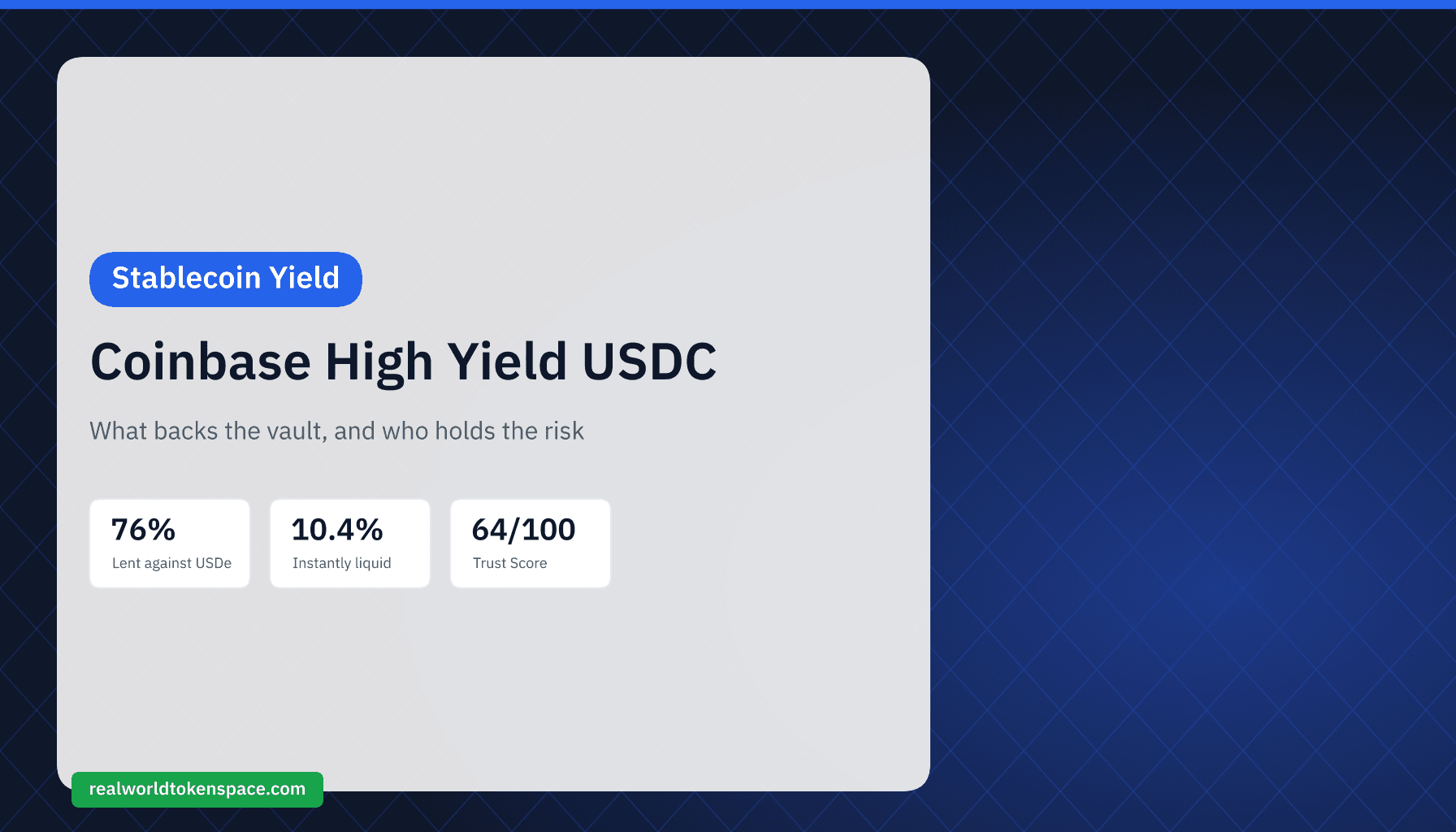
Loans, mostly against Ethena's USDe |
Morpho contracts |
| sUSDe |
61 (C+) |
5.29% |
Crypto hedged with short futures |
Copper and Ceffu custody |
| Maple syrupUSDC |
59 (C) |
5.22% |
Loans to crypto institutions, mostly BTC-backed |
Anchorage, BitGo, Zodia |
Sources: Trust Scores from the live directory pages, 16 Nov 2026. Rates: Coinbase's USDC page; Morpho API for the four Morpho vaults; DefiLlama yields for Aave, sUSDS and sUSDe; syrupUSDC from its directory page. *Coinbase says its rate can vary by country and account type. For institutions, tokenized Treasury funds sit beside these: BUIDL scores 84 at 3.53% with a $5M minimum, and USYC 81 at 3.42% from $100K.
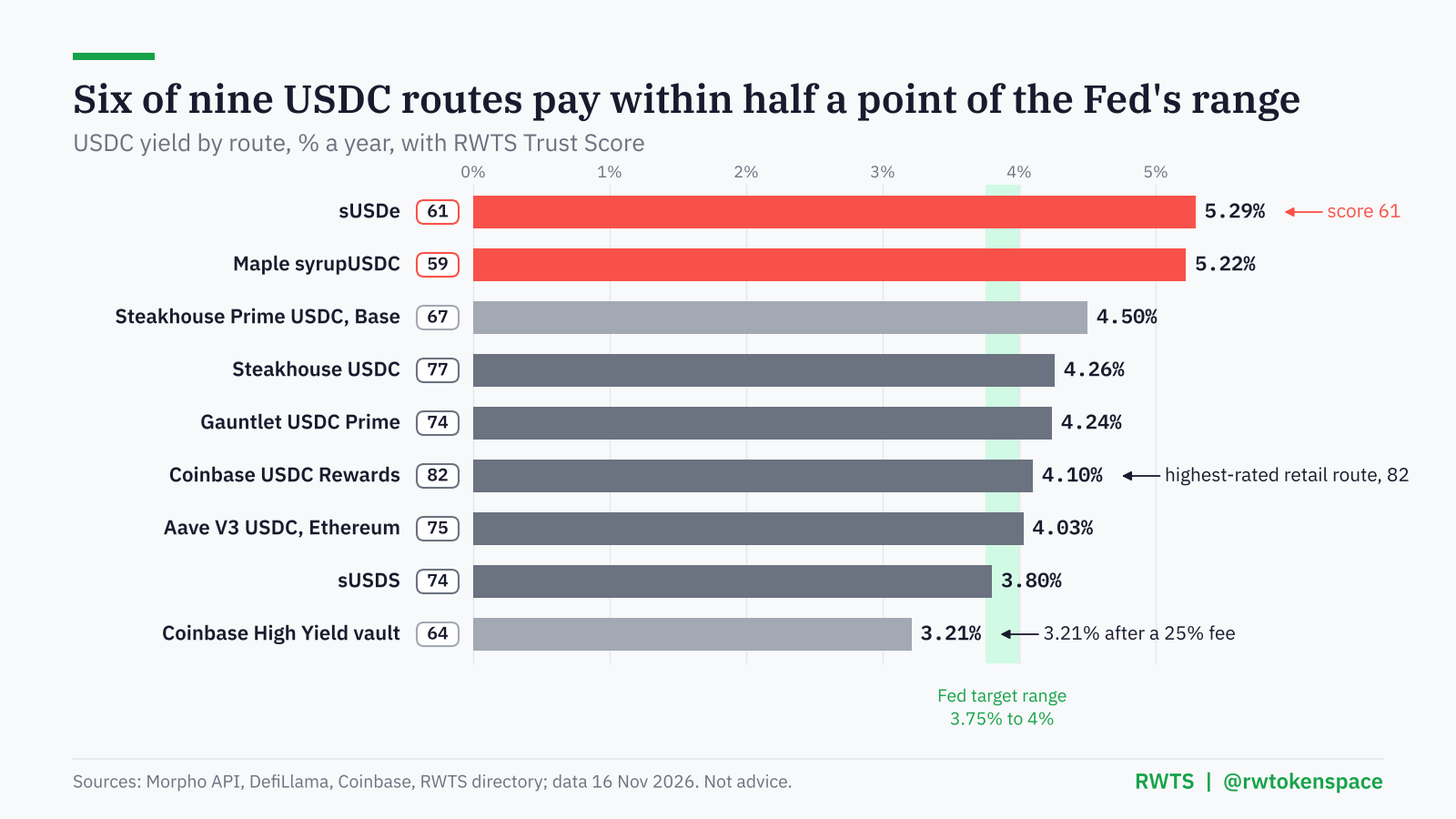
Two patterns stand out. Score and rate are not opposites here: the highest-rated retail route paid more than Aave and more than the vault named "High Yield". And the two routes paying above 5% score 61 and 59, below every route in the table that pays around 4%.
How you get out
The exit is where routes with similar rates stop looking alike.
- Coinbase USDC Rewards: no lock-up. Rewards accrue daily and arrive monthly; you can withdraw or sell USDC at any time, as long as Coinbase is operating normally.
- Aave and Morpho vaults: withdraw instantly, but only from cash that is not lent out. On 16 November Steakhouse's Ethereum vault had about 80% of its $72.9M available, Gauntlet Prime all of its $21.3M, and Steakhouse Prime on Base about 89% of $129.2M (Morpho API). The High Yield vault had 9.9% of $449.2M.
- sUSDS: unstake to USDS at any time with no fee, then swap back to USDC.
- sUSDe: unstake through a cooldown of up to seven days, or sell on the market at whatever price it offers.
- syrupUSDC: a first-in, first-out queue, most requests filled within 24 hours and some taking up to 30 days; open only to non-US holders.
If a route's rate is a few tenths higher but its exit is a queue, the rate is paying for the queue.
What can go wrong
The platform stops paying out. A custodial route depends on the exchange. On 30 October 2026 Binance suspended all deposits and withdrawals after a security breach it put at about $6.3 billion, and said it would cover losses from its SAFU fund and company funds (ABC7; The National). RWTS cut Binance Simple Earn from 66 to 58 (directory). Coinbase USDC balances are not FDIC or SIPC insured.
The reward gets cut or banned. Coinbase can change the rate monthly or end the programme (Coinbase FAQ). In Congress, the CLARITY Act's Section 404 would ban rewards paid "solely for holding a payment stablecoin" while allowing rewards tied to activity; the Senate failed to start debate on 15 September 2026, 49 to 50, and as of 28 October no vote was scheduled (Stablecoins Are Eating The World). If a version passes, passive exchange rewards are the route most exposed.
Lending markets run dry. When borrowers take most of the cash, withdrawals wait. A vault's rate curve pushes borrowing costs up to pull repayments in, but that takes time.
Collateral fails. Lending routes are only as safe as what borrowers posted and how fast it can be sold. The High Yield vault lends mostly against Ethena's USDe, which traded as low as $0.67 on Binance on 10 October 2025 (Coin Metrics); our vault breakdown explains how its price feed handles that.
The rate moves with the Fed. Every route here follows short-term rates. Markets were pricing a December hike after hot October inflation, which would lift these yields as T-bills roll; a cut later would lower them.
How RWTS scores USDC yield
The RWTS Rating scores six things out of 100: backing (25), verification (20), redeemability (15), security (15), regulation (15) and track record (10). It scores the structure, not the rate.
Coinbase USDC Rewards scores 82: backing 18/25, regulation 14/15 and track record 10/10 (live since October 2019), held back mainly by redeemability at 8/15, because your claim is an exchange balance and every exit runs through Coinbase. Aave's aUSDC scores 75, with full marks on security and track record but 7/15 on regulation, since no regulator covers it. sUSDe scores 61 mainly because of backing, 6/25: the dollar is a market position, not a claim on reserves. syrupUSDC scores 59, with 3/10 on track record and credit risk on the loans.
For the products in more depth, see Is Coinbase USDC Rewards Safe?, USDC Rewards vs Stablecoin Yield, and Tokenized Money Market Funds for the T-bill funds underneath many of these rates. The stablecoin yield hub lists every rated product.
FAQ
What is the best USDC yield right now?
On 16 November 2026 most routes paid between about 3.2% and 4.5%. The highest-rated route open to retail users was Coinbase USDC Rewards at 4.10% (Trust Score 82). Aave V3 paid about 4.0% (75) and Steakhouse's USDC vault on Morpho about 4.3% (77). Routes paying over 5%, such as sUSDe and Maple's syrupUSDC, score 61 and 59.
Does USDC pay interest on its own?
No. Under the GENIUS Act a stablecoin issuer cannot pay holders interest or yield just for holding the coin, so USDC itself earns nothing. Every USDC yield comes from a wrapper: an exchange reward, a lending market, a vault or a conversion into another token.
Is the Coinbase USDC Rewards rate fixed?
No. Coinbase says the programme is a loyalty reward paid from its own funds, that the rate can change at any time and can vary by country and account type, and that it can end the programme. Rewards accrue daily and are paid monthly.
Why do some USDC yields pay more than 5%?
Because the extra yield pays for a specific risk. sUSDe earns from Ethena's hedged crypto trade and has a cooldown of up to seven days; syrupUSDC lends to crypto institutions and can queue withdrawals for up to 30 days. Both score around 60 on the RWTS Trust Score, against 75 to 82 for the main routes near 4%.
What happened to the 10.8% Coinbase USDC lending rate?
That headline, reported at the September 2025 launch of Coinbase's USDC lending with Morpho, included temporary token incentives on top of borrower interest. On 16 November 2026 Morpho's data showed the two Steakhouse USDC vaults on Base paying about 3.2% and 4.5% net.
Figures as of 16 November 2026 unless stated; rates change daily. Not financial advice.
=====
X PIECE
The Yield Report is launching soon
Weekly yield intelligence on tokenized gold, silver, treasuries and on-chain yield. Join the early list for the first issue.
Join the early list