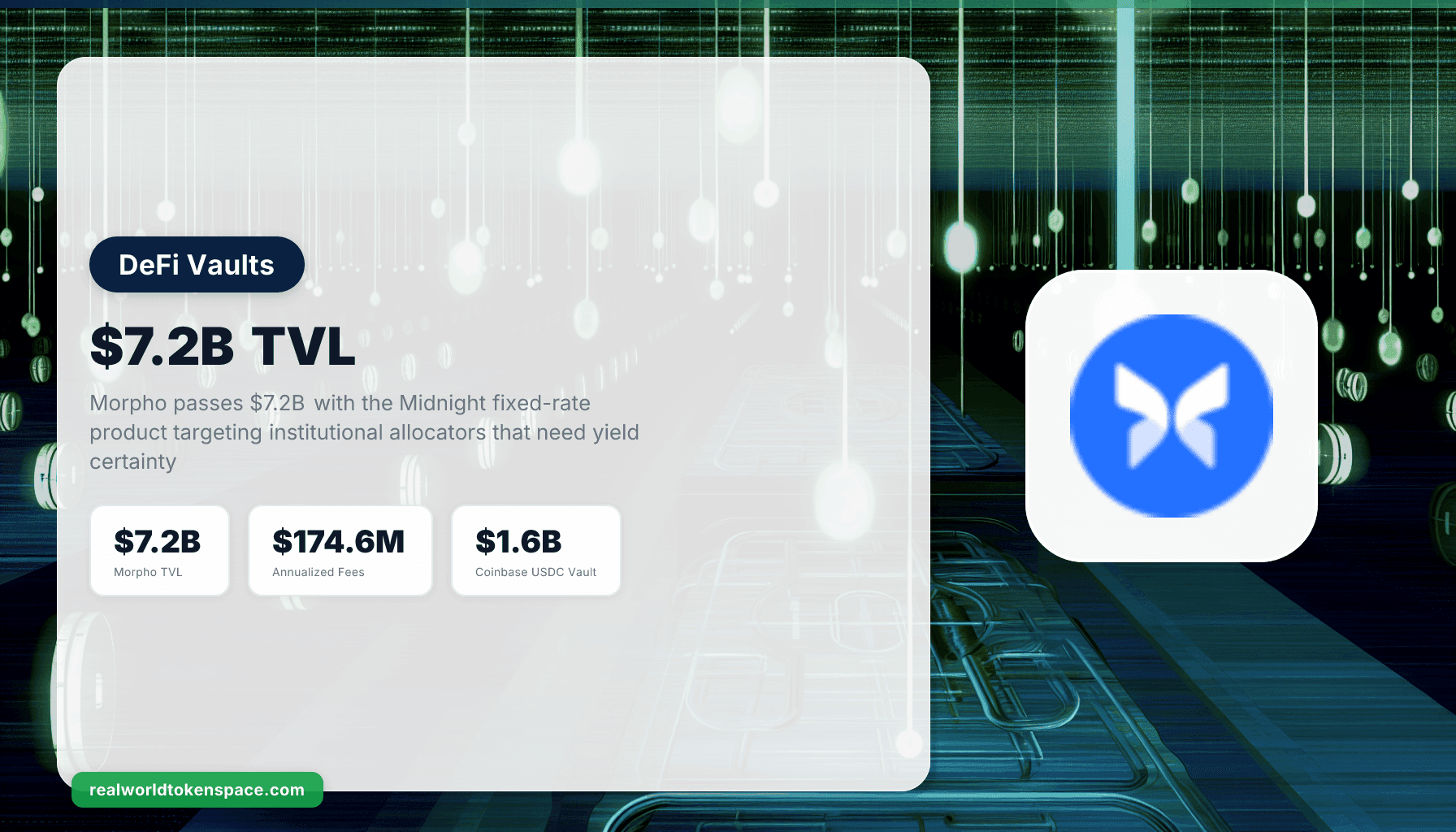
Morpho's total value locked crossed $7.2 billion in the first week of May, according to DefiLlama's protocol page. Annualized fees ran at $174.6 million on the same date. That puts Morpho at second place behind Aave v3 in DeFi lending, ahead of Spark, Compound, and Maple. The number that matters more for the next phase is what got built on top of it: Morpho Midnight, the protocol's fixed-rate institutional product, launched on April 14.
The institutional thesis for Morpho was never about retail yield-chasing. It was about giving allocators a configurable lending primitive with curators standing in for traditional credit committees. The April launch of Midnight is what completes that thesis. Variable rates are fine for crypto-native capital. They are unworkable for any treasury that has to forecast a quarter ahead.
What changed in April
Three product moves landed in the same window:
Morpho Midnight (April 14) introduces fixed-rate lending markets where the borrower locks in an APR before the loan opens. This is the structural piece TradFi treasurers have been asking for. A corporate treasurer cannot underwrite a position whose yield could move 400 basis points overnight, regardless of whether the protocol is otherwise sound. Midnight prices the rate up front by routing through an interest rate swap mechanism that hedges the floating leg in the background. From the borrower side, the experience is the same as a fixed-rate term loan. From the lender side, allocators receive a fixed coupon for the life of the position.
Morpho Agents Beta (April 8) opens a chat interface to the protocol for developers building automated allocators, vault rebalancers, and risk monitors. The agent surface is a precondition for the kinds of institutional integrations that would otherwise need a custom SDK. We expect this to matter more in 2027 than it does in 2026, but it is the right groundwork.
Coinbase USDC integration matured. The Steakhouse-curated vault that routes USDC from US Coinbase customers into Morpho markets has compounded since the September 2025 launch and now sits at $1.6 billion in deposits, per Steakhouse's vault page. That is a single distribution partner contributing roughly 22% of total Morpho TVL.
The pattern is consistent. Morpho is building infrastructure for somebody else's distribution.
The fixed-rate question, properly framed
Crypto-native lending has historically been variable-rate because the underlying yield sources are variable. Stablecoin demand fluctuates, perp funding fluctuates, and the protocols that pass that yield through to depositors fluctuate with it. Pendle's entire business is converting that floating exposure into fixed exposure through principal token mechanics, and we covered the TVL compression that hit Pendle this spring when underlying yields normalized.
Midnight's pitch is different. Rather than using a tokenized fixed-leg structure that requires the depositor to understand principal and yield tokens, it presents fixed-rate markets natively. The hedging happens at the protocol layer. The depositor sees a quoted rate and a maturity. That is the abstraction TradFi treasurers were trained on.
Three considerations sit underneath the abstraction:
The fixed leg is only as fixed as the swap counterparty's solvency. Midnight's launch documentation names the parties handling the rate hedge. Sophisticated allocators will read those names carefully before sizing.
The duration available at launch is short, in the 30 to 90 day range. That fits short-term cash management mandates. It does not yet fit longer-duration credit allocations. Morpho has signaled longer maturities are on the roadmap, but the curve is the curve until it isn't.
The yield premium over variable is currently around 40 to 60 basis points lower than the equivalent variable market, as the market pays for certainty. That is in line with traditional fixed-vs-floating spreads. Anyone expecting a fixed-rate product to pay more than its variable equivalent is reading the wrong product.
Trust Score: the curator question
Morpho is a primitive. The Trust Score that matters is the curator's, not the protocol's, because curators are the ones setting collateral lists, LTV thresholds, and oracle choices. The four curators we currently rate:
Steakhouse Financial, Trust Score 87, Tier 2. Steakhouse runs the largest Morpho vaults including the Coinbase USDC vault and several stablecoin yield vaults. Their public risk methodology is the most documented in the curator set. Drag on the score is operational concentration, with the team running too much capital relative to headcount.
Gauntlet, Trust Score 84, Tier 2. Gauntlet's risk modeling is the institutional benchmark and they manage curated vaults for several large allocators. Score reflects strong methodology and weaker direct distribution. They serve allocators who can underwrite curator quality themselves.
MEV Capital, Trust Score 81, Tier 2. MEV Capital runs the higher-yield curated vaults, with a more aggressive collateral list. The yield premium is real. The score reflects methodology completeness and recent vault performance. Suitable for allocators who explicitly want the higher-yield bucket.
Block Analitica, Trust Score 79, Tier 2. The most recent addition to the curator set. The model is solid and the team is credible. The score reflects shorter operating history under stress conditions.
Morpho the protocol receives an 84 Trust Score, Tier 2, on its own. The full institutional question is: which curator, which vault, which collateral list. Not "is Morpho safe."
What this means for an allocator
For a treasury looking to put stablecoins to work onchain with fixed-rate certainty, Midnight is the first DeFi product that prices like a bank product. The 30 to 90 day curve fits operating cash mandates. The Steakhouse and Gauntlet curated vaults give a credible curator option without requiring in-house DeFi expertise.
For a fund running variable-rate strategies, Morpho's existing markets remain the cleanest primitive in the lending stack. The fee revenue at $174.6M annualized confirms market activity. The Coinbase USDC vault confirms institutional distribution is live, not theoretical.
For a retail allocator, the curator-routed vaults remain the highest-quality on-ramp into Morpho. Direct market participation requires understanding LTV mechanics and oracle choice. Curated vaults abstract that work in exchange for a curator fee that is disclosed up front.
The case against Morpho remains the same as the case against any DeFi lending primitive: smart contract risk, oracle risk, and curator risk. The case for Morpho is that the team has built the cleanest abstraction for institutional capital to express any of those risks at the level it wants to take them.
The bottom line
Morpho at $7.2B is not a hype number. It is a distribution-driven number, with Coinbase's USDC routing accounting for a meaningful share of the growth. Midnight is the product that makes the institutional pitch make sense. Treasurers do not buy variable rates. They buy fixed rates. Morpho now offers both.
For the curators, the rating gap matters more than the protocol rating. We rate. You decide.
Related research
Sources