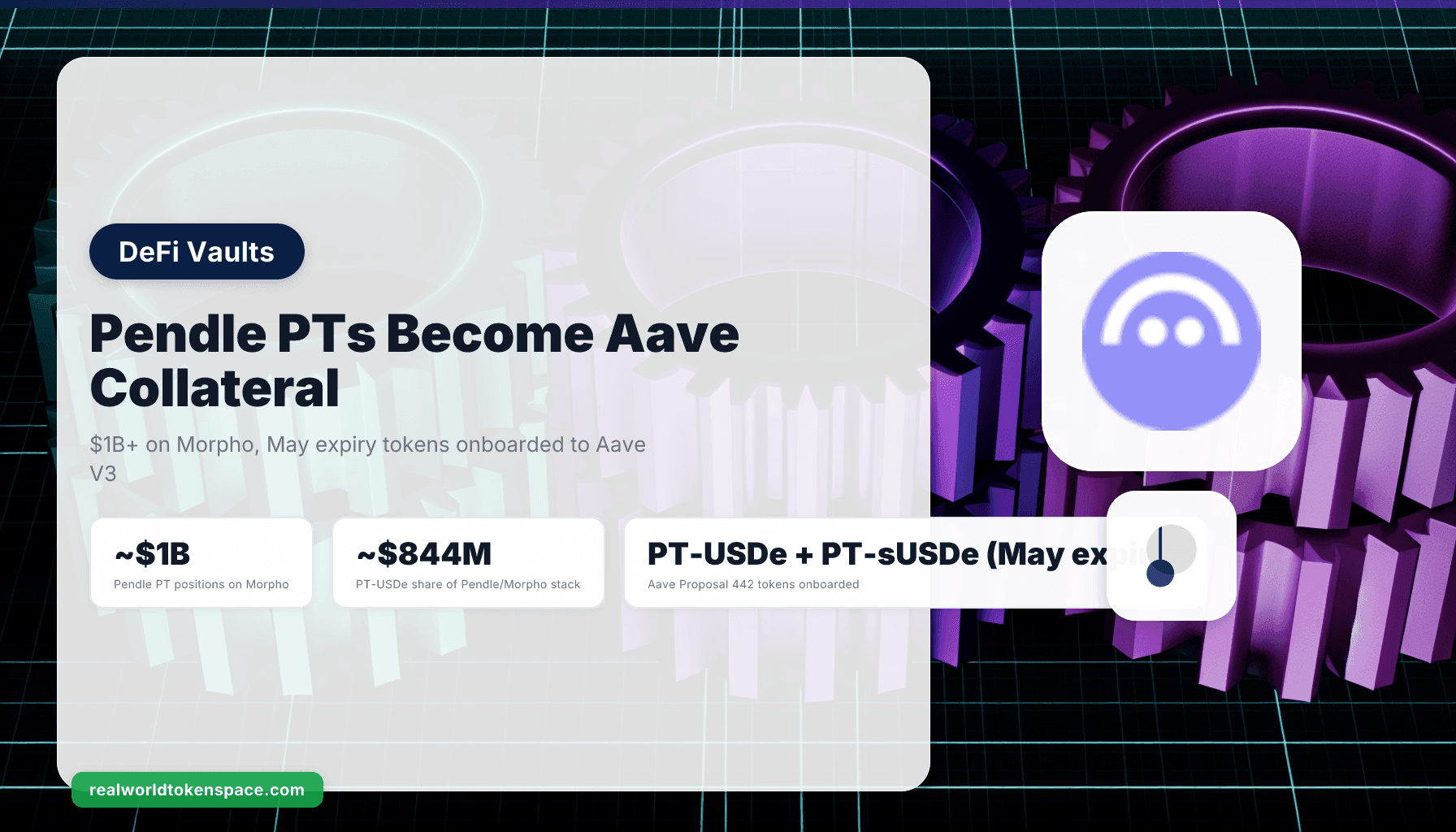
The Aave DAO approved Proposal 442 this month, onboarding May 2026 expiry Principal Tokens for USDe and sUSDe to Aave V3's Core instance as collateral assets. Read alone, this is a routine collateral listing. Read alongside Morpho's existing exposure (over $1 billion of Pendle PTs are already locked there as collateral, $844 million of which sits in PT-USDe positions), it is the institutionalization of a three-protocol yield engine that did not exist eighteen months ago. Ethena generates the yield. Pendle packages it into a fixed-rate token. Aave and Morpho lend against it. The flywheel is now formal infrastructure across the two largest DeFi lending venues.
The mechanism is elegant. The risk surface is also new. Allocators who want to participate need to understand both at the same level of resolution.
What the Proposal Actually Did
Pendle's Principal Tokens (PTs) represent the principal portion of a yield-bearing asset stripped from its yield. A holder of PT-sUSDe May expiry receives the right to redeem one sUSDe at maturity, but does not receive the streaming yield between now and expiry. Because the holder gives up the yield stream, the PT trades at a discount to one sUSDe today. That discount is the fixed APY embedded in the token. If sUSDe is priced at one dollar and PT-sUSDe May expiry trades at $0.99, the holder is locking in approximately 1% absolute return for the remaining time to maturity, expressed annualized. If the remaining tenor is two months, the annualized yield is roughly 6%. The PT structure converts the variable, funding-rate-driven sUSDe yield into a fixed-rate instrument over the chosen tenor.
Aave Proposal 442 made these PT tokens eligible as collateral on the V3 Core instance, meaning a holder can deposit PT-USDe or PT-sUSDe and borrow USDC, USDT, or other supported assets against them. The headline use case is leverage on the underlying yield: deposit PT-USDe, borrow USDC at Aave's borrow rate, swap the borrowed USDC for more PT-USDe, and repeat. Each loop amplifies the fixed-rate spread between the PT yield and the Aave borrow rate. With sUSDe yields around 5.37% headline and Aave USDC borrow around 5%, the unleveraged spread is thin. Leveraged three to four times, the spread becomes meaningful. The same loop has been running on Morpho for several quarters, which is why Morpho's $844 million PT-USDe position dwarfs every other category of curated vault collateral on the protocol.
The Mechanism, Named in One Sentence
Aave's onboarding of Pendle PTs as collateral converts a variable-rate yield product into a leveragable fixed-rate instrument, which compresses funding-rate volatility into discount-rate volatility while creating a recursive borrowing channel that materially expands the leverage capacity of the Ethena ecosystem.
The lever is composability. Each protocol in the stack does one thing well. Ethena holds the spot-and-perp basis trade and earns the funding spread plus stETH yield. Pendle decomposes Ethena's variable yield into a fixed-rate principal claim and a variable-rate yield claim, then makes a market in both. Aave and Morpho hold the lending side, accepting the PT as collateral and lending against it at a borrow rate that is normally below the PT's effective yield. The composability multiplies the capital efficiency of the underlying basis trade. A single dollar of USDC on the spot side can support several dollars of PT exposure on the leveraged side, and the protocol stack distributes the resulting yield to lenders, borrowers, curators, and PT-YT traders at each layer.
The ChainCatcher risk analysis from earlier in 2026 is the cleanest read on what this composability looks like under stress. The PT collateral on Aave is rate-sensitive in a way that pure spot collateral is not: the PT's market price is a function of the discount rate, and the discount rate moves with the funding rate of the underlying USDe basis trade. If funding rates compress further (we are already at a multi-quarter low), PT prices need to recalibrate upward to reflect the lower fixed rate they now embed. If funding rates spike (rare but possible during a leverage unwind or a CEX-side liquidation event), PT prices recalibrate downward and the leveraged loop on Aave faces real liquidation pressure. The PT collateral framework is robust at current rates, but it is not equivalent to depositing pure USDC.
The Numbers Behind the Composability
The cross-protocol picture as of mid-May 2026 is this. Morpho's total TVL sits at approximately $7.2 billion, with curated vault TVL around $5.8 billion. Of that, more than $1 billion is in Pendle PT collateral, with $844 million concentrated in PT-USDe positions and the remainder split across PT-sUSDe and other yield-stripped assets. This is the largest category of collateral on Morpho's curated stack and accounts for a meaningful share of the protocol's risk-weighted exposure.
Ethena's USDe TVL is approximately $5.88 billion, down from a July 2025 peak of $14.8 billion. The ratio of sUSDe to USDe outstanding sits around 55% in early 2026, which is the share of holders who are taking the staking yield rather than holding the unstaked stablecoin. The 7-day trailing average sUSDe APY is approximately 9.4% per Ethena's docs, with the 90-day trailing at 11.8% and the headline current rate at 5.37%. The difference between the trailing averages and the current rate captures the rapid funding compression of the past two months.
Pendle's TVL is approximately $1.5 billion as of late April, an 89% drawdown from the September 2025 peak of $13.1 billion. The drawdown reflects the leverage cycle reversal we wrote about on May 8: when the marginal borrower disappears, the speculative demand for yield tokenization collapses with it. Despite the headline TVL drop, Pendle's structural relevance has actually increased through this period because Aave and Morpho have institutionalized the PT format as collateral. The protocol's TVL is a snapshot of its own balance sheet; its systemic relevance is measured in the size of the lending markets that price PTs as collateral.
Aave V3's deposit base is approximately $27.8 billion as of February 2026, with USDC supply around $4 to $5 billion across all instances. The Proposal 442 onboarding of May expiry PTs is a measured expansion of an already-running flywheel. The Plasma instance and Base instance have separately onboarded sUSDe, USDe, and additional PT expiries through governance proposals throughout Q1 and Q2 2026, formalizing the three-protocol stack as a shared institutional layer rather than a single-protocol experiment.
The Risk Surface
Three layers of risk stack on top of each other, and each one needs naming.
The first is funding rate risk. Ethena's USDe yield is the funding spread of the perpetual basis trade plus the stETH staking yield. When perpetual funding compresses (which it has, sharply, since Q4 2025), the basis trade clears closer to the staking yield alone. The 90-day trailing 11.8% sUSDe APY versus the 5.37% current headline rate quantifies how much variability exists in this layer.
The second is discount rate risk. Pendle PT prices are functions of the time to maturity and the implied yield. When the underlying yield compresses or when the term structure flattens, the PT discount narrows and the price moves toward par. When it expands, the discount widens and the price moves away from par. Holders who acquired PTs at one implied yield and need to exit before maturity are exposed to mark-to-market moves that depend on the path of the underlying funding rate.
The third is liquidation cascade risk. Holders who lever PT positions through Aave or Morpho borrowing are exposed to the discount rate moving against them. If PT-USDe prices fall sharply (because funding rates spike or because the term structure inverts), the leveraged positions face liquidation thresholds. The cascade can be self-reinforcing: liquidations sell PT-USDe into a market that already has a price problem, deepening the move.
The October 2025 Ethena peg test provided a real read on how this stack behaves under stress. USDe held its peg through the event but with notable secondary-market dislocation, and the leveraged PT positions on Morpho that survived did so with maintenance margin that priced the dislocation. The lesson is that the three-protocol stack is robust at current scale but is not invariant to a sustained funding-rate or discount-rate shock.
The RWTS Read on the Cohort
For allocators evaluating this stack, the Trust Score view positions the underlying assets in a clear hierarchy. BUIDL at 88 (Tier 2) remains the risk-free benchmark for stablecoin yield: BlackRock's tokenized Treasury fund pays approximately 4.85%, the actual short-duration Treasury bill rate, with the lowest operational risk in the cohort. sUSDe at 74 (Tier 3) is the highest-variance product, exposed to the basis trade cycle and the funding-rate dependence we just walked through. PENDLE at 71 (Tier 2) is the protocol token that captures fees from the PT/YT market and is exposed to the protocol's TVL trajectory more directly than the underlying assets it tokenizes.
If a USDC allocator's choice is between BUIDL at 4.85% (Trust Score 88) and a leveraged PT-sUSDe loop on Aave or Morpho yielding 8% to 12% net of borrow cost, the risk-adjusted question is whether the additional 300 to 700 basis points of yield compensates for the layered funding rate, discount rate, and liquidation cascade risk we walked through. At current funding rates, the answer is closer to "no" than it was a year ago. At the 2025 peak when sUSDe was clearing 14% headline, the answer was clearly yes. Today's compressed-funding environment changes the calculus, and the institutional onboarding of PT collateral is happening at the same time the underlying yield is at its weakest in the cycle.
The Conditional Frame
If Aave Proposal 442 onboards subsequent PT expiries through 2026 and the Plasma and Base instances continue to formalize the stack, the three-protocol composability layer becomes the dominant institutional yield engine in DeFi. If funding rates rebuild and sUSDe headline yield returns to the 8% to 10% range, the leveraged PT loop becomes the most capital-efficient yield strategy on the major venues. If, instead, funding rates compress further and sUSDe trades closer to its staking-yield floor, the leverage spread compresses and the borrowed-loop economics break. The TVL of the three-protocol stack will follow the funding rate, not the other way around.
The Bottom Line
Aave Proposal 442 institutionalized Pendle PT-USDe and PT-sUSDe as Aave V3 collateral, formalizing a three-protocol yield engine that already holds over $1 billion on Morpho. Ethena generates yield from the perpetual basis trade. Pendle packages it into fixed-rate principal tokens. Aave and Morpho lend against the PTs. The composability multiplies capital efficiency. The risk surface multiplies as well.
Allocators participating in this stack are taking funding-rate risk, discount-rate risk, and liquidation-cascade risk simultaneously. At current compressed funding levels, the per-basis-point compensation for those risks is the lowest it has been in the cycle. At 2025 peak yields, the trade was structural. Today it is conditional.
RWTS isn't bullish or bearish on any of these protocols. We rate. You decide.
Not financial advice.
Related research