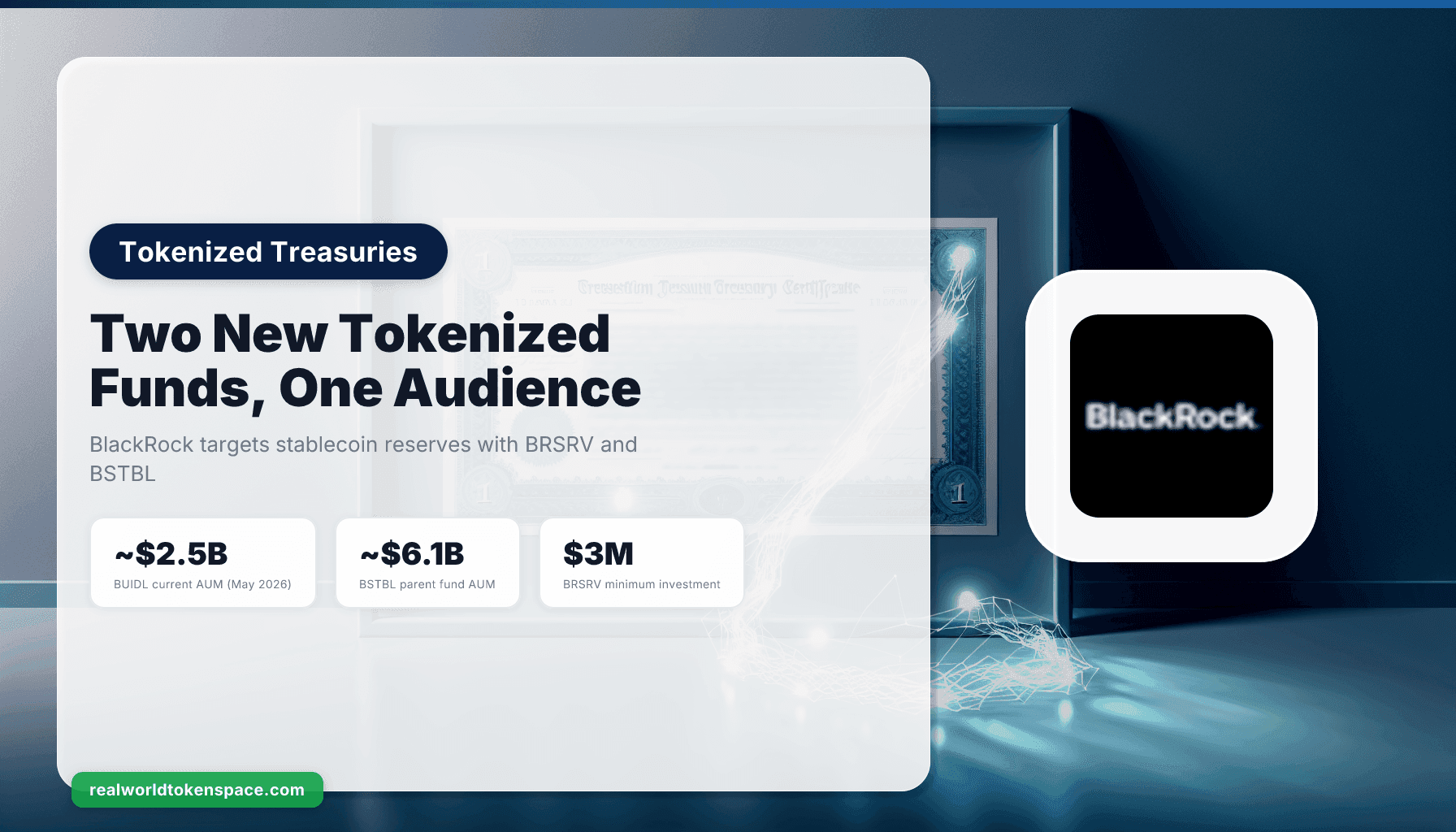
BlackRock filed two new tokenized fund applications with the SEC on May 8 and 9, 2026, in a move that extends the BUIDL footprint from a single $2.5 billion tokenized money market fund into a product line aimed at a specific, growing buyer: stablecoin issuers looking for a regulated, audited, ERC-20-wrapped home for the Treasury reserves backing their tokens. The two filings, the BlackRock Daily Reinvestment Stablecoin Reserve Vehicle (ticker BRSRV) and the BlackRock Select Treasury Based Liquidity Fund (ticker BSTBL), do not change the BUIDL fund itself. They define the next layer of the BlackRock tokenization stack and address an addressable footprint of roughly $6.1 billion in existing fund AUM that BlackRock can migrate onchain through the filings.
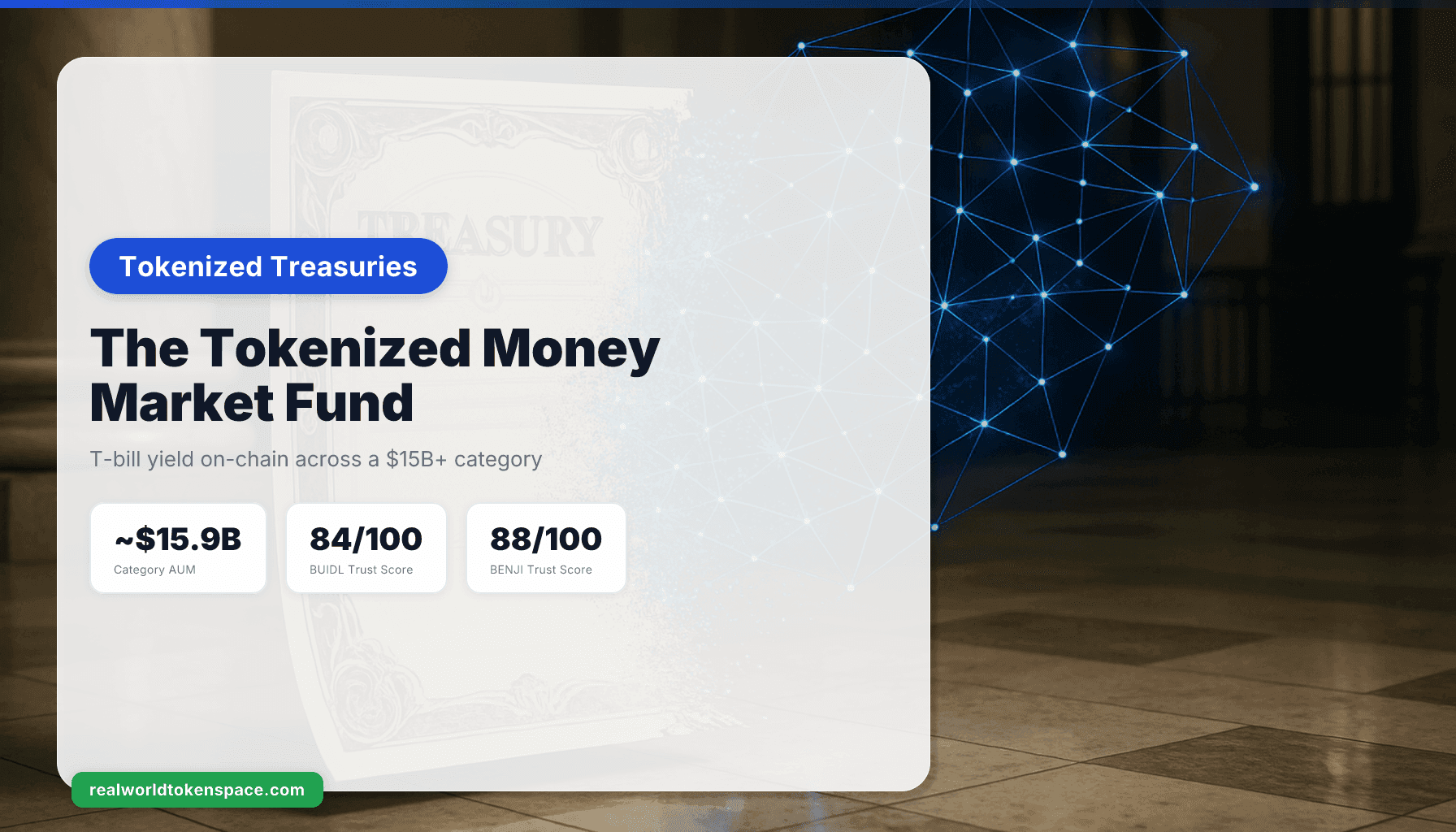
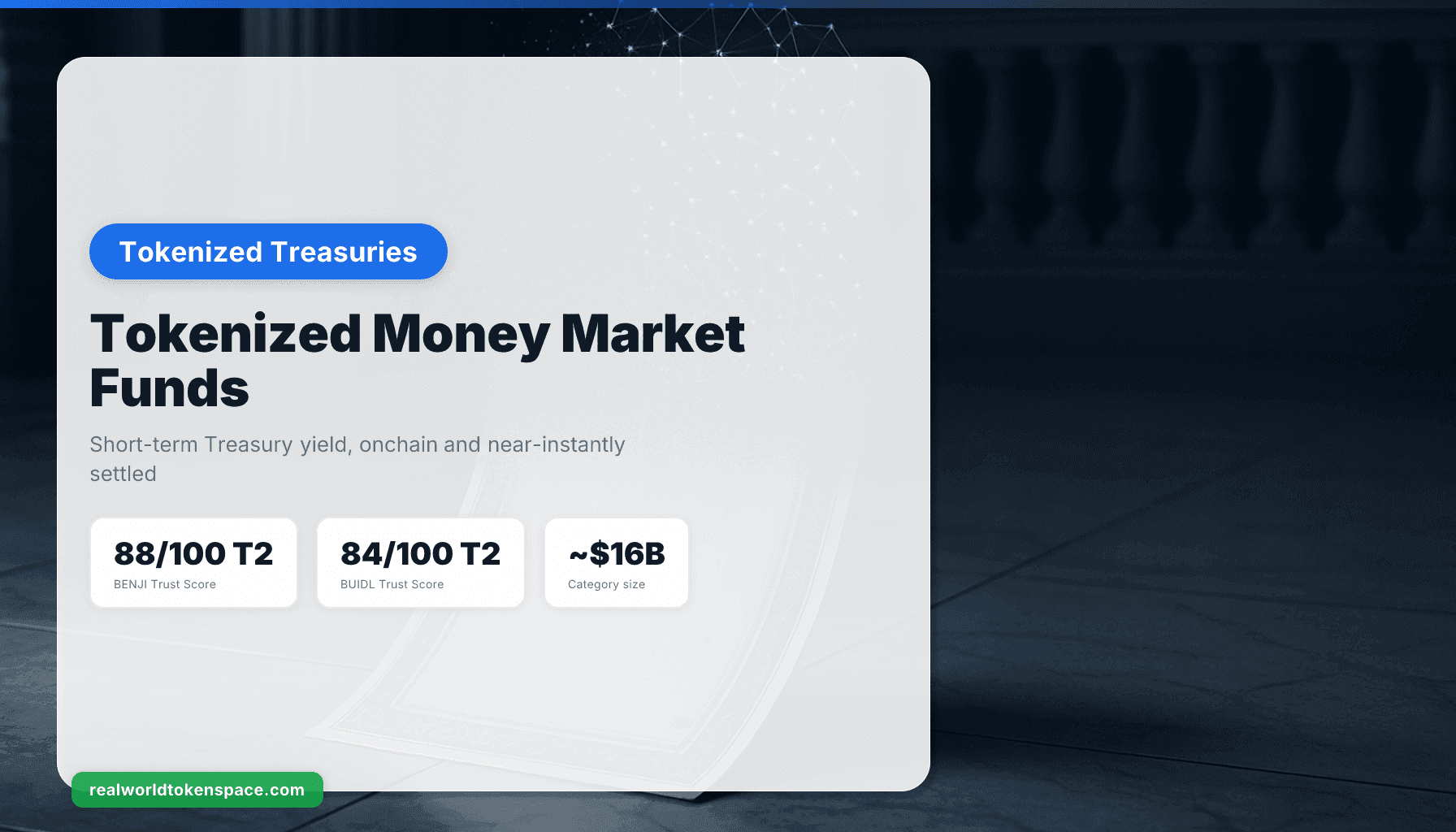
For allocators tracking the tokenized treasury market, the timing matters as much as the filings themselves. BUIDL is approaching three years on Ethereum, the broader tokenized treasury category has crossed $14 billion in market cap (per rwa.xyz), and the question for the next twelve months is whether the second wave of tokenization is driven by retail wrappers (USDY, USYC, OUSG) or by institutional wrappers aimed at stablecoin and corporate treasury balance sheets. The BlackRock filings are a clear vote for the latter.
What the Filings Actually Cover
The BRSRV fund is the more specific of the two. The Daily Reinvestment Stablecoin Reserve Vehicle invests in cash, short-term US Treasuries with maturities of 93 days or less, and overnight repurchase agreements backed by Treasuries. It issues "OnChain Shares" through a permissioned framework that connects to multiple public blockchains, with Securitize Transfer Agent LLC serving as the transfer agent of record (the same role Securitize plays for BUIDL). The minimum investment is $3 million, signaling a permissioned wholesale product rather than a retail wrapper. The naming is the tell: "Stablecoin Reserve Vehicle" is the product description, and the daily reinvestment structure is built around the operational pattern stablecoin issuers actually run, which is overnight reinvestment of Treasury collateral into the next-day reserves backing the outstanding token supply.
The BSTBL fund is a different shape. The roughly $6.1 billion BlackRock Select Treasury Based Liquidity Fund (BlackRock's existing institutional liquidity vehicle) gets a tokenized share class via the same Securitize transfer agent infrastructure. Holdings continue to be cash, US Treasury bills, and short-duration Treasury notes with maturities of 93 days or less. The migration is not a new fund. It is a tokenization wrapper around an existing $6 billion-plus AUM fund, with the onchain shares issued under ERC-20 standards and BNY Mellon Investment Servicing handling the official ownership records.
Both products are clearly aimed at the same buyer set: stablecoin issuers (USDC, USDT competitors, payment-focused stablecoins) and corporate treasury teams running large dollar balances who want a regulated treasury allocation with same-day onchain settlement.
The Mechanism, Named
The lever connecting BlackRock's filings to stablecoin economics is the reserve composition rule. Major dollar stablecoins back outstanding tokens with cash and short-dated Treasuries, and the yield on those reserves is the issuer's primary revenue stream. Today, that yield accrues to the issuer's balance sheet (Circle's IPO disclosures made this explicit at scale), and stablecoin holders typically receive zero or near-zero on-token yield. The BRSRV and BSTBL filings move BlackRock into the regulated layer of that economic stack: the products provide stablecoin issuers an onchain, audited Treasury vehicle that fits into reserve composition disclosures while reducing the operational friction of holding off-chain Treasury portfolios that mirror onchain liabilities. The mechanism is plumbing, not yield innovation. It is BlackRock charging a thin management fee to remove operational drag from a $200-plus billion stablecoin reserve market that has historically run on a manual, monthly attestation cadence.
Compared to BUIDL (which is currently held by a mix of crypto-native treasuries and the Ondo issuance pool), BRSRV's $3 million minimum and "Stablecoin Reserve Vehicle" naming makes its target audience explicit. The product is not for retail. It is for the operating treasuries of stablecoin issuers.
Where the Conditions Bind
The filings are still pending SEC approval as of this writing, and approval is not a given. The Clarity Act framework that passed earlier this year set a clearer regulatory perimeter around tokenized fund products, but the specific BRSRV structure (permissioned ERC-20 shares connected to multiple public blockchains) is a new combination that the SEC has not previously approved at scale. The historical BUIDL approval was on Ethereum only and went through a Form 144A path that was simpler regulatory territory. If BRSRV's multi-chain permissioned approach clears the SEC, the template becomes the default for the next wave of tokenized fund issuance. If it gets sent back for revisions, the BlackRock stack stays Ethereum-first for another twelve to eighteen months.
A second condition is whether stablecoin issuers actually move reserves into BRSRV. The economics of the move depend on the management fee BlackRock charges versus what the issuer would earn running its own Treasury portfolio. Circle has built out the infrastructure to run its own reserves at scale, and USDC's reserve composition is already disclosed in detail. Tether's posture is harder to read but historically has not used BlackRock for the bulk of its Treasury holdings. The most likely early adopters of BRSRV are the second-tier and emerging stablecoin issuers (payments-focused stablecoins, fintech-issued dollar tokens) who lack the operational capacity to run their own Treasury desk at scale. That is still a meaningful addressable market, and the $3 million minimum suggests BlackRock has scoped the product around it.
A third condition is competitive response. Ondo's OUSG and Circle's USYC are already in the same product space. Both have grown TVL meaningfully in the last six months. Ondo's combined TVL surpassed $3 billion in early Q2 2026. If BRSRV approval comes through cleanly, the competitive landscape narrows around three institutional-grade tokenized treasury products at scale: BUIDL/BRSRV, OUSG, and USYC. If BRSRV gets a long review, OUSG and USYC continue to fill the institutional gap.
The Trust Score View
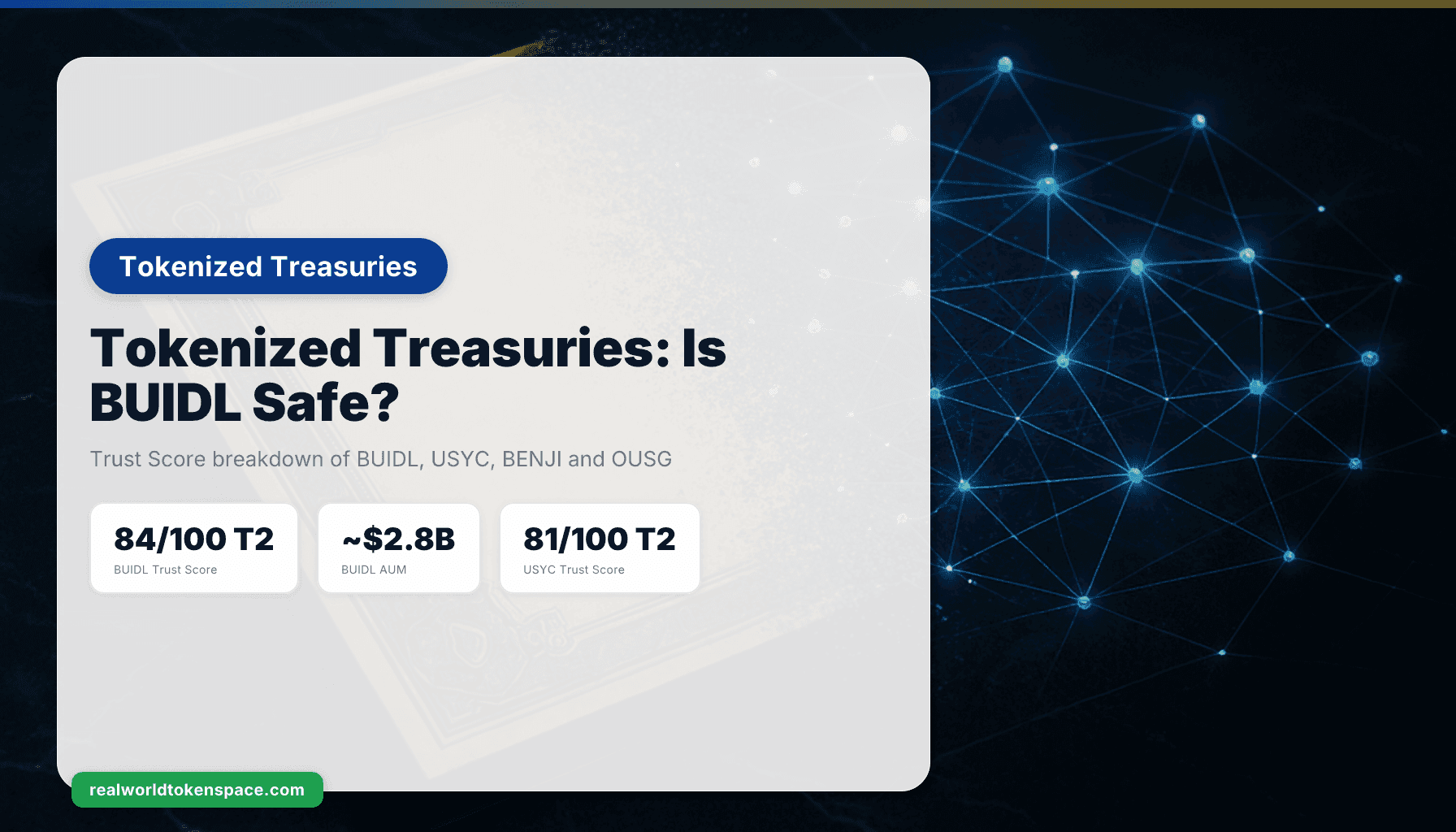
BUIDL at Trust Score 88, Tier 2 sits at the top of the institutional tokenized treasury category. The 88 score reflects BlackRock's name, the Securitize transfer agent layer, the BNY Mellon record-keeping, the daily attestation cadence, the Ethereum-native ERC-20 structure, and the operational maturity around redemption mechanics. The Tier 2 designation (rather than Tier 1) reflects the qualified-purchaser gating and the lack of full open-redemption mechanics that a retail-grade product would offer. The expected BRSRV product would land at a similar score profile, with the multi-chain permissioned structure adding complexity that needs to be evaluated post-approval.
OUSG (Ondo Short Treasuries) at Trust Score 87, Tier 2 is the closest non-BlackRock comparable. OUSG holds BUIDL and other tokenized treasury fund shares as its underlying reserve and provides a more accessible wrapper for institutional buyers who do not meet BUIDL's direct minimums. The 87 score reflects the indirect exposure (slightly more counterparty layers than direct BUIDL ownership), offset by the operational accessibility.
USYC (Circle Short-Term US Treasuries) at Trust Score 83, Tier 2 is the third major option. USYC is the Circle-issued tokenized money market product that has grown materially in the last two quarters. The 83 score reflects the somewhat shorter operational history and the dependency on Circle's broader reserve infrastructure.
For allocators evaluating where to position tokenized treasury allocations ahead of the BRSRV approval cycle, the three Trust Scored options span the range from BlackRock-direct (BUIDL, highest score, qualified purchaser gating), to BUIDL-wrapped (OUSG, slightly lower score, broader accessibility), to independent (USYC, slightly lower score, Circle-native).
The Bottom Line
BlackRock's May 8-9 SEC filings for BRSRV and BSTBL extend the BUIDL footprint from a single tokenized money market fund into a product line aimed at stablecoin issuers and corporate treasuries. The $6.1 billion BSTBL parent fund is the addressable migration footprint. The $3 million BRSRV minimum signals a permissioned wholesale product rather than a retail wrapper. The Securitize and BNY Mellon transfer agent and record-keeping stack is the operational backbone.
The mechanism is plumbing. The filings remove operational drag from a $200-plus billion stablecoin reserve market that has run on manual, monthly attestation cadence. If the SEC approves the permissioned multi-chain ERC-20 structure cleanly, BlackRock locks in the template for the next wave of institutional tokenized funds. If the review is long, OUSG and USYC continue to fill the institutional gap.
For the broader tokenized treasury category, the read is that the second wave of growth is institutional, not retail. The Trust Scored options (BUIDL, OUSG, USYC) cover the addressable allocation space. The choice between them is about counterparty layering, accessibility, and the role each plays inside an allocator's broader treasury strategy.
RWTS isn't bullish or bearish on tokenized treasury products. We're the credit-rating agency. We rate. You decide.
Not financial advice.
Related research