Tokenized money market funds are ordinary regulated cash funds whose shares live on a blockchain, and on the RWTS Trust Score the highest-rated of the nine compared here is Franklin Templeton's BENJI at 88/100, not BlackRock's BUIDL, which scores 84. They hold almost the same thing, so what separates them is who can buy, how you get your money back, and how long each structure has run on-chain.
All figures below are as of 12 November 2026 unless stated. USYC, VBILL and JTRSY are short-term Treasury funds rather than money market funds in the legal sense; they are included because holders use them the same way. Scores and sizes come from the live RWTS directory pages, which use each fund's own published total or its on-chain supply, with the date shown in the table.
How a tokenized money market fund works
A money market fund buys very short-dated government debt (Treasury bills, overnight repurchase agreements backed by Treasuries, and cash) and passes the interest to shareholders. A US government money market fund under SEC Rule 2a-7 aims to hold its share price at $1, and BENJI, for example, must keep at least 99.5% of assets in government securities, repo and cash (BENJI directory page, citing the fund's SEC filings).
Tokenization changes the share register, not the portfolio. The fund records ownership on public chains (BENJI on eight, including Stellar, Ethereum and Solana), so a share can move between approved wallets in seconds, at any hour, and can be posted as collateral. Income is paid in one of two ways:
- Stable $1 with daily distributions. BENJI, WTGXX, BUIDL and JLTXX keep the token at $1 and pay income as extra tokens.
- Rising price. Spiko's USTBL and EUTBL are variable-NAV UCITS funds, and JTRSY's token price accrues interest, so the price climbs and the token count stays the same.
The yield follows the front end of the curve. On the directory pages today, US dollar funds sit between 3.50% (WTGXX) and 4.13% (USTBL); the euro fund EUTBL shows 2.30%, because it holds euro area bills. When the Fed moves, these yields follow as maturing bills are replaced, over weeks rather than days. Markets were pricing about a 91% chance of a December hike after the hot October inflation report (RWTS Catalyst Note, 11 Nov).
What backs them and who holds the assets
The portfolios are close to identical: short-dated government bills, repo and cash, in dollars for eight of the nine and in euros for EUTBL. That is the point of the category, and it is why backing alone does not separate the leaders: every fund here scores 21 or 22 out of 25 on backing.
The custody chain is where they differ:
- BENJI: JPMorgan Chase Bank is the fund custodian.
- BUIDL: BNY is custodian and administrator; Securitize is transfer agent.
- JTRSY: J.P. Morgan is custodian; Centrifuge is the tokenization platform.
- Spiko USTBL and EUTBL: CACEIS Bank is depositary, PwC is auditor.
- VBILL: State Street is custodian.
- WTGXX and JLTXX: the custodian is not named on the sources we cite, which is one input to their verification marks.
The legal wrapper matters as much as the vault. BENJI, WTGXX and JLTXX are SEC-registered 1940 Act funds. Spiko's two funds are French UCITS regulated by the AMF. BUIDL and VBILL are unregistered private funds in the British Virgin Islands, JTRSY is a BVI professional fund, and USYC is a Cayman Islands mutual fund. Registration decides who can buy and which investor protections apply if something goes wrong.
How you get out
This is the part most holders skip, and it is where the scores split.
| Fund |
Your way out (directory, 12 Nov) |
Who can hold |
Minimum |
| BENJI |
Redeem at NAV via the Benji app, business hours |
KYC'd retail and institutions |
$20 |
| WTGXX |
Redeem T+0 by 3:30pm ET, or 24/7 sale against USDC |
US persons via WisdomTree Connect |
$1 |
| BUIDL |
Redeem via Securitize, or swap to USDC via a Circle contract |
Qualified purchasers |
$5M initial |
| USTBL / EUTBL |
Redeem at NAV daily, 11:30 Paris cut-off |
KYC'd investors, not US persons |
$1 / €1 |
| USYC |
Redeem T+0 to T+1 in USDC or PYUSD |
Institutions after KYC/KYB |
$100K |
| JLTXX |
Redeem at NAV on business days via Morgan Money, 5pm cut-off |
Institutions |
$1M initial |
| VBILL |
Redeem via Securitize; timing not disclosed |
Qualified purchasers |
$100K ($1M on Ethereum) |
| JTRSY |
Redeem daily in USDC, usually T+1, up to 7 business days |
Non-US professional investors |
500,000 USDC |
Two things stand out. First, a token that moves 24/7 does not mean a fund that redeems 24/7. Most of these funds pay out on business days, before a cut-off. Second, the round-the-clock exits that do exist run through a third party. WisdomTree's February 2026 SEC relief lets its affiliated broker-dealer buy WTGXX shares against USDC at any hour, acting as principal "up to its balance sheet capacity" (WisdomTree, 24 Feb 2026). BUIDL's USDC swap depends on the Circle facility having USDC available. Both are real advantages, and both have a ceiling.
What can go wrong
The risks are mostly the risks of a money market fund, plus a few that blockchains add.
- Liquidity mismatch under stress. The Bank for International Settlements found that tokenized money market funds carry risks that "mirror, and potentially amplify" those of conventional money market funds, including "liquidity mismatches" (BIS Bulletin 115, 26 Nov 2025). A token that settles at 3am meets a fund that redeems at 3pm.
- Use as collateral. The same BIS bulletin notes these funds "cater strongly" to DeFi protocols and are a fast-growing collateral asset. A fund share pledged in a lending market can be liquidated on that market's terms, not the fund's.
- Allow-lists and freezes. Every fund here answers "Can be frozen: Yes". Issuers control the register, and transfers only go to approved wallets. That protects against theft and sanctions breaches; it also means the issuer can stop a transfer. BIS adds that allow-lists "only constrain direct holding", so wrapped versions can travel further than the fund intends.
- Offshore wrappers. BVI and Cayman funds are regulated, but not under the 1940 Act. If you hold BUIDL, VBILL, JTRSY or USYC, the investor protections are those of the fund's own jurisdiction and documents.
- Fees eat the yield. Management fees range from 0.08% a year on JLTXX to 0.50% on BUIDL's Ethereum share class, per the directory pages. USYC charges 10% of yield instead. With dollar-fund yields between 3.50% and 4.13% on the directory pages, fees explain a good share of the difference.
- Rate risk on income, not principal. If the Fed cuts, yields fall within weeks. The $1 price does not promise a return; it reflects very short holdings.
How RWTS scores them
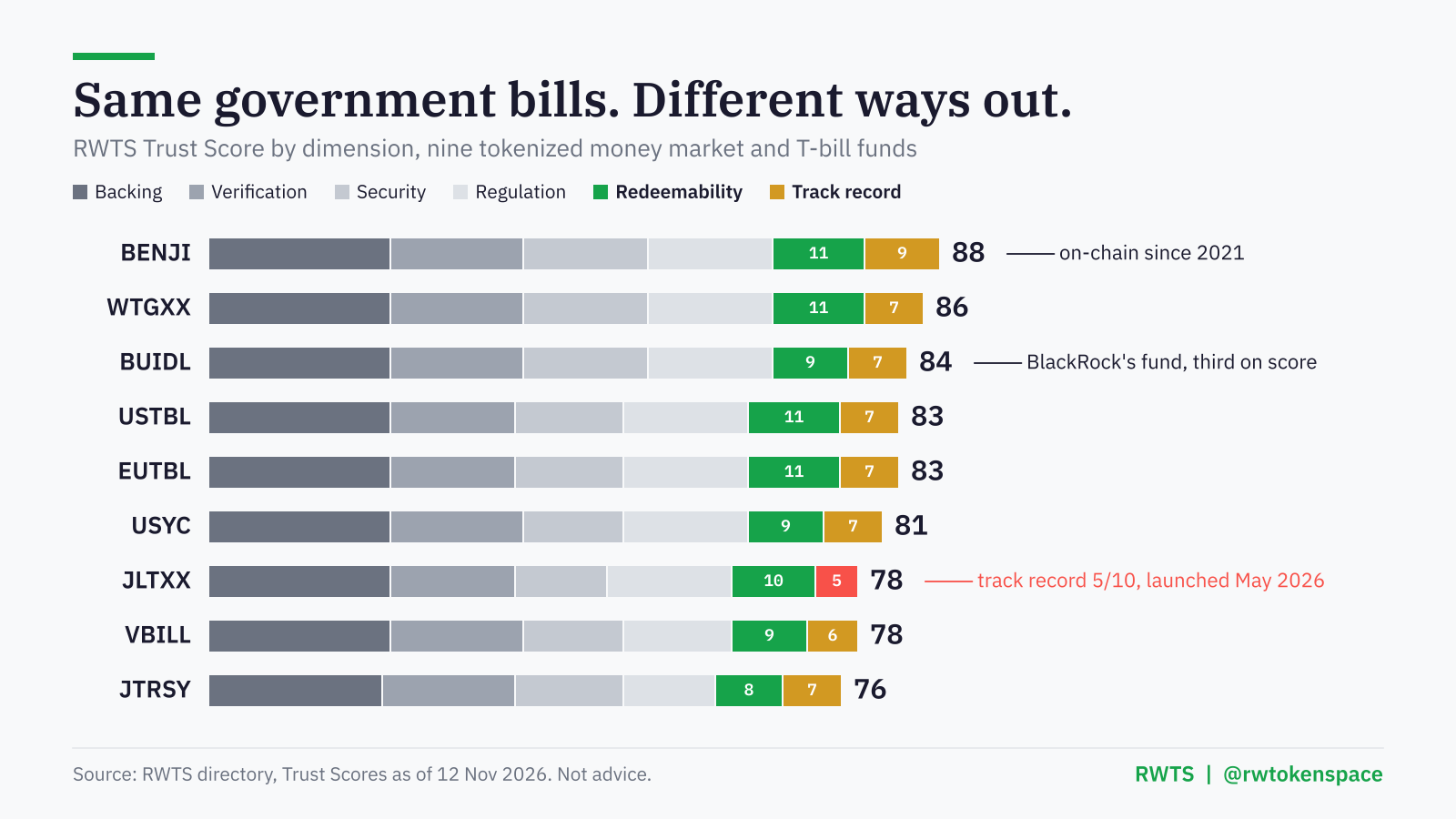
The RWTS Rating scores six dimensions out of 100: backing (25), verification (20), redeemability (15), security and audit (15), regulation (15) and track record (10).
| Fund |
Score |
Backing |
Verif. |
Redeem |
Security |
Reg. |
Track |
APY |
Size (as of) |
| BENJI |
88 |
22 |
16 |
11 |
15 |
15 |
9 |
3.80% |
$834M (31 Oct) |
| WTGXX |
86 |
22 |
16 |
11 |
15 |
15 |
7 |
3.50% |
$668M (12 Nov) |
| BUIDL |
84 |
22 |
16 |
9 |
15 |
15 |
7 |
3.53% |
$1.64B (11 Nov) |
| USTBL |
83 |
22 |
15 |
11 |
13 |
15 |
7 |
4.13% |
$160M (11 Nov) |
| EUTBL |
83 |
22 |
15 |
11 |
13 |
15 |
7 |
2.30% |
$912M (1 Nov) |
| USYC |
81 |
22 |
16 |
9 |
12 |
15 |
7 |
3.69% |
$2.10B (11 Nov) |
| JLTXX |
78 |
22 |
15 |
10 |
11 |
15 |
5 |
3.91% |
$795M (30 Oct) |
| VBILL |
78 |
22 |
16 |
9 |
12 |
13 |
6 |
3.79% |
$55M (12 Nov) |
| JTRSY |
76 |
21 |
16 |
8 |
13 |
11 |
7 |
3.59% |
$38M (12 Nov) |
Scores, APYs and sizes: RWTS directory pages, 12 Nov 2026. Sizes are each fund's published total or on-chain supply at the date shown. All Tier 2.
Read the columns, not just the total. Backing is flat. The spread lives in three places:
- Redeemability (8 to 11). BENJI, WTGXX and the Spiko funds score 11; each redeems at NAV on every business day, and WTGXX adds a 24/7 sale route. BUIDL, USYC and VBILL score 9, with access limited to qualified or onboarded institutions and the exit routed through Securitize or the issuer. JTRSY scores 8, with a window of usually T+1 and up to seven business days.
- Track record (5 to 9). BENJI has run on-chain since 2021 and scores 9. JLTXX launched in May 2026 (J.P. Morgan Asset Management, 13 May 2026) and scores 5. That is the main reason a fund from the largest US bank sits ten points below BENJI.
- Regulation (11 to 15). Most score 15, including the 1940 Act funds, the Spiko UCITS funds, BUIDL and USYC. VBILL scores 13 and JTRSY's BVI professional fund 11.
So the ranking is not a brand ranking. BUIDL is the second-largest fund on this list, after USYC, and it sits third. JLTXX holds only Treasuries and Treasury repo and is built to serve as stablecoin reserve collateral under the GENIUS Act, yet it sits seventh because it is six months old. Scores change when the facts do: JLTXX's track record mark rises with time, and a redemption change at any fund would move its redeemability mark.
For deeper head-to-heads, see BENJI vs WTGXX, BUIDL vs USYC and, one layer up, OUSG vs BUIDL, where a tokenized fund holds other tokenized funds. Every rated product is on the tokenized treasuries hub.
The short version
If two funds hold the same bills, the useful questions are the ones on the exit table: can you hold it at all, what is the minimum, which days can you redeem, and who stands between you and the cash. The Trust Score puts numbers on those questions. The yield, which differs by well under a point between dollar funds, mostly does not.
FAQ
What is a tokenized money market fund?
It is a regulated money market fund whose shares are recorded as tokens on a public blockchain. The fund still holds short-term government debt, repo and cash. The token is the share, so it can move between approved wallets at any hour, while subscriptions and redemptions still run through the fund on its own timetable.
Which tokenized money market fund has the highest Trust Score?
Franklin Templeton's BENJI, at 88/100 (Tier 2) on the RWTS Trust Score as of 12 November 2026. WisdomTree's WTGXX scores 86 and BlackRock's BUIDL 84. The gap comes from redemption design and track record, not from what the funds hold.
Can retail investors buy tokenized money market funds?
Some can. BENJI is open to KYC-verified retail investors from $20, and WTGXX to US persons from $1 through WisdomTree Connect. Spiko's USTBL and EUTBL start at $1 or one euro but exclude US persons. BUIDL needs $5 million and qualified-purchaser status, and JLTXX $1 million.
Do tokenized money market funds always stay at $1?
Not all of them. US government money market funds such as BENJI, WTGXX and JLTXX aim for a stable $1 share price. Spiko's funds are variable-NAV UCITS funds and JTRSY's token price accrues interest, so their prices rise slowly over time instead of paying out new tokens.
Can I redeem a tokenized money market fund at the weekend?
Usually not with the fund itself. Most redeem on business days before a cut-off. WTGXX adds a 24/7 sale route against USDC through WisdomTree's broker-dealer, and BUIDL holders can swap into USDC through a Circle contract, but both depend on those facilities having capacity.
For information only. Not financial advice. Scores reflect the RWTS Rating at the date shown and change when the underlying facts change.