Liquid staking tokens are the largest yield category in tokenized ETH, and the most misunderstood. Holders often treat stETH, wstETH, and rETH as interchangeable claims on the same Ethereum yield. The Trust Score treats them differently, and this note explains why. It is a companion to the full Trust Score methodology, focused specifically on how we rate liquid staking tokens (LSTs).
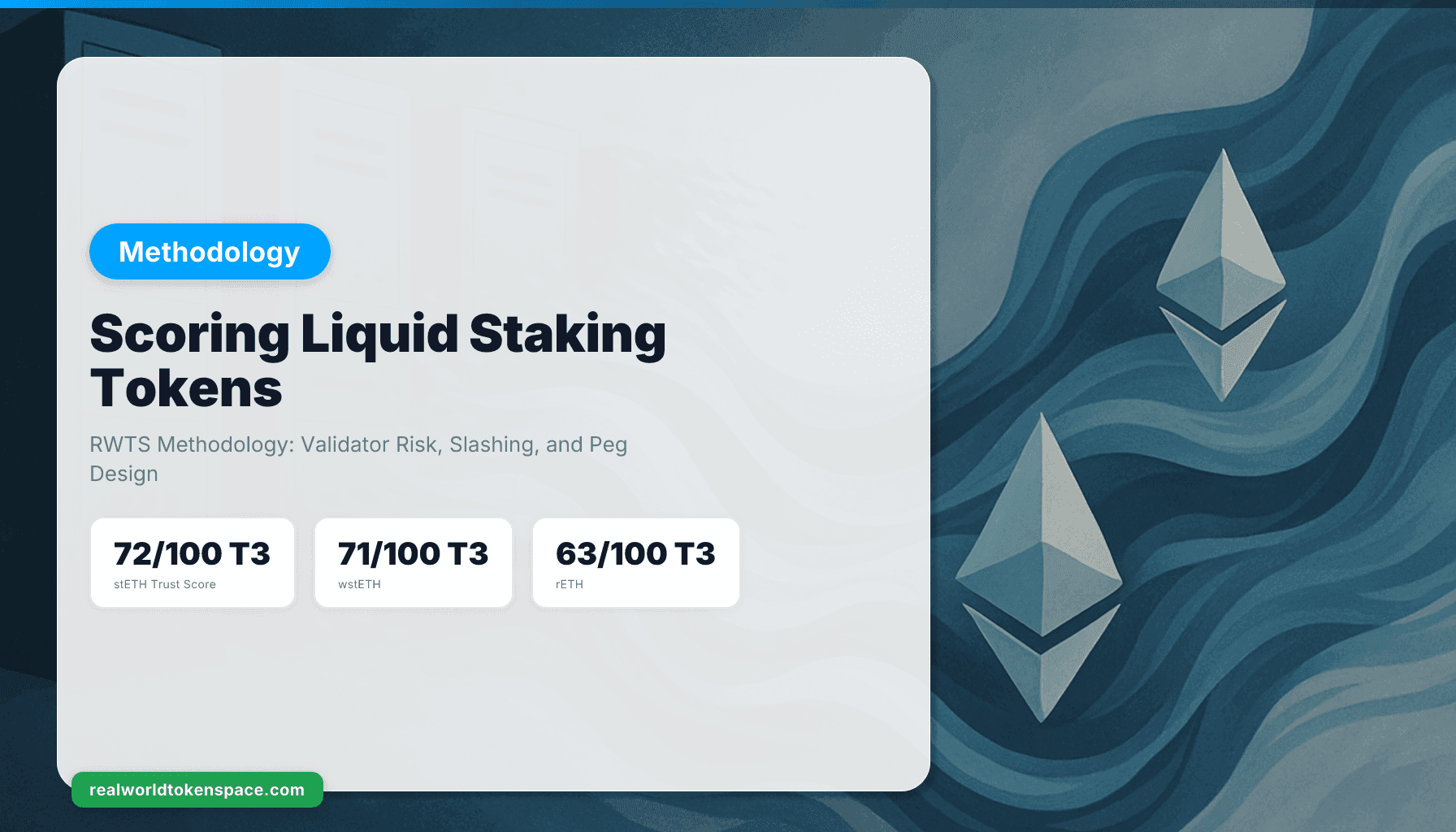
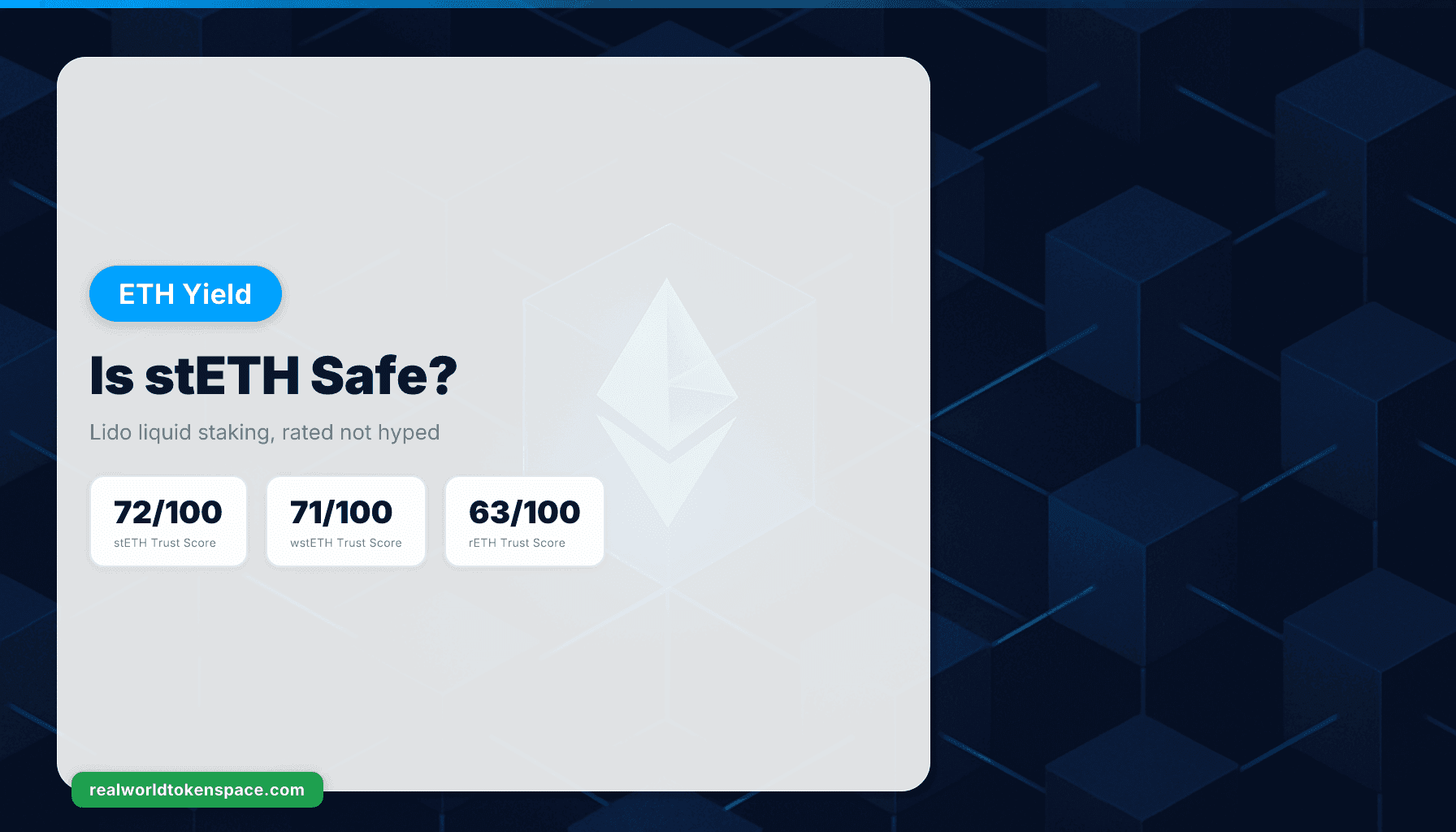
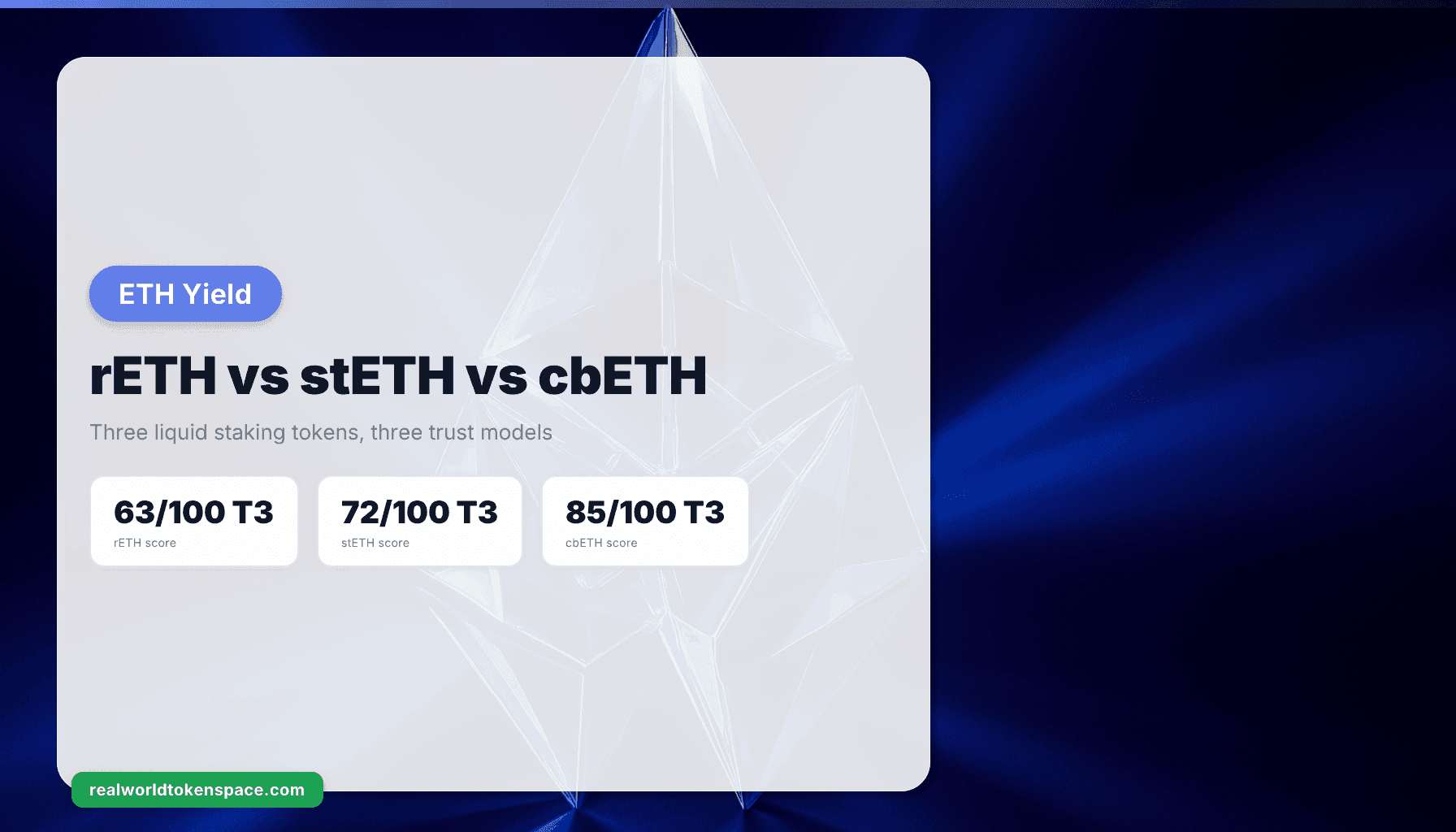
The headline numbers: stETH scores T3 (74/100), wstETH T3 (74/100), and rETH T3 (66/100). All three stake ETH. None scores identically. The spread is the methodology at work.
The base asset is the easy part
Every LST in our corpus shares the same underlying yield engine: Ethereum consensus and execution rewards. Those rewards are real and, by DeFi standards, conservative. Current staking APYs range from a low of 2% to 3% for basic exchange staking to a premium 3.0% to 4.8% for the more involved methods. The highest yields, hovering around 4-5% APY, are the prize for solo stakers who run their own validator. This is the gold standard, but it demands 32 ETH and 24/7 technical vigilance.
Liquid staking exists to remove that 32-ETH barrier and the operational burden. It lets anyone stake ETH without running a validator node and receive stETH, a liquid token that accrues staking rewards daily. Unlike traditional staking which locks your ETH, Lido's stETH can be used across DeFi: as collateral on Aave, in Curve pools, or for leveraged staking strategies through recursive lending.
Because the yield source is common, the base yield is not what separates the scores. The token wrapper around that yield is.
The five inputs we score
Our LST rubric breaks into five weighted dimensions.
1. Validator concentration. The single most important input. An LST that routes stake through a small or homogeneous operator set concentrates failure risk; one spread across many independent operators with diverse setups does not. Lido distributes stake across 38 professional node operators to minimize this exposure, and maintains a slashing insurance fund. That operator breadth is a positive. But concentration cuts both ways at the network level: the biggest critique comes from Ethereum core developers. Because Lido controls such a large percentage of the total staked ETH (often exceeding 30%), there is a fear that it could exert disproportionate influence over the network. We score operator diversity within the protocol as a strength and protocol-level dominance as a systemic flag.
2. Slashing design and coverage. We assess whether penalties are absorbed by a fund or passed to holders, and the historical loss record. Slashing risk, though minimal, exists whenever validators misbehave or experience extended downtime. Lido distributes stake across 38 professional node operators to minimize this exposure, and maintains a slashing insurance fund. Historical data shows Lido has experienced negligible slashing events, with total losses under 0.01% since inception. A concrete recent example illustrates the scale: in early February, a minor slashing event hit six validators within Lido's Community Staking Module (CSM). The initial penalties totaled under 0.047 ETH, a few hundred dollars at current prices. While further penalties could accrue as the validators exited, projections capped the total losses at below 1 ETH. Small, absorbed losses score well; uninsured holder-borne slashing scores poorly.
3. Peg and redemption mechanics. An LST's safety depends on how cleanly it converts back to ETH. If stETH trades below 1 ETH in secondary markets, it represents a temporary liquidity premium rather than a fundamental value loss, since each stETH remains redeemable for 1 ETH through Lido's withdrawal mechanism (taking 2-5 days). We score both the native withdrawal path and secondary-market depth, because under stress the queue and the order book are the two real exits. A protocol with a fast, reliable withdrawal queue and deep liquidity scores higher than one relying on either alone.
4. Smart-contract and audit history. Code is the irreducible risk in every LST. Lido has been audited by Certora, StateMind, Hexens, ChainSecurity, Oxorio, MixBytes, SigmaPrime, Quantstamp. A long, multi-firm audit record with no major incidents raises the sub-score; a thin audit trail or a history of exploits lowers it.
5. Governance structure. Who controls upgrades, fees, and operator selection matters. Lido operates as a DAO with LDO token holders voting on critical parameters including node operator selection, fee structures, and protocol upgrades. While this decentralization reduces single-point-of-failure risks, it also means that governance attacks or contentious votes could impact stETH holders. We treat decentralized governance as a mitigant but also price the residual governance-attack surface.
Why the scores diverge
Applying this rubric explains the spread. stETH at 74/100 earns the category's highest score on the strength of its operator breadth, deep liquidity, extensive audit history, and a near-zero slashing record, discounted modestly for Lido's network-level dominance. rETH at 66/100 runs a more decentralized operator philosophy but a smaller stake base and thinner liquidity, which our peg-and-redemption input penalizes relative to stETH.
The wstETH case is the most instructive. wstETH is a wrapped version of stETH that does not undergo daily rebases. While stETH's token balance changes daily to reflect each user's portion of the staked ETH and network rewards, wstETH does not change and maintains the same token balance. Same backing, same validators, same slashing exposure, so wstETH scores 74/100, one point below stETH. That single point is the added wrapper-contract surface, nothing more. When two tokens share an engine, our methodology should, and does, score them nearly identically.
What this means for allocators
The practical takeaway: do not assume two LSTs are interchangeable because they stake the same asset. The Trust Score isolates the wrapper risk (validator concentration, slashing absorption, redemption design, contract surface, governance) that sits on top of the shared yield. That wrapper is where capital is actually exposed. For the full category landscape, see the ETH yield hub and our deeper comparison in Is stETH Safe? Lido, Rocket Pool rETH Trust Score Comparison.
RWTS isn't bullish or bearish on Ethereum, Lido, or any liquid staking token. We're the credit-rating agency for tokenized real assets. We rate. You decide.
Related on RWTS
Stay Ahead of the Yield Curve
Subscribe to The Yield Report for weekly yield intelligence.
Subscribe Now