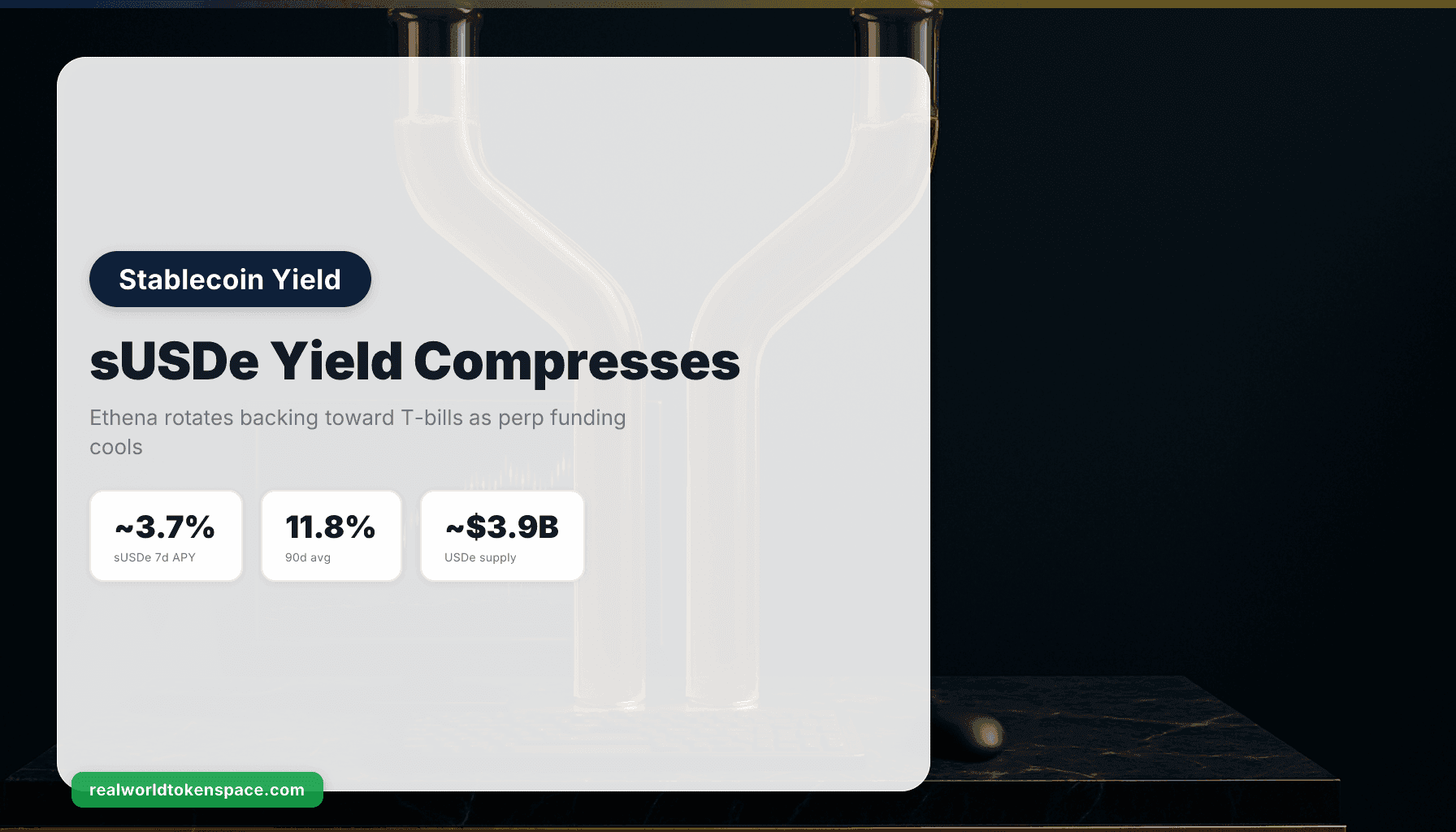
The headline yield on Ethena's staked synthetic dollar has cooled sharply. As of early 2026, current yields are approximately 3.72% according to Messari data, a compression that reflects both the broader market contraction following the October 2025 event and reduced leveraged demand for long exposure in perpetual markets. That sits well below the asset's longer-run run rate, as of April 25, 2026, the figure is 9.4%. The 90-day trailing average is 11.8%. The move is not a peg event. It is a change in where the yield comes from.
For allocators parking dollars on-chain, the distinction matters. RWTS is not bullish or bearish on sUSDe. We rate. You decide. So here is the mechanism, the risk picture, and where sUSDe sits in our stablecoin yield coverage.
The mechanism: funding-rate yield, not a savings rate
sUSDe earns from a delta-neutral basis trade, the same structure crypto market-makers have run for years. For every dollar of USDe minted, Ethena holds approximately one dollar of long crypto exposure split between LSTs (mostly Lido stETH) and spot BTC. The LST leg earns Ethereum staking yield, currently around 3% APY. The BTC leg earns nothing on its own. For every dollar of long crypto, Ethena opens an equivalent short position in the matching perpetual futures contract on a centralized exchange.
That short leg is the engine. When perpetual funding is positive, the protocol collects it; when funding inverts, it pays. sUSDe is the only major one earning crypto-native yield, funding rates, which means it scales with crypto market activity, not with the federal funds rate. So the yield is path-dependent, not smoothed. The current ~3.7% print tells you funding has cooled, not that anything broke.
The driver: a backing rotation toward T-bills
The second force is deliberate. Ethena has been shifting its collateral mix. Ethena rebalanced USDe backing, cutting perp exposure for T-bills and institutional loans. This altered sUSDe's yield (now ~3.5%, potentially <2%) and risk profile, reducing demand. The protocol has done this before during soft-funding windows. If negative funding persists at meaningful magnitude, the protocol has flexibility to rotate collateral, for example, holding a larger share in stablecoins or tokenized treasuries that earn a baseline yield without funding exposure. Onchain analyst Tom Wan has tracked this rotation publicly: during the June 2024 funding-rate compression, Ethena's USDT and tokenized-treasury share of backing rose to absorb the regime change. The peg held; the yield compressed.
A growing share of that T-bill leg routes through BlackRock's tokenized money market fund. These assets are predominantly backed by USDtb, which is itself backed by BlackRock's BUIDL money market fund. The inclusion is seen as a backing optimization opportunity, allowing Ethena to rotate out of non-yielding stablecoin positions like USDC and USDT in favor of assets that generate BUIDL yield for sUSDe holders. In other words, the lower headline rate is partly a swap from volatile funding income toward steadier (and lower) Treasury income through BUIDL.
If perp funding stays muted, the thesis holds that sUSDe behaves more like a T-bill proxy near 3.5–4%. If funding re-accelerates with a risk-on rotation, the basis-trade leg can lift the rate back into double digits. The fork hinges on two humility variables: trader appetite for leveraged long exposure, and the Fed posture that anchors the T-bill floor.
The buffer that backstops a soft-funding stretch
A negative-funding stretch does not push sUSDe yield below zero on day one. Ethena runs a reserve fund for exactly this. Ethena retains a portion of revenue in an insurance fund that absorbs negative funding periods. The fund stood at $61 million in March 2026, against $5.6 billion of supply (~1.1%). When funding turns negative, the protocol can subsidize the headline rate from the fund rather than letting yield go to zero. The watch level is straightforward. The fund as a percentage of total USDe supply is the buffer between negative funding and yield-zero. The fund has grown from $36 million to $61 million, with the ratio holding around 1.0% to 1.2% of supply. A drop below 0.7% would warrant attention.
Supply context matters too. Holding USDe gives you peg exposure but no yield, the yield accrues to sUSDe holders only. As of May 2026, USDe supply sits around $3.9B per DeFiLlama, with circulation across Ethereum, BNB Chain, Arbitrum, Solana, and several other EVM chains. The unstaked unit is a deliberate trade-off, peg without yield in exchange for collateral flexibility. The USDe float is where holders who want composability without lockup sit.
The RWTS Trust Score angle
We score sUSDe in Tier 2. The rotation toward T-bill backing is a mild positive for the backing-transparency component and a mild negative for yield durability, those offset. What the Trust Score does not reward is reaching for the 90-day average as if it were a forward rate. The honest framing: sUSDe pays what funding pays, with a T-bill floor underneath. Our methodology explains how we weigh redemption mechanics, the 7-day unstaking cooldown, and exchange-counterparty exposure in the score.
For readers weighing this against curated lending markets, our earlier analysis of the institutional curator model on Morpho covers a different way on-chain dollars earn, one that sources yield from borrowing demand rather than perp funding. The two regimes rarely peak together, which is why yield aggregators rotate between them.
The bottom line: a 3.7% sUSDe print is a signal about funding markets, not a verdict on the protocol. RWTS rates. You decide.
Related on RWTS
Stay Ahead of the Yield Curve
Subscribe to The Yield Report for weekly yield intelligence.
Subscribe Now