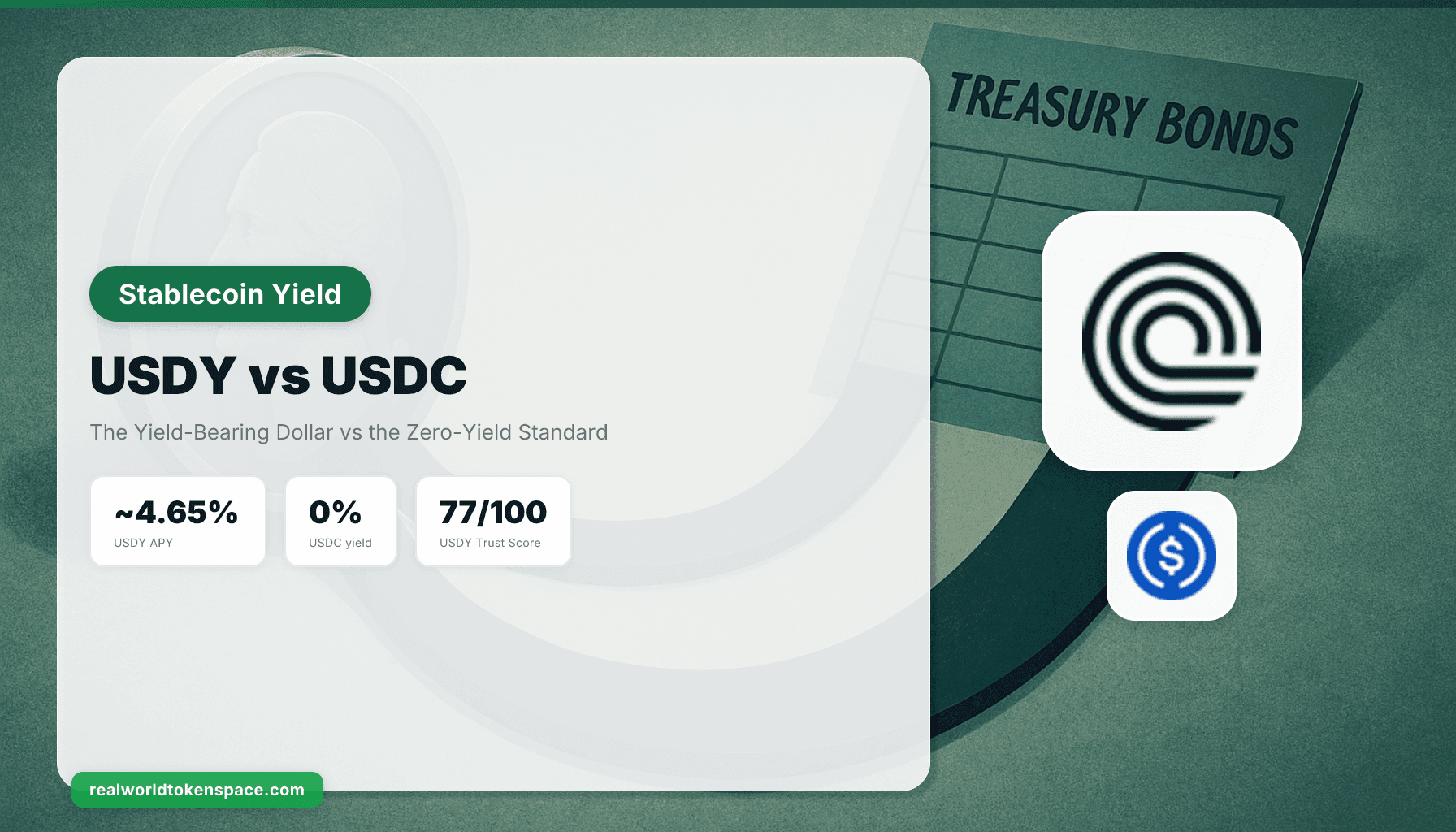
The simplest case for tokenized Treasuries is a side-by-side: the same dollar, two outcomes. Hold USDC, and earn nothing. Hold USDY, and the dollar works. Treasury teams use USDY as a yield-bearing alternative to plain USDC for working-capital balances, where 4.65% on idle dollars compares to 0% on Circle's USDC. That gap is the entire reason the category exists. But the yield comes attached to a different legal structure, a different redemption path, and an eligibility gate that rules out a large share of would-be holders.
RWTS isn't bullish or bearish on either token. We're the credit-rating agency for tokenized real assets. This is the comparison that actually matters before you move balances.
What each dollar actually is
USDC is a payment stablecoin. Its reserves sit in cash and short Treasuries, but the yield those reserves earn accrues to the issuer, not to you. The token is built for settlement, not for return.
USDY is a different instrument entirely. USDY is a yield-bearing token issued by Ondo Finance, backed by short-duration US Treasuries and bank demand deposits, where each token represents a senior unsecured claim on a portfolio held by Ondo USDY LLC, a Delaware bankruptcy-remote vehicle, and accrues interest through a rising redemption value. The yield is mechanical, not promotional. Yield tracks the front-end Treasury curve minus the 25 bps fee, roughly 4.65% APY as of April 2026 against a 3-month T-bill around 4.30% plus blended bank-deposit yield.
The custody and management stack is institutional. Ondo USDY LLC holds Treasuries through a regulated broker-dealer and bank deposits at multiple US insured banks, with short-duration Treasuries to minimize interest-rate risk and deposits providing T+1 redemption liquidity, while BlackRock acts as investment manager. That is a meaningfully different risk profile from a payment stablecoin's reserve pool.
The eligibility gate is the real divider
The most important difference is not the yield, it's who can legally hold each token. USDC is open. USDY is not. Most tokenized treasury products restrict access to Qualified Purchasers under the 1940 Act or non-US persons under Reg S of the Securities Act; Franklin BENJI is the lone retail-eligible registered money market fund. USDY sits in the non-US Reg S bucket. A US person cannot hold it. For US retail wanting on-chain Treasury yield, BENJI is the registered alternative, not USDY.
There's also a holding period to clear. USDY holders receive yield as increasing redemption value, and the issuance process is only completed after 40-50 days, when investors are allowed to mint their tokens. That lockout at the front end is a friction USDC simply doesn't have. USDY rewards patience and balance-sheet planning, not same-day liquidity.
Where USDY earns its place: chains
USDY's distinguishing feature is reach. USDY is the most chain-distributed of the major tokenized-Treasury wrappers, which makes it the de facto standard for cross-chain treasury allocations to short-duration government debt. The breakdown is genuinely multi-chain. As of March 2026, supply split roughly Ethereum at 40% with the deepest liquidity, Solana at 35% as the fastest-growing chain, and the remainder across Mantle, Sui, and Aptos. The practical consequence: the cross-chain availability is why USDY appears in DeFi vaults on Solana, Sui, and Mantle that have no other Treasury exposure. For a Solana- or Sui-native treasury, USDY is often the only realistic path to government-debt yield without bridging.
A rebasing variant exists for teams that prefer balance growth to price appreciation. A rebasing variant, rUSDY, pays interest as a balance increase rather than a price increase, and holders choose the form that fits their accounting. That flexibility matters for protocol treasuries with NAV-tracking or constant-price collateral requirements.
How RWTS scores the trade-off
RWTS rates USDY at T2 (77/100). The score is solid Tier 2 (a senior claim on a bankruptcy-remote vehicle with a named investment manager) but it sits below the larger institutional funds for reasons of redemption path, holder transparency, and the offshore wrapper. For comparison, the institutional Treasury funds USYC at T2 (84/100) and BUIDL at T2 (87/100) score higher but gate access to qualified investors with far larger minimums.
The structural distinction is worth internalizing. A tokenized treasury is either a share in a regulated fund recorded on a public blockchain as the official system of record, or a debt token issued by an offshore vehicle that holds T-bills and is redeemable into a stablecoin. USDY is the second kind. That is not a flaw, it is a design choice that trades 1940 Act protections for global, non-US accessibility and cross-chain reach.
The full weighting (custody, redemption, wrapper, disclosure) is documented at our methodology page. For the broader yield landscape, see our stablecoin yield hub and our recent Ethena sUSDe yield compression analysis, which covers the same T-bill rotation USDY benefits from.
The conditional bottom line
If you are a non-US treasury holding idle dollars and you can tolerate the 40-50 day mint window, USDY converts a zero-yield balance into roughly 4.65% with institutional-grade backing. If you need instant US-eligible liquidity for payments, USDC stays the right tool, you're simply paying the yield away for that flexibility.
The variable that decides the math is the Fed. A 25 bps cut translates to approximately 22 bps in USDY APY, the small difference being the time it takes the portfolio to roll into newly issued bills at the lower rate. If rates hold, USDY's edge over USDC widens. If the Fed cuts aggressively, the yield compresses smoothly but never inverts the comparison, a yielding dollar still beats a zero one.
We don't tell you which dollar to hold. We score what's underneath each. RWTS rates. You decide.
Related on RWTS
Stay Ahead of the Yield Curve
Subscribe to The Yield Report for weekly yield intelligence.
Subscribe Now